
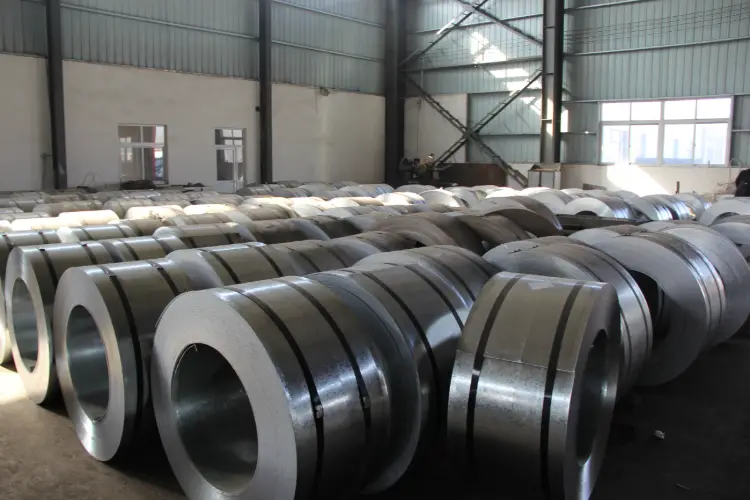
RINA E500 Shipbuilding Steel Coil
RINA E500 Shipbuilding Steel Coil - High Strength Marine Structural Plate
Comprehensive guide to RINA E500 steel: chemical composition, mechanical properties, thermal and electrical characteristics, equivalent standards, and application data for marine engineering.
Cutting, cold forming, welding, bending, machining
- Phone : +8618037372205
- Email : [email protected]
- WhatsApp: Contact via Whtsapp
- WeChat: +8618037372205
RINA E500 Shipbuilding Steel Coil Introduction
RINA E500 is an extra-high-strength shipbuilding structural steel certified by the Italian Classification Society RINA, intended for critical hull and offshore structures. It is designed in accordance with RINA Rules Part D, offering a minimum yield strength of 500 MPa and excellent toughness at -40°C. The steel is supplied primarily as hot-rolled coils or plates under thermomechanically controlled processing (TMCP) or quenching and tempering, ensuring a fine-grained microstructure, superior weldability, and resistance to brittle fracture. Typical applications include decks, shell plating, and stiffeners in large vessels and high-performance marine environments.
RINA E500 Shipbuilding Steel Coil Chemical Composition
The ladle analysis limits for RINA E500 steel are given below. The steel is fully killed and fine-grained. Micro-alloying elements (Nb, V, Ti) are added for strength and toughness, while the carbon equivalent (Ceq) is controlled to guarantee weldability. Typical values are based on RINA Rules, with Al used for deoxidation.
| Element | Specified Value (max unless range) | Remarks |
|---|---|---|
| C | 0.18 | Carbon |
| Mn | 0.90 – 1.60 | Manganese |
| Si | 0.10 – 0.50 | Silicon |
| P | 0.025 | Phosphorus |
| S | 0.025 | Sulphur |
| Altotal | ≥ 0.020 | Total aluminium content |
| Nb | 0.02 – 0.05 | Niobium (columbium) |
| V | 0.05 – 0.10 | Vanadium |
| Ti | 0.007 – 0.05 | Titanium |
| Cu | 0.35 | Copper |
| Cr | 0.20 | Chromium |
| Ni | 0.40 | Nickel |
| Mo | 0.08 | Molybdenum |
| N | 0.012 | Nitrogen (if combined with V) |
| CeqIIW | 0.38 – 0.45 (typical) | Carbon equivalent = C + Mn/6 + (Cr+Mo+V)/5 + (Ni+Cu)/15 |
RINA E500 Shipbuilding Steel Coil Thermal and Electrical Physical Properties
These are nominal values for high-strength structural steel at ambient temperature unless otherwise stated. Actual values can vary slightly depending on manufacturing route and heat treatment.
| Property | Typical Value | Unit | Test Condition |
|---|---|---|---|
| Density (ρ) | 7850 | kg/m³ | 20°C |
| Elastic modulus (E) | 210 | GPa | 20°C |
| Shear modulus (G) | approx. 81 | GPa | 20°C |
| Poisson's ratio (ν) | 0.3 | – | 20°C |
| Thermal expansion (α) | 12.0 | 10⁻⁶/K | 20 – 100°C |
| Thermal expansion (α) | 12.8 | 10⁻⁶/K | 20 – 200°C |
| Thermal expansion (α) | 13.5 | 10⁻⁶/K | 20 – 400°C |
| Thermal conductivity (λ) | 50 | W/(m·K) | 20°C |
| Thermal conductivity (λ) | 42 | W/(m·K) | 200°C |
| Thermal conductivity (λ) | 36 | W/(m·K) | 400°C |
| Specific heat capacity | 460 | J/(kg·K) | 20°C |
| Electrical resistivity (ρe) | 0.22 | 10⁻⁶ Ω·m | 20°C |
RINA E500 Shipbuilding Steel Coil Mechanical Properties
The mechanical properties are guaranteed for longitudinal test pieces according to RINA Rules. Yield strength is thickness-dependent above 50 mm. Impact energy is measured on Charpy V-notch specimens at -40°C. Bend test applies to both longitudinal and transverse directions.
| Property | Specified Value | Unit | Test Condition |
|---|---|---|---|
| Yield strength (ReH) | ≥ 500 | MPa | t ≤ 50 mm |
| Yield strength (ReH) | ≥ 490 | MPa | 50 < t ≤ 70 mm |
| Yield strength (ReH) | ≥ 480 | MPa | 70 < t ≤ 100 mm |
| Tensile strength (Rm) | 610 – 770 | MPa | All thicknesses |
| Elongation (A5) | ≥ 16 (longitudinal) | % | Gauge length 5.65√So |
| Elongation (A5) | ≥ 14 (transverse) | % | Gauge length 5.65√So |
| Bend test (180°) | D = 5t (t ≤ 50 mm); D = 6t (t > 50 mm) | – | No cracks, mandrel diameter D |
| Impact energy (KV2) | ≥ 34 (longitudinal) | J | -40°C |
| Impact energy (KV2) | ≥ 24 (transverse) | J | -40°C |
RINA E500 Shipbuilding Steel Coil Exact Equivalent Standards and Replaceable Grades
| Country/Region | Standard / Society | Grade | Remarks |
|---|---|---|---|
| International | IACS UR W23 | E500 | Unified high-strength hull structural steel |
| Italy | RINA | E500 | Original certification |
| United States | ABS | E500 | American Bureau of Shipping |
| Norway/Germany | DNV | E500 | Det Norske Veritas (now DNV GL) |
| United Kingdom | LR | E500 | Lloyd's Register |
| France | BV | E500 | Bureau Veritas |
| China | CCS | E500 | China Classification Society |
| Japan | NK | E500 | ClassNK (Nippon Kaiji Kyokai) |
| South Korea | KR | E500 | Korean Register |
| Russia | RS | E500 | Russian Maritime Register of Shipping |
RINA E500 Shipbuilding Steel Coil Application Introduction
RINA E500 steel is purpose-designed for shipbuilding and offshore engineering where high strength, low temperature toughness, and good weldability are essential. It is used in the construction of hull envelopes, decks, and stiffening members of vessels operating in harsh marine environments. The TMCP condition provides a fine grain structure that ensures ductile behaviour at sub-zero temperatures, reducing the risk of catastrophic brittle fracture. Typical fabrication includes plasma or laser cutting, cold forming, and submerged-arc or flux-cored welding with low-hydrogen procedures.
Product Applications: Hull plating (bottom, side, deck), Longitudinal and transverse stiffeners, Bulkheads and watertight doors, Deck girders and hatch coamings, Offshore module structural members
Processed into products: Welded built-up beams and columns, Shear plates and brackets, Keel plates and stem/stern frames, Pad-eyes and lifting lugs for heavy lifts, Transition pieces on offshore wind foundations
Application industries: Commercial and naval shipbuilding, Offshore oil and gas platforms, Floating production storage and offloading (FPSO) units, Marine and harbour engineering, Ice-breakers and Arctic-class vessels
RINA E500 Shipbuilding Steel Coil Near-Equivalent or Similar Alternative Materials
| Country/Region | Standard | Grade | Remarks |
|---|---|---|---|
| EU | EN 10025-6 | S500Q / S500QL / S500QL1 | Quenched and tempered structural steel; minimum yield 500 MPa, but higher Ceq, requires careful preheat and welding procedures; not specifically for shipbuilding. |
| EU | EN 10149-2 | S500MC | Thermomechanically rolled cold forming steel; similar strength but limited to thinner gauges and automotive/mechanical engineering, not meeting marine impact requirements. |
| Germany | SEW 092 | QStE 500 TM | High-strength micro-alloyed steel; comparable strength, but toughness and weld approval differ; not for primary ship structures. |
Notes:
All welding must be performed following a qualified welding procedure specification (WPS) in accordance with RINA rules. Preheat and interpass temperatures are determined by the carbon equivalent and plate thickness. For thicknesses over 70 mm, special through-thickness properties (Z-grade) may be specified. Impact test temperature is -40°C for E-grade; for harsher conditions, FH500 (-60°C) can be used. The steel is usually delivered with Class 1 or Class 2 surface quality and ultrasonically tested per EN 10160 or equivalent.
- Share



