
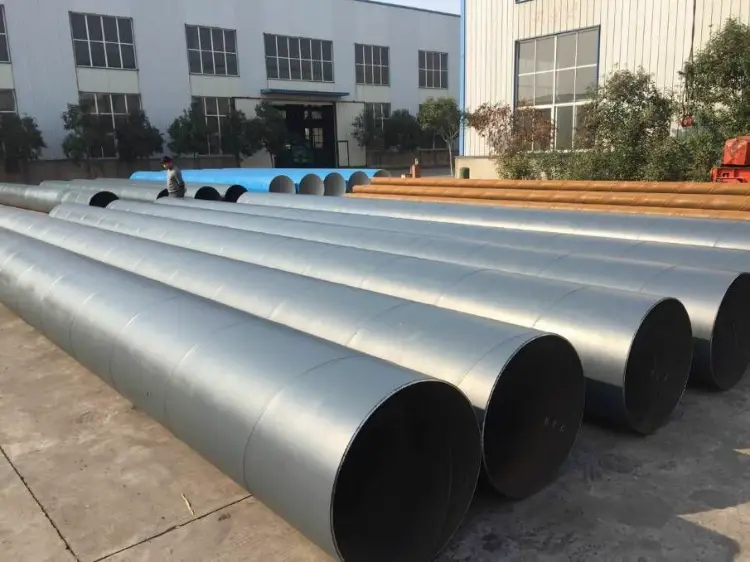
DIN 17400 1.4512 Stainless Steel Pipe
DIN 17400 1.4512 Stainless Steel Pipe - Ferritic Grade for Exhaust & Heat Applications
Complete material data for DIN 17400 1.4512 (X6CrTi12) ferritic stainless steel pipe: chemical composition, mechanical and physical properties, international equivalents, and application guide.
Cold drawing, cold rolling, welding (TIG, laser, plasma), bending, deep drawing
- Phone : +8618037372205
- Email : [email protected]
- WhatsApp: Contact via Whtsapp
- WeChat: +8618037372205
DIN 17400 1.4512 Stainless Steel Pipe Introduction
1.4512 is a titanium-stabilised ferritic stainless steel originally defined in DIN 17400 (now superseded by EN 10088). Known also as X6CrTi12 or its modern designation X2CrTi12, it offers excellent resistance to oxidation and scaling up to approximately 800°C, good weldability, and improved resistance to intergranular corrosion thanks to titanium stabilisation. The grade is magnetic, non-hardenable by heat treatment, and is widely used in automotive exhaust systems, heat exchangers, and other elevated-temperature structural applications where cost-effective corrosion resistance is required. Delivery condition is typically annealed and pickled or bright annealed for pipe products.
DIN 17400 1.4512 Stainless Steel Pipe Chemical Composition
The following table presents the chemical requirements according to DIN 17400 for grade 1.4512 (X6CrTi12) and its current EN 10088-2 equivalent X2CrTi12. Titanium is added to stabilise the structure and prevent sensitisation during welding.
| Element | DIN 17400 (X6CrTi12) | EN 10088-2 (X2CrTi12) |
|---|---|---|
| Carbon (C) | ≤ 0.08 | ≤ 0.030 |
| Silicon (Si) | ≤ 1.00 | ≤ 1.00 |
| Manganese (Mn) | ≤ 1.00 | ≤ 1.00 |
| Phosphorus (P) | ≤ 0.040 | ≤ 0.040 |
| Sulfur (S) | ≤ 0.015 | ≤ 0.015 |
| Chromium (Cr) | 10.50 – 12.50 | 10.50 – 12.50 |
| Nickel (Ni) | ≤ 0.50 | ≤ 0.50 |
| Titanium (Ti) | 6×(C+N) to 0.65 | 6×(C+N) to 0.65 |
| Nitrogen (N) | – | ≤ 0.030 |
DIN 17400 1.4512 Stainless Steel Pipe Physical Properties – Thermal & Electrical
The following physical properties are typical for 1.4512 ferritic stainless steel in the annealed condition. These data are representative for grade 1.4512 and are provided for general engineering calculations.
| Property | Typical Value | Unit | Remarks |
|---|---|---|---|
| Density (ρ) | 7.70 | g/cm³ | At 20 °C |
| Modulus of Elasticity (E) | 220 | GPa | At 20 °C |
| Shear Modulus (G) | 84 | GPa | At 20 °C, calculated from E and ν |
| Poisson's Ratio (ν) | 0.30 | – | At 20 °C |
| Mean Thermal Expansion Coefficient (α) | 10.5 | 10⁻⁶/K | 20 – 100 °C |
| Mean Thermal Expansion Coefficient (α) | 11.0 | 10⁻⁶/K | 20 – 200 °C |
| Mean Thermal Expansion Coefficient (α) | 11.5 | 10⁻⁶/K | 20 – 400 °C |
| Thermal Conductivity (λ) | 25 | W/(m·K) | At 20 °C |
| Thermal Conductivity (λ) | 26 | W/(m·K) | At 100 °C |
| Specific Heat Capacity (cp) | 460 | J/(kg·K) | At 20 °C |
| Electrical Resistivity (ρ_e) | 0.60 | µΩ·m | At 20 °C |
DIN 17400 1.4512 Stainless Steel Pipe Mechanical Properties at Room Temperature
Mechanical property requirements for 1.4512 pipes and tubes according to EN 10217-7 and EN 10088-2. Values apply to longitudinal test pieces taken from tubes with wall thickness ≤ 12.5 mm. Actual values may vary with product form and thickness.
| Property | Required Value | Unit | Test Conditions |
|---|---|---|---|
| Yield Strength (Rp0.2) | ≥ 210 | MPa | Room temperature, longitudinal |
| Tensile Strength (Rm) | 420 – 600 | MPa | Room temperature, longitudinal |
| Elongation (A) | ≥ 20 | % | Gauge length 50 mm (or 5.65√S₀), longitudinal |
| Hardness (HB) | ≤ 180 | HBW | Annealed condition |
| Bend Test | No cracks | – | D = 2a, 180° bend (D: mandrel diameter, a: thickness) |
DIN 17400 1.4512 Stainless Steel Pipe Directly Equivalent Standards and Substitutable Grades
| Country/Region | Standard / Specification | Designation | Remarks |
|---|---|---|---|
| Germany | DIN 17400 | 1.4512 (X6CrTi12) | Original standard; superseded |
| Germany / EU | EN 10088-2 | 1.4512 (X2CrTi12) | Current European standard; identical chemical concept, tighter C control |
| Germany / EU | EN 10217-7 | 1.4512 (X2CrTi12) | Welded tubes for pressure purposes |
| USA | ASTM A240 | UNS S40920 / S40930 | Titanium-stabilised 12% Cr ferritic; minor compositional differences |
| International | ISO 15510 | X6CrTi12 | Based on the older DIN chemistry; close to 1.4512 |
DIN 17400 1.4512 Stainless Steel Pipe Application Introduction
1.4512 is best suited for applications that require good oxidation resistance at moderate temperatures combined with a need for cost-effective, magnetic stainless steel. Its titanium stabilisation ensures reliable performance in welded constructions without the risk of intergranular corrosion. Typical working temperatures range from cryogenic up to approximately 800°C.
Product Applications: Welded and seamless pipes for exhaust systems, Tubular heat exchangers, Press-formed components (cookware, sinks), Rolled profiles and structural sections, Welded tanks and containers for non-aggressive media
Processed into products: Exhaust manifold pipes and downpipes, Catalytic converter shells, Heat-exchanger tube bundles, Flue gas ducting and expansion joints, Architectural façade panels, Baking oven internal panels and racks, Chimney liners and flashings
Application industries: Automotive (exhaust systems, mufflers, catalytic converter housings), Power generation (flue gas ducts, heat recovery components), Household appliances (oven liners, baking trays, dishwasher interiors), Building & construction (architectural cladding, chimney liners), Industrial engineering (heat exchangers, chemical equipment operating at moderate temperatures)
DIN 17400 1.4512 Stainless Steel Pipe Near/Similar Substitute Materials and Comparable Grades
| Country/Region | Standard | Designation | Remarks |
|---|---|---|---|
| Germany/EU | EN 10088-2 | 1.4510 (X3CrTi17) | 17% Cr ferritic; higher corrosion resistance but also higher cost |
| Germany/EU | EN 10088-2 | 1.4003 (X2CrNi12) | Low-carbon 12% Cr with Ni addition; better toughness and weldability, slight reduction in oxidation resistance |
| USA | ASTM A240 | 409 (UNS S40900) | Non-stabilised 12% Cr; inferior intergranular corrosion resistance; 1.4512 is the stabilised version |
| Japan | JIS G4305 | SUS 409L | Similar to UNS S40900; can be substituted if higher C is acceptable; 1.4512 is preferred for welded applications |
Notes:
- DIN 17400 has been withdrawn and replaced by the harmonised European standard EN 10088. The current designation for 1.4512 is X2CrTi12. The legacy X6CrTi12 designation is still used commercially but is not identical in carbon content.
- When ordering 1.4512 pipes, specifying EN 10217-7 + 1.4512 + delivery condition (e.g., +A) is recommended for pressure applications.
- For improved weld toughness, consider the similar grade 1.4003 (X2CrNi12) which contains a small nickel addition.
- Post-weld heat treatment is generally not required for thin sections, but full annealing (780–850°C followed by air cooling) may be applied to restore ductility after heavy forming.
- Share



