
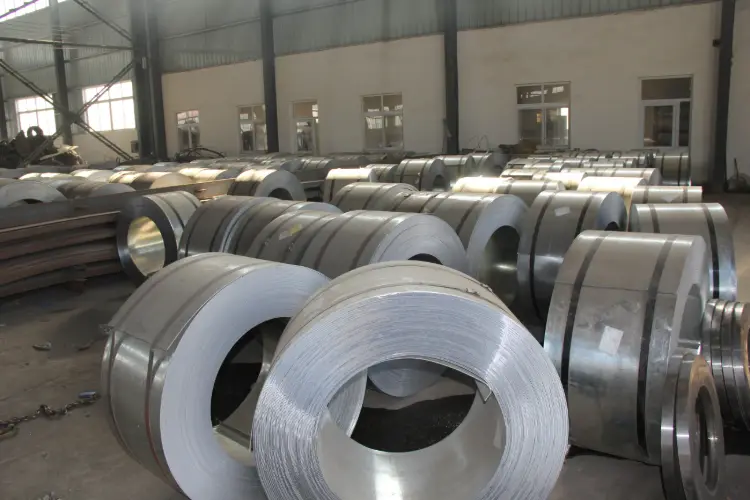
RINA D500 Shipbuilding Steel Coil
RINA D500 Shipbuilding Steel Coil: High-Strength Marine Hull Structural Steel
Comprehensive material data for RINA D500 shipbuilding steel coil, including chemical composition, mechanical properties, physical characteristics, equivalent grades worldwide, and applications in marine construction.
Hot rolling, thermomechanical controlled processing (TMCP), normalizing, cold forming, welding, cutting, machining
- Phone : +8618037372205
- Email : [email protected]
- WhatsApp: Contact via Whtsapp
- WeChat: +8618037372205
RINA D500 Shipbuilding Steel Coil Introduction
RINA D500 is a high-strength hull structural steel grade certified by Registro Italiano Navale (RINA), conforming to the IACS UR W11 requirements for shipbuilding steels. It is supplied as coils, plates, or strips, typically in the thermomechanically controlled rolled (TMCP) or normalized condition. With a minimum yield strength of 500 MPa, it combines excellent toughness at -20°C (DH grade) and good weldability, making it suitable for critical structural components in ships and offshore platforms. The fine-grained microstructure ensures high resistance to brittle fracture and fatigue. RINA D500 is designed for heavy-duty marine environments and complies with strict classification society rules. Its balanced chemistry enables efficient fabrication, including cold forming and welding without extensive preheating, provided low hydrogen practices are followed. This grade is widely adopted in large container vessels, tankers, and naval structures where weight reduction and high load-bearing capacity are essential.
RINA D500 Shipbuilding Steel Coil Chemical Composition
The chemical composition of RINA D500 steel is designed to achieve high strength and excellent low-temperature toughness while maintaining good weldability. Maximum limits are specified for impurities and alloying elements. The carbon equivalent (Ceq) value is controlled to ensure weldability, especially for thicker sections. Microalloying elements such as niobium, vanadium, and titanium are added for grain refinement and precipitation strengthening.
| Chemical Element | Standard Value | Remarks |
|---|---|---|
| Carbon (C) | ≤ 0.20 | For thickness ≤ 100 mm |
| Manganese (Mn) | 0.90 – 1.60 | Higher Mn may be used with appropriate Ceq control |
| Silicon (Si) | ≤ 0.50 | Deoxidation element |
| Phosphorus (P) | ≤ 0.025 | Impurity control |
| Sulphur (S) | ≤ 0.025 | Impurity control |
| Aluminium total (Al) | ≥ 0.020 | Grain refinement, acid-soluble aluminum or aluminium total |
| Niobium (Nb) | ≤ 0.05 | Microalloying; Nb+V+Ti ≤ 0.12% |
| Vanadium (V) | ≤ 0.10 | Microalloying |
| Titanium (Ti) | ≤ 0.02 | Microalloying, grain refinement |
| Nitrogen (N) | ≤ 0.020 | Maximum content for fine grained practice |
| Copper (Cu) | ≤ 0.35 | Optional element, improves corrosion resistance |
| Chromium (Cr) | ≤ 0.20 | Residual element |
| Nickel (Ni) | ≤ 0.40 | Residual element |
| Molybdenum (Mo) | ≤ 0.08 | Residual element |
| Carbon Equivalent (Ceq) | ≤ 0.43 (for t ≤ 50 mm); ≤ 0.45 (for 50 < t ≤ 100 mm) | Ceq = C + Mn/6 + (Cr+Mo+V)/5 + (Ni+Cu)/15 |
RINA D500 Shipbuilding Steel Coil Thermo-Physical and Electrical Properties
The following physical properties are typical for carbon-manganese high-strength steels and applicable to RINA D500 under normal conditions. These values are not part of the mandatory certification test but are useful for design and engineering calculations. Variations may occur based on exact composition and heat treatment.
| Property | Standard Value | Unit | Test Condition |
|---|---|---|---|
| Density (ρ) | 7850 | kg/m³ | At 20°C |
| Elastic modulus (E) | 205 | GPa | At 20°C |
| Shear modulus (G) | 80 | GPa | At 20°C |
| Poisson's ratio (ν) | 0.3 | — | Elastic range |
| Coefficient of thermal expansion (α) | 1.2 × 10⁻⁵ | /°C | 20–100°C |
| Thermal conductivity (λ) | 50 | W/(m·K) | At 20°C |
| Specific heat capacity (c) | 460 | J/(kg·K) | At 20°C |
| Electrical resistivity (ρₑ) | 0.20 × 10⁻⁶ | Ω·m | At 20°C |
RINA D500 Shipbuilding Steel Coil Mechanical Properties
Mechanical tests are performed on test pieces taken from coils or plates in the delivery condition. The values below meet the requirements of RINA Rules for grade D500. Impact testing is carried out at -20°C using Charpy V-notch specimens. Yield strength, tensile strength, and elongation are measured on transverse specimens unless longitudinal testing is specified.
| Property | Standard Requirement | Unit | Test Condition |
|---|---|---|---|
| Yield strength (ReH) | ≥ 500 | MPa | Thickness t ≤ 50 mm, transverse |
| Yield strength (ReH) | ≥ 490 | MPa | 50 < t ≤ 70 mm, transverse |
| Yield strength (ReH) | ≥ 480 | MPa | 70 < t ≤ 100 mm, transverse |
| Tensile strength (Rm) | 610 – 770 | MPa | All thicknesses ≤ 100 mm, transverse |
| Elongation (A) | ≥ 16 | % | t ≤ 50 mm, 5.65√S0 gauge length, transverse |
| Elongation (A) | ≥ 16 | % | 50 < t ≤ 70 mm, transverse |
| Elongation (A) | ≥ 15 | % | 70 < t ≤ 100 mm, transverse |
| Impact energy (KV) | ≥ 34 (longitudinal) / ≥ 24 (transverse) | J | At -20°C, Charpy V-notch, t ≥ 6 mm |
| Bending test (180°) | No cracks | Mandrel diameter d = 3t for t ≤ 25 mm; d = 4t for 25 < t ≤ 50 mm; d = 5t for 50 < t ≤ 100 mm |
RINA D500 Shipbuilding Steel Coil Completely Equivalent Grades from Other Classification Societies
| Country / Region | Standard | Grade | Remarks |
|---|---|---|---|
| International | IACS UR W11 | DH500 | Mother specification |
| USA | ABS (American Bureau of Shipping) | DH500 | Identical per IACS |
| France | BV (Bureau Veritas) | DH500 | Identical per IACS |
| China | CCS (China Classification Society) | DH500 | Identical per IACS |
| Norway / Germany | DNV (Det Norske Veritas) | DH500 | Now includes GL; identical per IACS |
| UK | LR (Lloyd's Register) | DH500 | Identical per IACS |
| Japan | NK (Nippon Kaiji Kyokai) | DH500 | Identical per IACS |
| South Korea | KR (Korean Register) | DH500 | Identical per IACS |
RINA D500 Shipbuilding Steel Coil Application Introduction
RINA D500 steel coil is ideally suited for high-strength shipbuilding and offshore construction where weight reduction and structural integrity are critical. It can be processed into various products by cutting, forming, and welding using standard techniques appropriate for TMCP high-strength steels.
Product Applications: Hull shell plates (bottom, side, bilge), Strength deck plates, Longitudinal girders and stiffeners, Transverse web frames and floor plates, Bulkhead panels, Offshore topside structural plates, Jacket legs and bracing pipes (when rolled to pipes)
Processed into products: Bottom shell long plates and stringer plates, Side shell strakes, Main deck and poop deck plating, Hatch coaming and corners, Bilge keel connection plates, Transverse frames and brackets, Longitudinal stiffeners, bulb flats, and angle profiles (by slitting coil and cold forming), Offshore module columns and transition pieces
Application industries: Commercial shipbuilding (container ships, tankers, bulk carriers, passenger vessels), Naval shipbuilding (warships, frigates, support vessels), Offshore oil & gas (platforms, FPSOs, jack-up rigs), Marine engineering (port structures, lock gates, heavy buoys)
RINA D500 Shipbuilding Steel Coil Similar / Alternative Materials with Comparable Performance
| Country / Region | Standard | Grade | Remarks |
|---|---|---|---|
| International | IACS UR W11 | EH500 | Same strength, higher toughness at -40°C; suitable for colder service temperatures |
| International | IACS UR W11 | FH500 | Same strength, highest low-temperature toughness at -60°C |
| Europe | EN 10025-6 | S500G1+M | Thermomechanically rolled steel for offshore structures; similar yield 500 MPa, different notch impact requirements |
| Europe | EN 10025-6 | S500Q (+Q) | Quenched and tempered steel with min. YS 500 MPa; used in heavy offshore structures, requires preheating for welding |
| USA | ASTM A572 / A572M | Grade 65 (Type 3) | High-strength low-alloy steel with YS 450 MPa (not 500 MPa); generally not certified for shipbuilding |
Notes:
Welding recommendations: Use low-hydrogen electrodes or filler wires matched to the strength level (e.g., AWS E11018-M or equivalent). Preheating is generally not required for thicknesses up to 50 mm when CEV ≤ 0.43; for thicker sections, a minimum preheat of 50–100°C is advised. Cold forming: Minimum bending radii should be ≥ 3t for t ≤ 25 mm to avoid cracking. Surface condition: Coils are supplied with hot-rolled surface, possibly oiled or pickled and oiled. Certification: Each coil must be accompanied by a RINA inspection certificate (3.1 or 3.2). Storage: Store in dry conditions to prevent corrosion; interleaf paper or protective oil recommended for long-term storage.
- Share



