
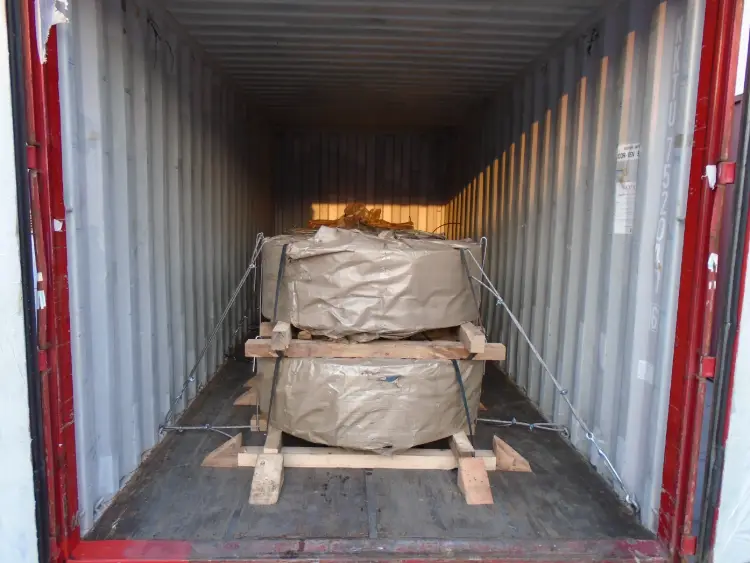
RINA F420 Shipbuilding Steel Coil
RINA F420 Shipbuilding Steel Coil – High Strength Hull Structural Steel for Arctic Conditions
Comprehensive material data for RINA F420 shipbuilding steel coil: chemical composition, mechanical properties, thermal and electrical properties, international equivalents, similar materials and application guidance. Compliant with RINA Rules for classification of ships.
Cutting, cold forming, welding, machining, hot bending (under controlled conditions)
- Phone : +8618037372205
- Email : [email protected]
- WhatsApp: Contact via Whtsapp
- WeChat: +8618037372205
RINA F420 Shipbuilding Steel Coil Introduction
RINA F420 is a high-strength hull structural steel coil certified by the Italian Classification Society (RINA). It offers a minimum yield strength of 420 MPa and is designed for use in ship and offshore structures operating at low temperatures. The 'F' designation indicates guaranteed impact toughness at -60 °C, making it suitable for Arctic and winter navigation conditions. The steel is typically supplied in the thermo-mechanical controlled processed (TMCP) or normalized condition and possesses excellent weldability, toughness, and fatigue resistance. It complies with the IACS Unified Requirement W11 for high-strength hull structural steels
RINA F420 Shipbuilding Steel Coil Chemical composition in weight %
The chemical composition conforms to RINA Rules Part D Chapter 3 Section 1 for grade F420. The steel is fully killed and produced with fine grain practice. Elements such as Ni, Cr, Cu and Mo may be present as residuals from scrap. Niobium, vanadium and titanium are added singly or in combination for grain refinement. Carbon equivalent is controlled to ensure good weldability.
| Element | Typical value (max) | Remarks |
|---|---|---|
| C | 0.18 % | max |
| Si | 0.10 – 0.50 % | typical range |
| Mn | 0.90 – 1.60 % | |
| P | 0.025 % | max |
| S | 0.020 % | max |
| Al (acid soluble) | ≥ 0.015 % | min for fine grain practice |
| Nb | 0.02 – 0.05 % | optional, max 0.05 % |
| V | 0.05 – 0.10 % | optional, max 0.10 % |
| Ti | ≤ 0.02 % | optional |
| Cu | ≤ 0.35 % | residual |
| Cr | ≤ 0.20 % | residual |
| Ni | ≤ 0.40 % | residual |
| Mo | ≤ 0.08 % | residual |
| N | ≤ 0.009 % | if not bound by Al or other nitride formers |
| CEV* | ≤ 0.43 | Carbon Equivalent Value depending on thickness, for weldability assessment |
RINA F420 Shipbuilding Steel Coil Physical properties
The following data are typical for high-strength low-alloy structural steel of this type and can be used for design calculations. Actual values may vary slightly depending on heat treatment and exact composition. The values do not constitute mandatory normative requirements.
| Property | Typical value | Unit | Test conditions |
|---|---|---|---|
| Density (ρ) | 7.85 | g/cm³ | at 20 °C |
| Modulus of elasticity (E) | 205 | GPa | at 20 °C |
| Shear modulus (G) | 80 | GPa | at 20 °C |
| Poisson's ratio (ν) | 0.3 | – | at 20 °C |
| Thermal expansion coefficient (α) | 11.5 × 10⁻⁶ | K⁻¹ | 20 – 100 °C |
| Thermal expansion coefficient (α) | 12.0 × 10⁻⁶ | K⁻¹ | 20 – 200 °C |
| Thermal expansion coefficient (α) | 13.0 × 10⁻⁶ | K⁻¹ | 20 – 400 °C |
| Thermal conductivity (λ) | 50 | W/(m·K) | at 20 °C |
| Thermal conductivity (λ) | 47 | W/(m·K) | at 200 °C |
| Specific heat capacity (c) | 460 | J/(kg·K) | at 20 °C |
| Electrical resistivity (ρₑ) | 0.20 | µΩ·m | at 20 °C |
RINA F420 Shipbuilding Steel Coil Mechanical properties
Mechanical properties are determined in accordance with RINA Rules and IACS UR W11. Impact tests are performed on Charpy V-notch specimens taken transversely. The F grade requires impact toughness at -60 °C. Elongation is measured on a gauge length L₀ = 5.65√S₀. For thicknesses > 50 mm, properties may be agreed at the time of the order.
| Property | Required value | Unit | Test conditions / thickness range |
|---|---|---|---|
| Yield strength (ReH) | ≥ 420 | MPa | t ≤ 50 mm |
| Yield strength (ReH) | ≥ 390 | MPa | 50 mm < t ≤ 100 mm (typical agreed value) |
| Tensile strength (Rm) | 530 – 680 | MPa | full thickness range |
| Elongation after fracture (A) | ≥ 18 % | % | t ≤ 50 mm ; L₀ = 5.65√S₀ |
| Elongation after fracture (A) | ≥ 17 % | % | 50 mm < t ≤ 100 mm (typical agreed value) |
| Bend test (bending angle 180°) | D = 3t | diameter of former (D) | t ≤ 25 mm, transverse specimen |
| Bend test (bending angle 180°) | D = 4t | diameter of former (D) | 25 mm < t ≤ 50 mm, transverse specimen |
| Charpy V-notch impact (KV) | ≥ 47 (average) | J | F grade, transverse, -60 °C, t ≤ 50 mm |
| Charpy V-notch impact (KV) | ≥ 31 (single) | J | F grade, transverse, -60 °C, individual value |
RINA F420 Shipbuilding Steel Coil Fully equivalent standards and interchangeable grades
| Country/Region | Standard | Grade | Remarks |
|---|---|---|---|
| International (IACS) | UR W11 | F420 | Unified Requirement for normal and high strength hull structural steel |
| American Bureau of Shipping | ABS Rules | ABS F420 | Identical toughness level and yield strength |
| Bureau Veritas | BV Rules | BV F420 | |
| DNV (Det Norske Veritas) | DNV Rules | DNV F420 | Equivalent to OS-F420 in offshore standards |
| Lloyd's Register | LR Rules | LR F420 | |
| China Classification Society | CCS Rules | CCS F420 | |
| Nippon Kaiji Kyokai (ClassNK) | NK Rules | NK F420 | |
| Korean Register | KR Rules | KR F420 | |
| Polish Register of Shipping | PRS Rules | PRS F420 |
RINA F420 Shipbuilding Steel Coil Application Introduction
RINA F420 steel coil is specifically designed for shipbuilding and offshore structures where high strength and low-temperature toughness are critical. It can be used in structural members subjected to static and dynamic loads. The coil form allows efficient production of long profiles, stiffeners, and panels. Good weldability reduces fabrication costs.
Product Applications: Hull shells, decks and bottom plates of icebreakers and Arctic tankers, Longitudinal stiffeners and transverse web frames, Offshore platform decks and module support stools, Jack-up rig legs and spudcans, Piles and transition pieces for offshore wind turbines, Heavy-duty welded beams and columns for marine cranes
Processed into products: Hull plating (shell plates, deck plating), Stiffeners (flat bar, bulb profiles, angle sections), Web frames and stringers, Brackets and deck supporting elements, Foundation plates for heavy machinery, Pipe racks and cable tray supports, Bulkhead panels and blast walls, Helideck support structures
Application industries: Shipbuilding industry (commercial vessels, naval ships), Offshore oil & gas (platforms, FPSOs, risers), Renewable energy (offshore wind turbine foundations, substations), Arctic and ice-class marine equipment, Heavy lifting and construction equipment (crane booms, offshore modules)
RINA F420 Shipbuilding Steel Coil Similar alternative materials
| Country/Region | Standard | Grade | Remarks |
|---|---|---|---|
| Europe | EN 10025-4 | S420M / S420ML | Thermomechanical rolled structural steels for offshore, yield 420 MPa, ML grade has -50 °C impact (not -60 °C) |
| Europe | EN 10025-6 | S500Q / S500QL | Quenched and tempered steel, higher strength but different toughness class |
| Russia | GOST 5521 | E420 | Similar strength, impact temperature typically -40 °C |
| Japan | JIS G 3106 | SM490A / SM490YA | Lower yield strength range but often used in structural applications; not directly interchangeable |
| International (IACS) | IACS UR W11 | F460 | Higher yield strength (460 MPa) but same -60 °C toughness; requires redesign for thinner sections |
Notes:
- Weldability: RINA F420 has a controlled carbon equivalent (CEV) typically ≤ 0.43 % for thickness up to 50 mm. Preheating and interpass temperature control may be required for thicker sections to prevent hydrogen cracking. Suitable welding consumables meeting yield strength and low-temperature toughness should be used.
- Tolerance: Thickness, width and flatness tolerances comply with RINA or EN 10029 for plates and EN 10051 for coils.
- Certification: Each delivery is accompanied by a RINA 3.1 or 3.2 inspection certificate as per EN 10204, verifying ladle analysis, mechanical properties and impact test results.
- Coil specific conditions: The coil is processed from trimmed edges, and tensile properties in the coil longitudinal direction should meet agreement between purchaser and manufacturer.
- Share



