
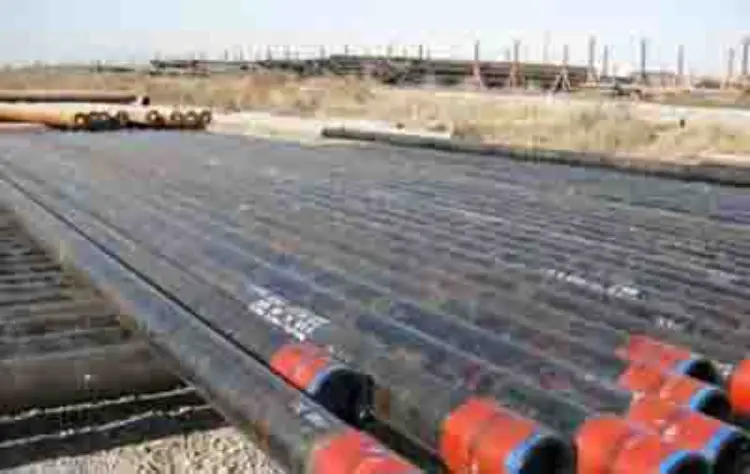
DIN 17400 1.4571 Stainless Steel Pipe
DIN 17400 1.4571 Stainless Steel Pipe: Properties, Equivalents & Applications
Explore DIN 17400 1.4571 (X6CrNiMoTi17-12-2) stainless steel pipe with full chemical, mechanical and physical properties, international equivalents, similar grades and application guide.
Hot rolling, cold drawing, welding, bending, machining
- Phone : +8618037372205
- Email : [email protected]
- WhatsApp: Contact via Whtsapp
- WeChat: +8618037372205
DIN 17400 1.4571 Stainless Steel Pipe Introduction
Austenitic stainless steel grade 1.4571 (X6CrNiMoTi17-12-2) specified in DIN 17400 is a titanium-stabilized version of the classic 18/12 chromium-nickel-molybdenum steel. Its main characteristic is excellent resistance to intergranular corrosion after welding or elevated temperature exposure, thanks to the addition of titanium which stabilizes carbides. The alloy offers good corrosion resistance in many environments, particularly against reducing acids and pitting. It is widely used for seamless and welded pipes in the chemical, petrochemical, food processing and marine industries. Typical delivery condition is solution annealed at 1020-1120°C followed by rapid cooling, providing a homogeneous austenitic structure and optimal ductility.
DIN 17400 1.4571 Stainless Steel Pipe Chemical composition
The following chemical requirements apply to grade 1.4571 according to DIN 17400 for wrought products. Titanium content is specified as a minimum of five times carbon to ensure full stabilization. All values are weight percent.
| Element | Standard value (wt%) | Remarks |
|---|---|---|
| Carbon (C) | ≤ 0.08 | Typical range 0.04-0.06 |
| Silicon (Si) | ≤ 1.00 | |
| Manganese (Mn) | ≤ 2.00 | |
| Phosphorus (P) | ≤ 0.045 | |
| Sulfur (S) | ≤ 0.030 | Controlled for weldability; often ≤ 0.020 in practice |
| Chromium (Cr) | 16.50 - 18.50 | Provides passivity and corrosion resistance |
| Nickel (Ni) | 10.50 - 13.50 | Austenite stabilizer |
| Molybdenum (Mo) | 2.00 - 2.50 | Improves pitting resistance |
| Titanium (Ti) | ≥ 5 × C ≤ 0.70 | Stabilizing element against intergranular corrosion |
| Iron (Fe) | Balance |
DIN 17400 1.4571 Stainless Steel Pipe Thermal and electrical physical properties
These physical constants are typical for 1.4571 in the solution-annealed condition at room temperature unless otherwise noted. They are derived from published data for 18/12 Cr-Ni-Mo-Ti stainless steels and are suitable for engineering calculations.
| Property | Typical value | Unit | Test condition / remarks |
|---|---|---|---|
| Density (ρ) | 7.9 | g/cm³ | 20°C |
| Modulus of elasticity (E) | 200 | GPa | Tension, 20°C |
| Shear modulus (G) | 77 | GPa | 20°C |
| Poisson's ratio (ν) | 0.30 | - | 20°C |
| Thermal expansion coefficient (α) | 16.5 | 10⁻⁶/K | 20–100°C |
| Thermal expansion coefficient (α) | 17.5 | 10⁻⁶/K | 20–300°C |
| Thermal expansion coefficient (α) | 18.5 | 10⁻⁶/K | 20–500°C |
| Thermal conductivity (λ) | 15 | W/(m·K) | 20°C |
| Thermal conductivity (λ) | 18 | W/(m·K) | 500°C |
| Specific heat capacity (cp) | 500 | J/(kg·K) | 20°C |
| Specific heat capacity (cp) | 550 | J/(kg·K) | 500°C |
| Electrical resistivity (ρe) | 0.75 | Ω·mm²/m | 20°C |
DIN 17400 1.4571 Stainless Steel Pipe Mechanical properties
Minimum mechanical properties for solution-annealed 1.4571 seamless pipe as per DIN 17400. Values are valid for wall thicknesses up to 50 mm. For welded pipe, slightly lower minimum strength may apply, and elongation may be reduced depending on welding procedure. The steel exhibits high ductility and toughness even at cryogenic temperatures.
| Property | Standard requirement (min/max) | Unit | Test condition |
|---|---|---|---|
| Yield strength (Rp0.2, min) | 200 | MPa | Room temperature, longitudinal |
| Tensile strength (Rm) | 500 - 700 | MPa | Room temperature, longitudinal |
| Elongation (A5, min) | 40 | % | Gauge length 5.65√S0, wall thickness ≤ 50 mm |
| Bend test (mandrel diameter) | No cracks | - | 180° bend, mandrel diameter = 3 × wall thickness |
| Impact energy (KV, typical) | ≥ 100 | J | Charpy V-notch, room temperature (informative) |
| Hardness (HB) | ≤ 215 | - | Annealed condition, for reference |
DIN 17400 1.4571 Stainless Steel Pipe Exact equivalent material standards and replaceable grades
| Country/Region | Standard | Grade | Remarks |
|---|---|---|---|
| Europe/Germany | EN 10088-1 | 1.4571 (X6CrNiMoTi17-12-2) | Current European designation |
| USA | ASTM A240 / A312 | 316Ti (S31635) | For plate and pipe; also UNS S31635 |
| China | GB/T 20878 / GB/T 14976 | S31668 (06Cr17Ni12Mo2Ti) | For seamless stainless steel pipes |
| Japan | JIS G4304 / G3459 | SUS316Ti | Corresponding austenitic grade |
| International | ISO 15510 | X6CrNiMoTi17-12-2 | ISO designation consistent with EN |
DIN 17400 1.4571 Stainless Steel Pipe Application Introduction
1.4571 stainless steel pipe finds broad use where welded structures require immunity to intergranular attack and good general corrosion resistance. It is suitable for moderately aggressive chemical environments, elevated temperature service up to about 800°C (scaling resistance) and sub-zero applications. The material can be shaped by all common techniques, including cold bending, flanging, and machining, but its work hardening rate is higher than that of carbon steel, requiring powerful equipment.
Product Applications: Seamless and welded pipe for fluid transport, Tube for heat exchangers and condensers, Boiler and superheater tubes, Pressure vessel shells and piping, Sanitary tubing for food/dairy equipment, Instrumentation tubing and hydraulic lines, Architectural handrails and structural hollow sections
Processed into products: Pipe spools and fittings (elbows, tees, reducers), Furnace parts and heating element supports, Sterilizer and autoclave pipes, Offshore platform process piping, Cryogenic transfer lines, Exhaust systems and flanges, Digesters and reactors in pulp & paper
Application industries: Chemical and petrochemical processing, Food and beverage production, Pharmaceutical and biotechnology, Marine engineering and shipbuilding, Power generation (heat exchangers, boiler tubes), Water treatment and desalination, Architectural metalwork and structural tubes
DIN 17400 1.4571 Stainless Steel Pipe Similar and alternative materials recommendation
| Country/Region | Standard | Grade | Remarks |
|---|---|---|---|
| Europe | EN 10088-1 | 1.4404 (X2CrNiMo17-12-2) | 316L: lower carbon for better as-welded corrosion resistance without Ti stabilization |
| Europe | EN 10088-1 | 1.4401 (X5CrNiMo17-12-2) | 316: standard unstabilized grade with slightly higher carbon |
| Europe | EN 10088-1 | 1.4435 (X2CrNiMo18-14-3) | Higher Ni and Mo for improved corrosion in chloride environments |
| USA | ASTM A240 | 317L (S31703) | Higher molybdenum (3-4%) for superior pitting resistance |
Notes:
DIN 17400 has been superseded by EN 10088-1 and EN 10216-5 for seamless tubes, but the grade 1.4571 continues under the new designation. When ordering to the old standard, ensure the product also meets current PED or ASME requirements if used in pressurized equipment. The titanium addition causes a tendency for streak-like surface defects (titanium stringers), which may require enhanced quality control during tube production. For optimal corrosion performance, post-weld heat treatment is not required; the stabilized grade can be used directly in the as-welded condition.
- Share



