
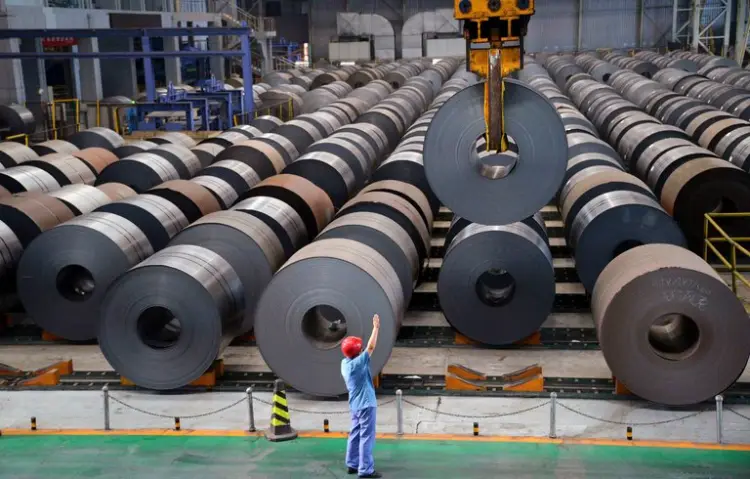
RINA E420 Shipbuilding Steel Coil
RINA E420 Shipbuilding Steel Coil - High Strength Hull Structural Steel Properties
Comprehensive material data for RINA E420 shipbuilding steel coil: chemical composition, mechanical properties, physical properties, equivalent grades, and application guidelines for marine engineering.
Cutting, cold forming, hot forming (limited), welding (all conventional methods), machining
- Phone : +8618037372205
- Email : [email protected]
- WhatsApp: Contact via Whtsapp
- WeChat: +8618037372205
RINA E420 Shipbuilding Steel Coil Introduction
RINA E420 is a high-strength shipbuilding steel grade certified by the Registro Italiano Navale (RINA). It belongs to the normalized or thermomechanically rolled fine-grain structural steel category with a minimum yield strength of 420 MPa. Key characteristics include excellent weldability, good low-temperature toughness (down to -40°C), and high resistance to brittle fracture, making it ideal for critical hull structures and offshore platforms.
- Superior notch toughness at sub-zero temperatures (E-class, test temperature -40°C)
- Controlled chemical composition to ensure consistent mechanical properties and weldability
- Available in coil form for further processing such as cutting, forming, and welding
- Fulfills the requirements of IACS UR W11 for Grade EH420 equivalent steels
RINA E420 Shipbuilding Steel Coil Chemical Composition
The chemical composition is controlled to achieve the required strength and toughness while maintaining good weldability. Values are maximum unless a range is stated, according to RINA and IACS UR W11 specifications for Grade E/420. Microalloying elements such as Nb, V, Ti are added for grain refinement and precipitation strengthening. Low carbon content ensures excellent weldability and resistance to cold cracking.
| Element | Standard Value (max %) | Remarks |
|---|---|---|
| Carbon (C) | 0.18 | Ladle analysis, max |
| Manganese (Mn) | 0.90 - 1.60 | Range |
| Silicon (Si) | 0.10 - 0.50 | Range, min 0.10 |
| Phosphorus (P) | 0.025 | Max |
| Sulfur (S) | 0.025 | Max |
| Aluminium (Al, acid-soluble) | 0.015 min | Minimum, typically 0.020 - 0.050 for fine grain practice |
| Niobium (Nb) | 0.05 | Max, optional but commonly used |
| Vanadium (V) | 0.10 | Max |
| Titanium (Ti) | 0.02 | Max |
| Copper (Cu) | 0.35 | Max, typically for special corrosion resistance |
| Chromium (Cr) | 0.20 | Max |
| Nickel (Ni) | 0.40 | Max |
| Molybdenum (Mo) | 0.08 | Max |
| Nitrogen (N) | 0.009 | Max, if no Al present then limit applies to the steel |
RINA E420 Shipbuilding Steel Coil Thermal and Electrical Physical Properties
These properties are typical for normalized or TM rolled high strength structural steel of similar composition. They are not mandatory in RINA rules but are derived from published data for HSLA steels with 420 MPa yield strength. Actual values may vary slightly with manufacturing route and exact chemical analysis. Thermal conductivity and thermal expansion are important for welding and design of structures subjected to temperature gradients.
| Property | Standard/Typical Value | Unit | Test Condition / Remarks |
|---|---|---|---|
| Density (ρ) | 7850 | kg/m³ | At 20°C |
| Elastic Modulus (E) | 205 - 210 | GPa | At ambient temperature |
| Shear Modulus (G) | 80 | GPa | Approximate |
| Poisson's Ratio (ν) | 0.3 | - | Typical |
| Thermal Expansion Coefficient (α) | 11.5 - 12.5 x 10⁻⁶ | /K | Linear expansion between 20°C and 100°C |
| Thermal Conductivity (λ) | 45 - 52 | W/(m·K) | At 20°C |
| Specific Heat Capacity (c) | 460 - 480 | J/(kg·K) | At 20°C |
| Electrical Resistivity (ρ_e) | 0.25 - 0.30 | μΩ·m | At 20°C |
RINA E420 Shipbuilding Steel Coil Mechanical Properties
Mechanical properties are guaranteed for plates and wide flats in the delivery condition (N, TM or QT). Tensile testing is performed on transverse specimens. Charpy V-notch impact energy is measured on longitudinal specimens at -40°C for E-grade. The values below are based on RINA Rules and IACS UR W11 for thicknesses typically up to 50 mm. For thicker sections, special agreements may apply.
| Property | Standard Requirement | Unit | Test Condition / Remarks |
|---|---|---|---|
| Yield Strength (ReH) | 420 min | MPa | Thickness ≤ 100 mm; for sections >100 mm, please check specific standard |
| Tensile Strength (Rm) | 530 - 680 | MPa | Thickness ≤ 100 mm |
| Elongation (A) | 18 min | % | Gauge length 5.65√S₀, transverse specimen; applicable to thickness ≤ 50 mm |
| Bend Test (d=na) | No cracks | - | 180° bending test, diameter of former na (n depends on thickness), usually d=3a |
| Charpy Impact Energy (KV) at -40°C | 27 min (longitudinal) | J | Average of 3 specimens, single value not less than 70% of specified average, -40°C |
| Thickness Reduction Area | No specific requirement | - | Not applicable |
RINA E420 Shipbuilding Steel Coil Exactly Corresponding Material Standards and Substitutable Grades
| Country/Region | Standard/Specification | Grade | Remarks |
|---|---|---|---|
| International | IACS UR W11 | E420 | Unified requirement for high strength hull structural steel |
| USA | ABS Rules | EH420 | American Bureau of Shipping |
| Norway/Germany | DNV Rules | E420 | Det Norske Veritas (now DNV GL) |
| UK | LR Rules | EH420 | Lloyd's Register |
| France | BV Rules | EH420 | Bureau Veritas |
| China | CCS Rules | EH420 | China Classification Society |
| Japan | NK Rules | KE420 | Nippon Kaiji Kyokai (ClassNK) |
| South Korea | KR Rules | EH420 | Korean Register |
RINA E420 Shipbuilding Steel Coil Application Introduction
RINA E420 steel coil is specifically designed for high-demand structural components in shipbuilding and offshore engineering. Its high strength-to-weight ratio allows for lighter construction compared to lower grades, while maintaining excellent safety margins against brittle fracture in cold environments. The material can be formed and welded using standard shipyard practices. Typical applications include:
Product Applications: Container ships, Bulk carriers, Oil tankers, LNG/LPG carrier hulls, Offshore jacket legs and topsides, Floating production storage and offloading (FPSO) units
Processed into products: Main deck plating and stringers, Bottom and side shell plating, Transverse bulkheads and web frames, Hatch coamings and box girders, Rudder horns and stern frames, Offshore structural nodes (cast/forged equivalents), Tension leg platform (TLP) columns, Arc-welded tubular joints
Application industries: Commercial and naval shipbuilding, Offshore oil and gas platforms, Port and harbor infrastructure, Marine container manufacturing, Heavy lifting equipment (crane booms for shipyards), Wind turbine support structures (offshore monopiles, transition pieces)
RINA E420 Shipbuilding Steel Coil Similar/Comparable Material Grades
| Country/Region | Standard/Specification | Grade | Remarks / Analysis |
|---|---|---|---|
| EU | EN 10025-4 | S420ML / S420Q | Thermomechanical rolled or quenched and tempered fine grain steel; yield 420 MPa but not specifically certified for marine, though used. Check toughness requirement and marine classification if needed. |
| Japan | JIS G 3128 | SHY685 (approx) | Higher strength level; comparable in toughness concept but higher yield. E420 is positioned between EH36 and EH460. |
| International | API 2W Gr.50 | Grade 50 (345 MPa) | Lower yield strength but similar in concept; for offshore structures, not direct substitute. |
| Other Classification | EH36 (various) | EH36 | Lower strength (min 355 MPa) but similar toughness at -40°C. Could be used with increased thickness if design allows; not a direct mechanical substitute. |
Notes:
Material may be ordered with additional requirements such as Z-quality (through-thickness tensile properties) per RINA rules for structural members under high strain in the z-direction. Supplementary testing like CTOD (Crack Tip Opening Displacement) can be agreed upon. For coil delivery, proper decoiling and flattening procedures must be followed to retain mechanical properties. Surface condition: unless otherwise specified, as-rolled or pickled and oiled. Coil weight and dimensions are subject to manufacturer's capability.
- Share



