
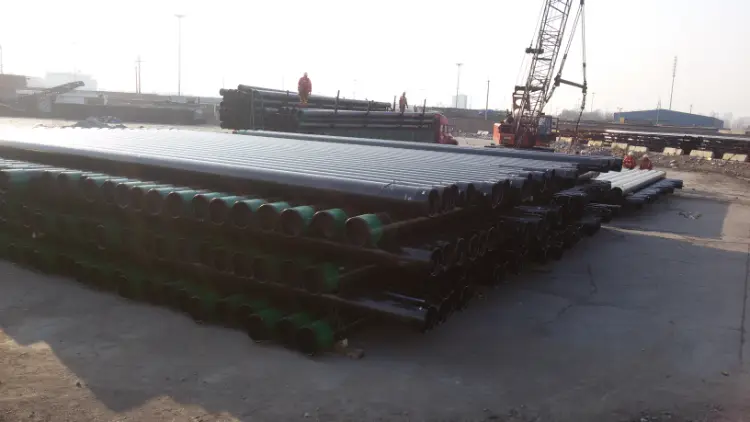
DIN 17400 1.4404 Stainless Steel Pipe
DIN 17400 1.4404 Stainless Steel Pipe - Comprehensive Material Guide & Equivalent Grades
Explore the full technical data for DIN 17400 1.4404 stainless steel pipe: chemical composition, mechanical properties, thermal & electrical properties, international equivalents, and application guidelines. Ideal for corrosion-resistant piping systems.
Hot forming, cold forming, machining, welding (all common methods), solution annealing
- Phone : +8618037372205
- Email : [email protected]
- WhatsApp: Contact via Whtsapp
- WeChat: +8618037372205
DIN 17400 1.4404 Stainless Steel Pipe Introduction
DIN 17400 1.4404 is a low-carbon, molybdenum-alloyed austenitic stainless steel, also designated as X2CrNiMo17-12-2. It is the European equivalent to AISI 316L and offers excellent corrosion resistance, particularly against pitting and crevice corrosion in chloride environments. The low carbon content minimizes carbide precipitation during welding, making it suitable for as-welded applications. Key characteristics include:
- Excellent weldability without post-weld annealing
- High resistance to intergranular corrosion
- Good strength and toughness at cryogenic temperatures
- Exceptional formability and machinability in the annealed condition
Commonly supplied in the solution-annealed condition, this grade is widely used for piping, pressure vessels, and structural components in aggressive chemical and marine settings.
DIN 17400 1.4404 Stainless Steel Pipe Chemical Composition
The chemical composition of 1.4404 is defined to ensure a fully austenitic microstructure with enhanced corrosion resistance. The low carbon content (<0.03%) prevents sensitization during welding, while molybdenum significantly improves pitting resistance. The analysis shown below reflects the requirements of DIN 17400 and the harmonized EN 10088-2 standard, which are identical for this grade. Sulfur content may be specified lower (≤0.015%) for improved weldability.
| Element | Standard Value (%) | Remarks |
|---|---|---|
| Carbon (C) | ≤ 0.03 | Low carbon to prevent intergranular corrosion |
| Silicon (Si) | ≤ 1.00 | Deoxidizer; improves oxidation resistance |
| Manganese (Mn) | ≤ 2.00 | Austenite stabilizer; compensates for low nickel |
| Phosphorus (P) | ≤ 0.045 | Residual element; controlled for ductility |
| Sulfur (S) | ≤ 0.015 | Usually controlled low for weldability; older DIN may allow 0.030 |
| Chromium (Cr) | 16.5 - 18.5 | Primary element for corrosion resistance |
| Nickel (Ni) | 10.0 - 13.0 | Stabilizes austenitic structure |
| Molybdenum (Mo) | 2.0 - 2.5 | Enhances pitting and crevice corrosion resistance |
DIN 17400 1.4404 Stainless Steel Pipe Thermal & Electrical Physical Properties
These physical properties are typical for 1.4404 in the solution-annealed condition at room temperature unless a temperature range is specified. Thermal expansion data are crucial for design when mating with different materials. Thermal conductivity increases with temperature, while specific heat capacity and electrical resistivity also vary. These values are derived from authoritative sources for 316L-type stainless steels.
| Property | Typical Value | Unit | Condition / Temperature |
|---|---|---|---|
| Density (ρ) | 8.0 (7.98) | g/cm³ | 20 °C |
| Elastic Modulus (E) | 200 | GPa | 20 °C |
| Shear Modulus (G) | 77 | GPa | 20 °C |
| Poisson's Ratio (ν) | 0.3 | — | 20 °C |
| Thermal Expansion (α) | 16.0 | 10⁻⁶/K | 20 – 100 °C |
| Thermal Expansion (α) | 16.5 | 10⁻⁶/K | 20 – 200 °C |
| Thermal Expansion (α) | 17.0 | 10⁻⁶/K | 20 – 300 °C |
| Thermal Expansion (α) | 17.5 | 10⁻⁶/K | 20 – 400 °C |
| Thermal Conductivity (λ) | 15 | W/(m·K) | 20 °C |
| Thermal Conductivity (λ) | 18 | W/(m·K) | 200 °C |
| Thermal Conductivity (λ) | 21 | W/(m·K) | 500 °C |
| Specific Heat Capacity (c) | 500 | J/(kg·K) | 20 °C |
| Electrical Resistivity (ρ_e) | 0.75 | µΩ·m | 20 °C |
DIN 17400 1.4404 Stainless Steel Pipe Mechanical Properties
Values represent the minimum mechanical properties for solution-annealed seamless pipe according to EN 10216-5 (applicable to 1.4404). Tests are conducted at room temperature on longitudinal specimens. The elongation requirement decreases with increasing wall thickness; the values given are for wall thickness up to 60 mm. For welded pipes (EN 10217-7), similar requirements apply. Hardness is not normally part of the mandatory release test but is provided for guidance.
| Property | Standard Requirement | Unit | Test Condition |
|---|---|---|---|
| Tensile Strength (Rm) | 500 - 700 | MPa | Room temperature, longitudinal |
| Yield Strength (Rp0.2) | ≥ 200 | MPa | Room temperature, 0.2% offset |
| Yield Strength (Rp1.0) | ≥ 240 | MPa | Room temperature, 1.0% offset (for information) |
| Elongation (A) | ≥ 40 | % | longitudinal, gauge length 5.65√S₀, wall thickness ≤ 60 mm |
| Elongation (A) | ≥ 35 | % | longitudinal, wall thickness > 60 mm (for information) |
| Hardness (HB) | ≤ 215 | HB | Typical annealed condition, for information |
DIN 17400 1.4404 Stainless Steel Pipe Fully Equivalent Material Standards & Substitutable Grades
| Country/Region | Standard | Grade | Remarks |
|---|---|---|---|
| Europe | EN 10088-2, EN 10216-5 | 1.4404 / X2CrNiMo17-12-2 | Direct successor to DIN 17400 |
| USA | ASTM A240, A312 | UNS S31603 (AISI 316L) | Molybdenum content identical |
| Japan | JIS G4304, G3459 | SUS 316L | Chemical and mechanical match |
| China | GB/T 20878, GB/T 24593 | 022Cr17Ni12Mo2 (formerly 00Cr17Ni14Mo2) | Full interchangeability |
| Sweden | SS 14 23 48 | 2348 | Traditional Swedish standard grade |
| UK (historical) | BS 970-1, BS EN 10088 | 316S11 / 316S31 | Now superseded by EN grades |
DIN 17400 1.4404 Stainless Steel Pipe Application Introduction
1.4404 (316L) is the workhorse of the chemical and marine industries. Its combination of weldability, corrosion resistance, and availability makes it the default choice for piping systems exposed to mild chlorides, acids, and high-purity water. Key application areas include:
- Chemical processing: reactors, storage tanks, and transfer lines for organic and inorganic chemicals.
- Marine & offshore: seawater piping, splash zone components, and heat exchanger tubing.
- Food & beverage: dairy, brewery, and pharmaceutical tubing that requires cleanability and corrosion resistance.
- Cryogenics: components for LNG transportation and storage due to retained toughness at low temperatures.
Product Applications: Seamless and welded pipes for fluid transport, Heat exchanger and condenser tubes, Pressure vessels and boilers (shell and tube side), Sanitary tubing (ASTM A270, DIN 11850), Flanges, fittings, and valves, Structural hollow sections in corrosive atmospheres
Processed into products: Piping spools and bends, Reactor jackets and cooling coils, Seawater intake and discharge pipes, Sterilization and CIP (clean-in-place) manifolds, LNG vaporizer tube bundles, Offshore platform handrails and grating (in cladding application), Architectural fasteners and tension systems
Application industries: Chemical and Petrochemical, Oil & Gas (Upstream & Downstream), Marine Engineering, Pharmaceutical & Biotechnology, Food & Beverage Processing, Pulp & Paper, Power Generation (condenser tubes, heat exchangers), Water Treatment & Desalination
DIN 17400 1.4404 Stainless Steel Pipe Similar / Alternative Material Recommendations
| Country/Region | Standard | Grade | Remarks |
|---|---|---|---|
| Europe | EN 10088 | 1.4306 (X2CrNi19-11) | 304L type; lower corrosion resistance without Mo, but lower cost |
| Europe | EN 10088 | 1.4401 (X5CrNiMo17-12-2) | 316; carbon up to 0.07%, may require post-weld annealing |
| Europe | EN 10088 | 1.4438 (X2CrNiMo18-15-4) | 317L; higher Mo and Ni for superior pitting resistance |
| Europe | EN 10088 | 1.4539 (X1NiCrMoCu25-20-5) | 904L grade for extreme chloride environments |
| USA | ASTM | UNS S31703 (AISI 317L) | Higher molybdenum than 316L, similar to 1.4438 |
| Japan | JIS | SUS 317L | Higher corrosion resistance alternative |
Notes:
Welding: All common processes (TIG, MIG, SAW, stick) are suitable with matching filler metal (e.g., ER 316L wire). No post-weld heat treatment is required for most service environments, but solution annealing restores optimum corrosion resistance. Machining: Use rigid setups, sharp tools, and adequate cooling; 1.4404 has a higher work-hardening rate than carbon steel. Standards note: DIN 17400 is technically withdrawn but remains recognized in industry specifications. For new projects, refer to EN 10216-5 (seamless) or EN 10217-7 (welded) for pipes.
- Share



