
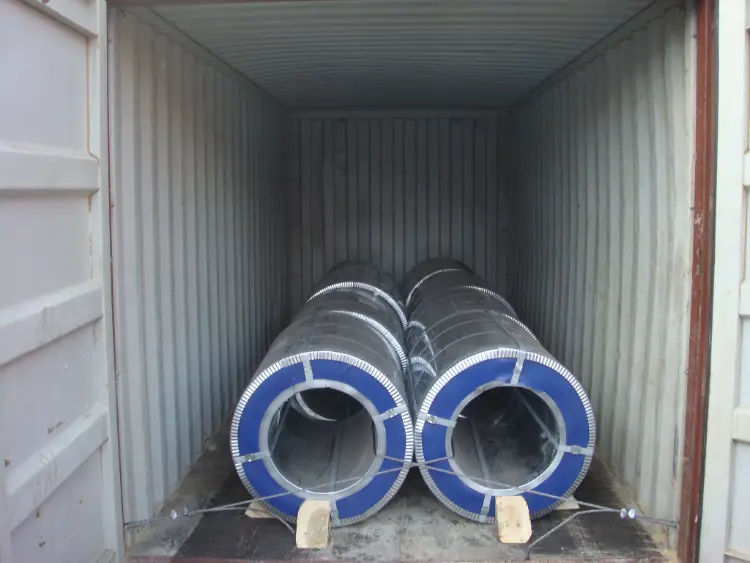
RINA A460 Shipbuilding Steel Coil
RINA A460 Shipbuilding Steel Coil: Extra High Strength Marine Plate
Detailed analysis of RINA A460 shipbuilding steel coil, including chemical composition, mechanical and thermal properties, international equivalents, and application guidelines.
Hot rolling, thermomechanical controlled processing (TMCP), normalizing, quenching and tempering; suitable for cold forming, welding, and flame cutting
- Phone : +8618037372205
- Email : [email protected]
- WhatsApp: Contact via Whtsapp
- WeChat: +8618037372205
RINA A460 Shipbuilding Steel Coil Introduction
RINA A460 is an extra high strength shipbuilding structural steel grade certified by the Italian classification society RINA (Registro Italiano Navale). It is designed for critical welded structures in ship and offshore engineering where weight savings and high load-bearing capacity are essential. With a minimum yield strength of 460 MPa and good low-temperature impact toughness at 0°C, it belongs to the A460 toughness class (equivalent to IACS AH460). It is typically supplied in coil form, suitable for continuous processing into plates, profiles, and welded components. The steel meets stringent requirements for weldability, ductility, and through-thickness properties, and is commonly delivered in thermomechanically rolled (TMCP) or quenched and tempered (QT) condition.
RINA A460 Shipbuilding Steel Coil Chemical Composition
The chemical composition of RINA A460 complies with RINA Rules Part D, Ch.3 and IACS UR W11 for extra high strength shipbuilding steels. Controlled contents of carbon, manganese, and microalloying elements (Nb, V, Ti) ensure high strength and good weldability. Carbon equivalent (CE) is typically limited to 0.41% for thickness ≤50 mm to avoid cold cracking.
| Element | Specified Value (max unless range) | Remarks |
|---|---|---|
| C | ≤0.20% | Improves strength; limited for weldability |
| Mn | 0.70 – 1.70% | Major strengthening and deoxidation element |
| Si | 0.10 – 0.55% | Deoxidizer; affects toughness |
| P | ≤0.025% | Impurity; minimized for ductility |
| S | ≤0.025% | Impurity; minimized for toughness |
| Al (acid soluble) | ≥0.020% | Grain refiner; if not used, other grain refiners must be present |
| Nb | ≤0.05% | Microalloy for grain refinement and precipitation strengthening |
| V | ≤0.10% | Microalloy; similar effect |
| Ti | ≤0.02% | Grain refinement; deoxidation |
| Cu | ≤0.35% | May improve corrosion resistance; limited for hot shortness |
| Cr | ≤0.20% | Increases hardenability; limited in hull steels |
| Ni | ≤0.40% | Improves toughness at low temperature; limited |
| Mo | ≤0.08% | Increases strength and hardenability; limited |
| N | ≤0.020% | May cause ageing; controlled |
| CE (typical) | ≤0.41% (for t≤50mm) | Carbon equivalent = C+Mn/6+(Cr+Mo+V)/5+(Ni+Cu)/15 |
RINA A460 Shipbuilding Steel Coil Thermal and Electrical Physical Properties
These physical properties are representative for high-strength low-alloy structural steels similar to A460. They are not explicitly specified in RINA rules but serve as reliable engineering data for design. Slight variations may occur depending on the actual chemical composition and heat treatment.
| Property | Typical Value | Unit | Test Condition / Remarks |
|---|---|---|---|
| Density (ρ) | 7850 | kg/m³ | At 20°C |
| Elastic Modulus (E) | 200 – 210 | GPa | At room temperature |
| Shear Modulus (G) | 75 – 80 | GPa | Calculated from E and ν |
| Poisson's Ratio (ν) | 0.3 | — | In elastic range |
| Thermal Expansion Coefficient (α) | 12×10⁻⁶ – 13×10⁻⁶ | 1/K | Between 20°C and 100°C |
| Thermal Conductivity (λ) | 45 – 55 | W/(m·K) | At 20°C |
| Specific Heat Capacity | 460 – 500 | J/(kg·K) | At 20°C |
| Electrical Resistivity (ρ_e) | 0.15 – 0.25 | μΩ·m | At 20°C |
RINA A460 Shipbuilding Steel Coil Mechanical Properties
Mechanical properties are per RINA Rules for thickness ≤100 mm, impact testing at 0°C (grade A). The steel exhibits high yield and tensile strength with adequate elongation. Impact energy requirements are thickness-dependent and stricter for higher thicknesses to guarantee brittle fracture resistance.
| Property | Specified Value | Unit | Test Condition / Remarks |
|---|---|---|---|
| Yield Strength (ReH) | ≥460 | MPa | Thickness ≤100 mm; transverse or longitudinal |
| Yield Strength (ReH) | ≥440 | MPa | Thickness >100 mm ≤150 mm |
| Tensile Strength (Rm) | 570 – 720 | MPa | All thicknesses |
| Elongation (A5) | ≥17% | % | Longitudinal direction; gauge length 5.65√So |
| Elongation (A5) | ≥14% | % | Transverse direction; gauge length 5.65√So |
| Impact Energy KV 0°C, long. | ≥34 | J | Thickness ≤50 mm; average of 3 tests |
| Impact Energy KV 0°C, trans. | ≥24 | J | Thickness ≤50 mm; average of 3 tests |
| Impact Energy KV 0°C, long. | ≥41 | J | Thickness >50 mm ≤70 mm |
| Impact Energy KV 0°C, trans. | ≥27 | J | Thickness >50 mm ≤70 mm |
| Impact Energy KV 0°C, long. | ≥50 | J | Thickness >70 mm ≤100 mm |
| Impact Energy KV 0°C, trans. | ≥34 | J | Thickness >70 mm ≤100 mm |
| Bend Test (180°) | d = 3a | — | Bend diameter; a = specimen thickness; no cracks; for t ≤35 mm |
| Bend Test (180°) | d = 4a | — | For thickness >35 mm |
RINA A460 Shipbuilding Steel Coil Fully Equivalent Substitute Materials
| Country / Region | Standard / Regulation | Grade | Remarks |
|---|---|---|---|
| International | IACS UR W11 | AH460 | IACS unified requirement for extra high strength hull steel; A460 equivalent |
| France | BV Rules | AH460 | Bureau Veritas; identical requirements |
| UK | LR Rules | AH460 | Lloyd's Register |
| Norway/Germany | DNV GL Rules | AH460 | DNV class notation; now DNV only |
| USA | ABS Rules | AH460 | American Bureau of Shipping |
| China | CCS Rules | AH460 | China Classification Society |
| Japan | NK/ClassNK Rules | AH460 | Nippon Kaiji Kyokai |
| Korea | KR Rules | AH460 | Korean Register |
| Russia | RMRS Rules | AH460 | Russian Maritime Register of Shipping (equivalent strength level) |
RINA A460 Shipbuilding Steel Coil Application Introduction
RINA A460 steel is engineered for high-stress welded ship and marine structures where weight savings and excellent fatigue resistance are crucial. It is extensively used in the construction of large container ships, bulk carriers, tankers, and offshore platforms. The coil form permits efficient continuous manufacturing of stiffeners and long hull profiles. Typical delivery condition involves TMCP to achieve the required strength with good toughness and weldability. Welding procedures must follow approved methods with low hydrogen electrodes, and preheating may be necessary depending on thickness and carbon equivalent. Proper surface preparation and corrosion protection are necessary for service in marine atmosphere.
Product Applications: Main hull plates, side shell, bottom shell, Strength deck and stringer plates, Longitudinal bulkheads and transverse webs, Stiffeners, beams, and T-bars (from coil slit and formed sections), Structural tubulars and pile guides for offshore jacket legs
Processed into products: Cut-to-length plates for panel lines, Welded box girders and H-beams, Ship blocks and sub-assemblies, Offshore module frames, Brackets, stiffening ribs, and collar plates
Application industries: Commercial and naval shipbuilding (hull, deck, superstructure), Offshore oil & gas platforms (jackets, topsides, modules), Marine renewable energy structures (wind turbine foundations, tidal energy), Heavy machinery and structural engineering requiring high-strength weldable steel
RINA A460 Shipbuilding Steel Coil Similar / Alternative High-Strength Steels
| Country / Region | Standard | Grade | Remarks |
|---|---|---|---|
| International | IACS UR W11 | DH460, EH460, FH460 | Same strength, lower impact test temperatures (-20°C, -40°C, -60°C); may be used if better low-temperature toughness required |
| Europe | EN 10025-4 | S460M/ML | Thermomechanical rolled structural steel, yield 460 MPa; not specifically for shipbuilding but may be acceptable for some marine structures with additional approval |
| Europe | EN 10025-6 | S460Q/QL/QL1 | Quenched and tempered steel, yield 460 MPa; higher alloy content, suitable for heavy offshore structures |
| USA | ASTM A131 / A131M | EH46 | Similar strength (460 MPa) but with E-grade notch toughness (-40°C); shipbuilding steel |
| Japan | JIS G 3106 | SM570 | Structural steel with 570 N/mm² tensile, yield ≥460 MPa; used in welded structures, not specifically marine |
| International | IACS UR W11 | A500/A550/A620 | Higher strength grades (500-620 MPa) within same shipbuilding class; can be considered for weight reduction |
Notes:
- All values are based on RINA Rules for the Classification of Ships, Part D, Chapter 3, and IACS UR W11 (2021 revision). Actual mechanical properties are verified by mill test certificates.
- For thicknesses above 100 mm, specific supplementary requirements may apply, such as increased impact energy or ultrasonic testing for through-thickness properties (Z-quality).
- Welding consumables should match the base metal strength and toughness. Preheating is recommended when CE exceeds 0.41% and thickness >30 mm.
- Surface condition after shot blasting and primer application is standard for shipbuilding grade steel.
- The material is recyclable and complies with international environmental standards for ship steel.
- Share



