
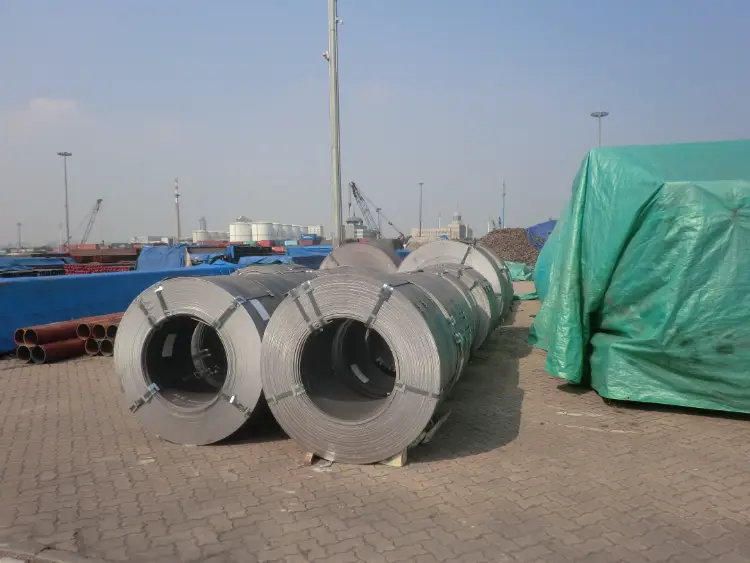
RINA F40 Shipbuilding Steel Coil
RINA F40 Shipbuilding Steel Coil – High Strength Marine Structural Plate
Comprehensive data sheet for RINA F40 shipbuilding steel coil under Italian naval register: chemical composition, mechanical properties, thermal & electrical performance, international equivalents, and application guidance.
Hot rolling, TMCP, Normalizing, Quenching and Tempering
- Phone : +8618037372205
- Email : [email protected]
- WhatsApp: Contact via Whtsapp
- WeChat: +8618037372205
RINA F40 Shipbuilding Steel Coil Introduction
RINA F40 is a high-strength hull structural steel certified by the Registro Italiano Navale (RINA). It is designed for critical load-bearing components in shipbuilding and offshore engineering, offering a minimum yield strength of 390 MPa and excellent toughness down to -40°C. The steel is typically supplied in coil or plate form, processed via
- Thermo-Mechanical Control Process (TMCP)
- Normalizing
- Quenching and Tempering
to achieve the required fine grain structure and mechanical properties. With strict control of chemical composition (low carbon, microalloyed with Nb, V, Ti), RINA F40 ensures good weldability and resistance to brittle fracture, making it suitable for the most demanding marine environments. It is fully compliant with IACS Unified Requirement W11 and interchangeable with other classification society grades such as ABS FH40, DNV NV F40, and LR FH40.
RINA F40 Shipbuilding Steel Coil Chemical Composition
The chemical composition of RINA F40 is governed by IACS UR W11 for high strength hull structural steels. The steel is fully killed and fine grain treated with a minimum aluminum content.
- Carbon equivalent (CEV) is controlled to guarantee weldability.
- Microalloying elements such as Nb, V, and Ti are optionally added singly or in combination to refine grain size and improve strength.
Residual elements (Cr, Ni, Mo, Cu) are kept below specified limits to avoid adverse effects on toughness and corrosion resistance.
| Element | Standard Value (wt%) | Remarks |
|---|---|---|
| Carbon (C) | ≤ 0.18 | |
| Silicon (Si) | 0.10 – 0.50 | |
| Manganese (Mn) | 0.90 – 1.60 | If content ≤ 1.60%, CEV shall be ≤ 0.38 |
| Phosphorus (P) | ≤ 0.025 | |
| Sulfur (S) | ≤ 0.025 | |
| Aluminum (Al total) | ≥ 0.020 | Acid soluble Al ≥ 0.015% |
| Niobium (Nb) | ≤ 0.05 | Optional microalloying |
| Vanadium (V) | ≤ 0.10 | Optional microalloying |
| Titanium (Ti) | ≤ 0.02 | Optional microalloying |
| Chromium (Cr) | ≤ 0.20 | Residual element |
| Nickel (Ni) | ≤ 0.40 | Residual element |
| Molybdenum (Mo) | ≤ 0.08 | Residual element |
| Copper (Cu) | ≤ 0.30 | Residual element |
| Nitrogen (N) | ≤ 0.012 | If present |
RINA F40 Shipbuilding Steel Coil Thermal & Electrical Physical Properties
Physical constants are typical for low-carbon microalloyed steel and are valid at room temperature unless otherwise noted. These values demonstrate the material's behavior under thermal and electric loads and are used in design calculations. Thermal expansion and thermal conductivity values vary with temperature; the listed data cover the most common range encountered in ship and offshore structures.
| Property | Typical Value | Unit | Test Condition |
|---|---|---|---|
| Density (ρ) | 7.85 | g/cm³ | 20°C |
| Modulus of elasticity (E) | 210 | GPa | 20°C |
| Shear modulus (G) | 81 | GPa | 20°C |
| Poisson's ratio (ν) | 0.3 | – | 20°C |
| Coefficient of thermal expansion (α) | 11.5 × 10⁻⁶ | 1/K | 20–100°C |
| Coefficient of thermal expansion (α) | 12.3 × 10⁻⁶ | 1/K | 20–200°C |
| Thermal conductivity (λ) | 50 | W/(m·K) | 20°C |
| Specific heat capacity (cp) | 460 | J/(kg·K) | 20°C |
| Electrical resistivity (ρe) | 0.18 × 10⁻⁶ | Ω·m | 20°C |
RINA F40 Shipbuilding Steel Coil Mechanical Properties
Tensile and impact properties are determined in accordance with RINA rules and IACS UR W11. Values depend on product thickness and orientation. Tensile testing is carried out at room temperature on transverse specimens (unless otherwise agreed), and Charpy V-notch impact testing is performed at -40°C on longitudinal specimens. Bend tests are conducted to verify ductility: samples bent to 180° over a former of specified diameter must show no cracks.
| Property | Standard Requirement | Unit | Test Condition |
|---|---|---|---|
| Yield Strength (ReH) | ≥ 390 | MPa | Thickness ≤ 50 mm |
| Yield Strength (ReH) | ≥ 380 | MPa | Thickness 50 < t ≤ 70 mm |
| Yield Strength (ReH) | ≥ 370 | MPa | Thickness 70 < t ≤ 100 mm |
| Tensile Strength (Rm) | 510 – 660 | MPa | All thickness |
| Elongation after fracture (A) | ≥ 20 | % | Thickness ≤ 50 mm (L0 = 5.65√S0) |
| Elongation after fracture (A) | ≥ 19 | % | Thickness 50 < t ≤ 100 mm |
| Impact energy (KV) at -40°C | ≥ 41 (average) / ≥ 28 (single minimum) | J | Longitudinal Charpy-V specimens |
| Bend test (180°) | No cracks | – | Bend diameter = 3 × thickness |
RINA F40 Shipbuilding Steel Coil Exactly Equivalent Standards and Substitute Grades
| Country / Region | Classification Society / Standard | Grade | Remarks |
|---|---|---|---|
| Italy | RINA | F40 | Original grade |
| USA | ABS (American Bureau of Shipping) | FH40 | Identical mechanical and chemical requirements |
| Norway / Germany | DNV (Det Norske Veritas) | NV F40 | Same as FH40; often designated as NV F40 |
| UK | LR (Lloyd's Register) | FH40 | Equivalent fine grain high strength grade |
| France | BV (Bureau Veritas) | FH40 | Direct equivalent |
| China | CCS (China Classification Society) | F40 | Identical designation and properties |
| Japan | NK (ClassNK) | K F40 | Grade specification matches FH40 |
| South Korea | KR (Korean Register) | F40 | Same performance criteria |
| Russia | RS (Russian Maritime Register of Shipping) | F40 | Equivalent designation |
RINA F40 Shipbuilding Steel Coil Application Introduction
RINA F40 steel is engineered for primary structural members in ships and offshore units that require high strength and excellent low-temperature toughness. Its typical uses involve welded structures subjected to dynamic loads and harsh marine environments. The material is suitable for cold forming and machining, provided proper practices are followed.
- Commonly delivered in TMCP condition to maximize weldability and toughness.
- Welding must be performed with low-hydrogen procedures and matching electrodes (e.g., AWS A5.18 ER70S-6 or equivalent).
- Preheat and interpass temperature control may be required depending on thickness.
Product Applications: Hull structural plates and coils, Deck and bottom plates, Longitudinal and transverse bulkheads, Secondary stiffeners and girders, Topsides modules and flare booms
Processed into products: Shell plating for ice-strengthened vessels, Hatch coamings and corner reinforcements, Bilge keels and rudder horns, Jacket legs and bracing members of offshore structures, Mooring brackets and heavy load-bearing connections
Application industries: Commercial and naval shipbuilding, Offshore oil and gas platforms, Marine and coastal engineering, Port machinery and heavy cranes, Arctic class vessel construction
RINA F40 Shipbuilding Steel Coil Near Equivalent / Substitute Material Recommendations
| Country / Region | Standard | Grade | Description |
|---|---|---|---|
| Italy / International | RINA / IACS | E40 | Same yield strength (390 MPa) but impact temperature only -20°C instead of -40°C; suitable for less severe cold climates. |
| Italy / International | RINA / IACS | D40 | 390 MPa yield strength with impact temperature at -20°C (D-grade equivalent), lower toughness than F40. |
| International | EN 10025-4 | S420ML / S420MLO | Thermomechanically rolled weldable fine grain structural steel with minimum yield 420 MPa and impact at -50°C; slightly higher strength, can replace F40 after design review. |
| International | IACS | FH36 | Lower strength level (355 MPa yield) but same -40°C impact toughness; suitable if strength requirements permit downgrading. |
| USA | ASTM A131 / ABS | FH36 (A131 Grade EH36 mod.) | Similar toughness but 355 MPa minimum yield; not a direct strength equivalent but sometimes used in lighter structures. |
Notes:
- RINA F40 coil is typically supplied with mill certificates (3.1 or 3.2 per EN 10204) confirming all chemical and mechanical results.
- Tolerances on thickness and flatness follow EN 10029 or the purchaser's specific agreement.
- For welding, the carbon equivalent (CEV) is usually limited to ≤ 0.40% (for TMCP) to avoid cold cracking.
- Ultrasonic testing (UT) can be performed according to ASTM A578/A578M or EN 10160 upon request.
- Share



