
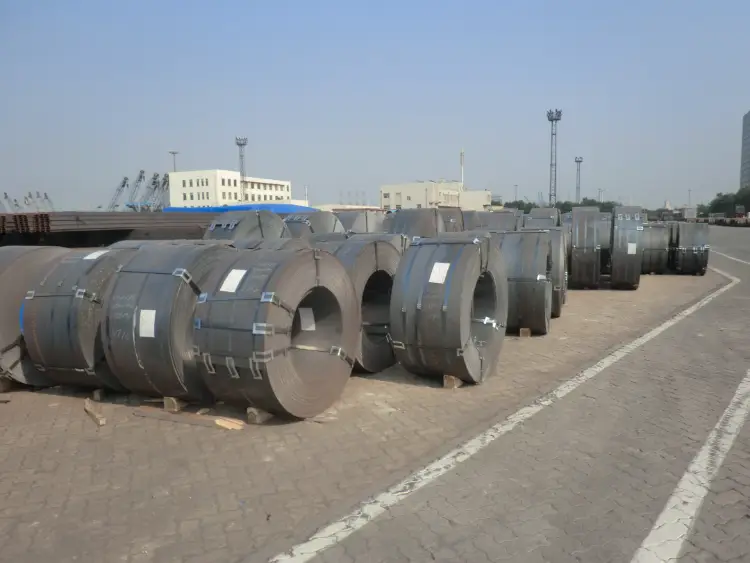
RINA E40 Shipbuilding Steel Coil
RINA E40 Shipbuilding Steel Coil - High-Strength Low-Temperature Hull Steel Data
Complete material datasheet for RINA E40 shipbuilding steel coil: chemistry, mechanical and thermal properties, international equivalences, similar grades, and application guidance.
Hot rolling, controlled rolling, TMCP, welding, gas/plasma/laser cutting, bending, cold forming
- Phone : +8618037372205
- Email : [email protected]
- WhatsApp: Contact via Whtsapp
- WeChat: +8618037372205
RINA E40 Shipbuilding Steel Coil Introduction
RINA E40 is a high-strength structural steel grade regulated by the Registro Italiano Navale (RINA) for the construction of ships and offshore facilities. With a minimum yield strength of 390 MPa and guaranteed Charpy impact toughness at −40 °C, this steel is designed for primary hull members operating in cold and Arctic regions.
Key characteristics:
- Fine‑grained, fully killed steel produced via controlled rolling or thermo‑mechanical controlled processing (TMCP).
- Excellent weldability and ductility, allowing forming and welding without excessive preheating.
- Supplied as coil for efficient processing into plates, strips, and custom‑cut parts.
- Meets the IACS UR W11 (EH40) unified requirement, making it interchangeable with equivalent grades from other major classification societies.
Typical applications include hull plating, deck structures, longitudinals, transverse frames, and components for offshore platforms.
RINA E40 Shipbuilding Steel Coil Chemical Composition
The composition complies with RINA Rules for grade E40. The steel is fully killed and fine‑grain treated. Residual elements are kept low to ensure good weldability and low‑temperature toughness. Note: For thicknesses ≤ 50 mm the values apply; for heavier gauges slight adjustments may be necessary.
| Element | Requirement (wt%) | Remarks |
|---|---|---|
| C | ≤ 0.18 | |
| Si | 0.10 – 0.50 | |
| Mn | 0.90 – 1.60 | |
| P | ≤ 0.035 | |
| S | ≤ 0.035 | |
| Cr | ≤ 0.20 | residual |
| Ni | ≤ 0.40 | residual |
| Mo | ≤ 0.08 | residual |
| Cu | ≤ 0.35 | residual |
| Al (total) | ≥ 0.015 | grain refining |
| Nb | ≤ 0.05 | |
| V | ≤ 0.10 | |
| Ti | ≤ 0.02 | |
| Nb+V+Ti | ≤ 0.12 | sum of microalloying |
| N | ≤ 0.012 | if not fixed by Al or Ti |
RINA E40 Shipbuilding Steel Coil Thermal and Electrical Physical Properties
These values are indicative for carbon‑manganese structural steels and are not part of the RINA specification. Actual properties may vary slightly depending on mill processing and temperature. They are useful for design calculations, heat transfer analysis, and welding procedure qualification.
| Property | Typical value | Unit | Conditions / Remarks |
|---|---|---|---|
| Density (ρ) | 7850 | kg/m³ | 20 °C |
| Modulus of elasticity (E) | 210 | GPa | 20 °C, static |
| Shear modulus (G) | ≈ 81 | GPa | calculated from E and ν |
| Poisson's ratio (ν) | 0.3 | – | elastic range |
| Thermal expansion coefficient (α) | 11.5 × 10⁻⁶ | K⁻¹ | 20 – 100 °C |
| Thermal conductivity (λ) | ≈ 52 | W/(m·K) | 20 °C |
| Specific heat capacity (cₚ) | ≈ 460 | J/(kg·K) | 20 °C |
| Electrical resistivity (ρₑ) | ≈ 0.23 × 10⁻⁶ | Ω·m | 20 °C |
RINA E40 Shipbuilding Steel Coil Mechanical Properties
Mechanical testing is performed on transverse test pieces according to RINA requirements. The Charpy impact test is carried out at −40 °C (E‑grade). For coil products, properties are verified on samples taken from flattened strip. Bending is conducted with a mandrel diameter equal to 3 times the specimen thickness.
| Property | Specified value | Unit | Test conditions |
|---|---|---|---|
| Yield strength (ReH) | ≥ 390 | MPa | Transverse, ambient |
| Tensile strength (Rm) | 510 – 650 | MPa | Transverse, ambient |
| Elongation after fracture (A) | ≥ 20 | % | Transverse, gauge length 5.65√S₀ |
| Charpy impact energy (KV) | ≥ 27 | J | Longitudinal, −40 °C, V‑notch |
| Charpy impact energy (KV) | ≥ 20 | J | Transverse, −40 °C, V‑notch |
| Bend test (mandrel diameter) | d = 3a | – | 180° bending, no cracks, transverse |
RINA E40 Shipbuilding Steel Coil Fully Equivalent Material Standards and Replaceable Grades
| Country / Region | Standard | Grade | Remarks |
|---|---|---|---|
| International | IACS UR W11 | EH40 | Unified requirement for ship steel |
| United States | ABS Rules | EH40 | Identical requirements |
| Norway | DNV Rules | E40 | Identical requirements |
| France | BV Rules | E40 | Identical requirements |
| China | CCS Rules | E40 | Identical requirements |
| United Kingdom | LR Rules | EH40 | Identical requirements |
| Germany | DNV‑GL (former GL) Rules | GL‑E40 | Identical requirements |
| Japan | NK Rules | KE40 | Identical requirements |
| South Korea | KR Rules | EH40 | Identical requirements |
| Russia | RMRS Rules | E40 | Identical requirements |
RINA E40 Shipbuilding Steel Coil Application Introduction
RINA E40 steel coil is optimized for the construction of ships, offshore platforms, and marine equipment requiring high strength combined with reliable low‑temperature impact toughness. Its coil form enables efficient nesting and processing in modern fabrication facilities.
Product Applications: Hull plating and shell expansion strakes, Main deck and strength deck plates, Transverse and longitudinal bulkheads, Bottom and side girders, Flanges for built‑up sections, Offshore jacket and topside structural steel, Caissons and transition pieces for wind turbines
Processed into products: Cut‑to‑length plates (flame cut, plasma or laser), Welded T‑beams, I‑beams and box girders, Cold‑bent frames and stiffeners, Brackets, gussets and connection plates, Deck fittings and lifting padeyes, Fatigue‑critical welded nodes
Application industries: Commercial and naval shipbuilding, Offshore oil & gas platforms, Offshore wind turbine foundations, Marine and coastal engineering, Pressure vessel manufacturing (with additional certification), Polar‑class and ice‑breaking vessels
RINA E40 Shipbuilding Steel Coil Similar / Alternative Material Grades with Close Performance
| Country / Region | Standard | Grade | Remarks & differences |
|---|---|---|---|
| Italy (RINA) | RINA Rules | DH40 | Same strength, impact tested at −20 °C instead of −40 °C |
| Italy (RINA) | RINA Rules | FH40 | Same strength, impact tested at −60 °C, for severe cold |
| Italy (RINA) | RINA Rules | E36 | Lower yield strength (355 MPa), similar low‑temperature grade |
| Italy (RINA) | RINA Rules | E47 | Higher yield strength (460 MPa), same low‑temperature grade |
| International | IACS UR W11 | EH36 | 355 MPa yield, otherwise comparable chemistry and toughness |
| International | IACS UR W11 | EH47 | 460 MPa yield, stricter process controls required |
Notes:
Welding recommendations: Preheat may be required depending on plate thickness, carbon equivalent (Ceq), and welding method. Typical preheat temperature is 50–100 °C for thicknesses up to 40 mm under low‑hydrogen processes.
Certification: Material is delivered with RINA 3.2 inspection certificate. Additional testing (Z‑direction, CTOD, etc.) can be agreed upon at the time of order.
- Share



