
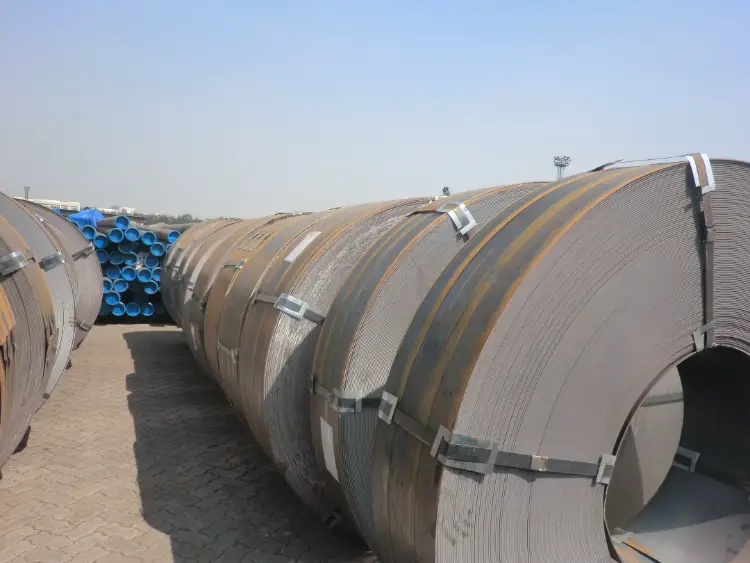
RINA F36 Shipbuilding Steel Coil
RINA F36 Shipbuilding Steel Coil: High-Strength Hull Structural Material for Arctic-Class Vessels
Detailed material data for RINA F36 shipbuilding steel coil, a high-strength hull structural steel with excellent low-temperature toughness, commonly used in ship and offshore construction under RINA classification rules.
Hot rolling, thermomechanical controlled processing (TMCP), normalizing
- Phone : +8618037372205
- Email : [email protected]
- WhatsApp: Contact via Whtsapp
- WeChat: +8618037372205
RINA F36 Shipbuilding Steel Coil Introduction
RINA F36 is a high-strength hull structural steel grade specified by the Italian classification society RINA (Registro Italiano Navale). It belongs to the FH36 category according to IACS UR W11, characterized by a minimum yield strength of 355 MPa and guaranteed impact toughness at -60°C. The steel is typically supplied in coil or plate form, produced via thermomechanical rolling or normalizing. Key features include excellent weldability, good formability, and superior notch toughness for arctic and extreme cold environments.
- Designed for critical structural components in ship hulls
- Meets stringent requirements for low-temperature service (-60°C)
- Available in coiled form for efficient fabrication of long profiles and cut-to-length parts
RINA F36 Shipbuilding Steel Coil Chemical Composition , Typical Limits per IACS UR W11 for FH36
The chemical composition is controlled to achieve a fine-grained microstructure and ensure good weldability. Carbon equivalent (CEV) is typically limited to 0.38–0.43% depending on thickness. Microalloying elements like Nb, V, and Ti are used for grain refinement.
- For thicknesses ≤100 mm.
- Al content is required if grain refining practices are employed.
| Element | Standard Value (max % unless range given) | Remarks |
|---|---|---|
| C | 0.18 | Ladle analysis |
| Mn | 0.90 – 1.60 | Ladle analysis |
| Si | 0.10 – 0.50 | Ladle analysis |
| P | 0.035 | Max |
| S | 0.035 | Max |
| Cu | 0.35 | Max |
| Cr | 0.20 | Max |
| Ni | 0.40 | Max |
| Mo | 0.08 | Max |
| Al (acid soluble) | 0.015 min | If grain refining, total Al 0.020 min |
| Nb | 0.02 – 0.05 | Optional grain refiner |
| V | 0.05 – 0.10 | Optional grain refiner |
| Ti | 0.02 | Max, optional |
| N | 0.009 (0.012 if not Al treated) | Max |
RINA F36 Shipbuilding Steel Coil Thermal and Electrical Physical Properties
These values are based on typical carbon-manganese structural steel at room temperature and may vary slightly with composition and manufacturing. They are provided for engineering design guidance.
- Density is standard for steel.
- Elastic modulus is direction-dependent but within range.
| Property | Typical Value | Unit | Condition/Remarks |
|---|---|---|---|
| Density (ρ) | 7850 | kg/m³ | 20°C |
| Elastic Modulus (E) | 200 – 210 | GPa | Room temperature |
| Shear Modulus (G) | ~80 | GPa | Room temperature |
| Poisson's Ratio (ν) | 0.3 | - | Room temperature |
| Thermal Expansion Coefficient (α) | 11.2 × 10⁻⁶ / K | 1/K | 20–100°C |
| Thermal Conductivity (λ) | ~50 | W/(m·K) | At 100°C |
| Specific Heat Capacity | ~460 | J/(kg·K) | At 20°C |
| Electrical Resistivity (ρ_e) | ~0.20 × 10⁻⁶ | Ω·m | At 20°C |
RINA F36 Shipbuilding Steel Coil Mechanical Properties
Tensile and impact properties are determined in accordance with RINA/IACS requirements. Impact tests are performed on longitudinal specimens at -60°C for F grade.
- Thickness t ≤ 100 mm
- Bend test mandrel diameter: 3t for t < 25 mm; 4t for t ≥ 25 mm
- All values are minimum unless stated otherwise
| Property | Standard Required Value | Unit | Test Condition |
|---|---|---|---|
| Yield Strength (ReH) | ≥ 355 | MPa | t ≤ 100 mm |
| Tensile Strength (Rm) | 490 – 620 | MPa | t ≤ 100 mm |
| Elongation (A) | ≥ 21 | % | L0 = 5.65√S0 |
| Bend Test (mandrel dia.) | 3t (t < 25 mm) | - | 180° bend, no cracks |
| Bend Test (mandrel dia.) | 4t (t ≥ 25 mm) | - | 180° bend, no cracks |
| Charpy V-notch Impact (KV) Long., avg | ≥ 34 (t ≤ 50 mm) | J | -60°C |
| Charpy V-notch Impact (KV) Long., avg | ≥ 41 (50 < t ≤ 70 mm) | J | -60°C |
| Charpy V-notch Impact (KV) Long., avg | ≥ 50 (70 < t ≤ 100 mm) | J | -60°C |
| Charpy V-notch Impact (KV) Trans., avg | ≥ 24 (t ≤ 50 mm) | J | -60°C |
| Charpy V-notch Impact (KV) Trans., avg | ≥ 27 (50 < t ≤ 70 mm) | J | -60°C |
| Charpy V-notch Impact (KV) Trans., avg | ≥ 34 (70 < t ≤ 100 mm) | J | -60°C |
RINA F36 Shipbuilding Steel Coil Fully Equivalent Material Standards and Replaceable Grades
| Country/Region | Standard / Classification Society | Grade | Remarks |
|---|---|---|---|
| International | IACS UR W11 | FH36 | Identical mechanical and toughness requirements |
| USA | ABS - American Bureau of Shipping | FH36 | ABS Rules Part 2, Chapter 1 |
| Norway/Germany | DNV - Det Norske Veritas | FH36 | DNV Rules, Pt. 2 Ch. 2 |
| UK | LR - Lloyd's Register | FH36 | LR Rules for Materials |
| France | BV - Bureau Veritas | FH36 | BV Rules NR216 |
| China | CCS - China Classification Society | FH36 | CCS Rules Part 1, Chapter 3 |
| Japan | NK - Nippon Kaiji Kyokai | FH36 | NK Rules Part K |
| Korea | KR - Korean Register | FH36 | KR Rules Pt. 2, Ch. 1 |
| Europe | EN 10225 | S355G10+M/ML | Offshore structural steel with similar strength and toughness, although specific toughness grades vary; G10 typically has -40°C test, not -60°C; check supplementary requirements for F-grade equivalent |
| Europe | EN 10025-4 | S355ML (Thermomechanical, N= -50°C) | For structural steel, not specifically for ship hull, but often accepted by class societies with proper certification |
RINA F36 Shipbuilding Steel Coil Application Introduction
RINA F36 steel coil is primarily employed in the fabrication of ship hulls and marine structures that require exceptional toughness at low temperatures, such as polar-class vessels and icebreakers. Its coiled form enables efficient production of longitudinally continuous profiles, reducing weld seams and improving structural integrity. Typical processing includes uncoiling, decoiling, cutting, roll forming, and welding. The steel shows good weldability with low carbon equivalent; preheating may be required for thicker sections.
Product Applications: Ship hull plates (bottom, side, deck, bulkhead), Stiffeners and stringers, Frames, beams, and girders, Deckhouses and superstructure components, Offshore module structural frames, Ice-breaking bow structures
Processed into products: Plates and coils cut to size for ship sections, Roll-formed corrugated bulkheads, Cold-formed or press-bent profiles, Welded built-up beams, Various fabricated sub-assemblies for shipyards
Application industries: Shipbuilding (commercial, naval, specialized vessels), Offshore oil & gas platforms and FPSOs, Port and harbor engineering, Wind turbine installation vessels and service operation vessels (SOVs), Ice-class ships and arctic marine structures
RINA F36 Shipbuilding Steel Coil Similar or Near-Equivalent Material Recommendations
| Country/Region | Standard / Specification | Grade | Remarks |
|---|---|---|---|
| International | IACS UR W11 | EH36 | Same strength, but impact tested at -40°C instead of -60°C; suitable for less severe cold conditions |
| International | IACS UR W11 | FH32 | Slightly lower strength (min yield 315 MPa) but same F-grade toughness at -60°C |
| Europe | EN 10025-4 | S420ML (-50°C) | Higher strength (420 MPa yield) with good toughness, may be substituted where higher strength is needed, but requires design re-evaluation |
| API | API 2H / 2W | Grade 50 | Offshore structural steel with yield ≥ 345 MPa, toughness at -40°C or -60°C specified individually; often used in offshore platforms but not automatically accepted for shipbuilding without class approval |
Notes:
- All data conforms to IACS UR W11 (Rev. 8 2019) and typical RINA rules. Actual certification must follow specific RINA approval and testing procedures.
- For thicknesses above 100 mm, separate specifications may apply; consult the class society.
- The coiled product is typically thermomechanically rolled and may require subsequent normalizing for certain critical applications as per RINA guidelines.
- Weldability: Preheating and interpass temperature should be established based on carbon equivalent and thickness. Typical CEV is ≤0.38% for thin gauges, up to 0.43% for thicker plates.
- Share



