
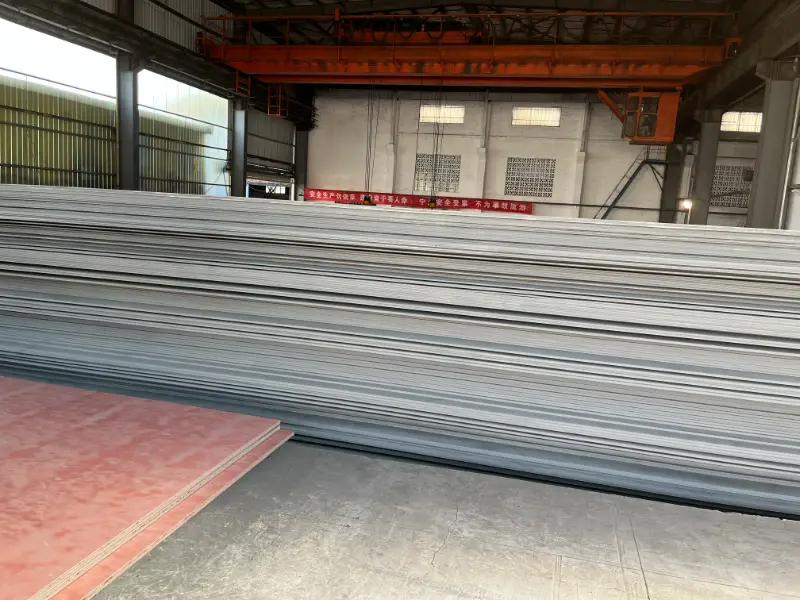
317LM (UNS S31725) Austenitic Stainless Steel Plate & Coil
317LM (UNS S31725) Austenitic Stainless Steel Plate & Coil Datasheet | Mo-Enhanced Alloy
Detailed material properties for 317LM (UNS S31725) stainless steel plate and coil: chemical composition, mechanical and physical performance, equivalent grades, and application guidance.
Hot rolling, cold rolling, solution annealing, pickling, descaled
- Phone : +8618037372205
- Email : [email protected]
- WhatsApp: Contact via Whtsapp
- WeChat: +8618037372205
317LM Austenitic Stainless Steel Plate & Coil Introduction
317LM (UNS S31725) is an austenitic low‑carbon stainless steel with increased molybdenum (4.0‑5.0%) and controlled nitrogen, offering superior corrosion resistance over 317L in acidic and chloride‑bearing environments. It provides excellent resistance to pitting and crevice corrosion, good formability, weldability, and high toughness. Delivered in solution‑annealed condition, it is widely used in chemical processing, flue gas desulfurization, marine, and pharmaceutical equipment where reliability in harsh media is essential.
317LM Austenitic Stainless Steel Plate & Coil Chemical Composition
The chemical requirements for UNS S31725 ensure a low carbon content to prevent intergranular attack, high molybdenum for pitting resistance, and controlled nitrogen for strength. Iron is the balance. All values are maximum unless a range is indicated.
| Element | Standard Value | Remarks |
|---|---|---|
| Carbon (C) | ≤0.03 | |
| Manganese (Mn) | ≤2.00 | |
| Silicon (Si) | ≤0.75 | |
| Phosphorus (P) | ≤0.045 | |
| Sulfur (S) | ≤0.030 | |
| Chromium (Cr) | 18.0 - 20.0 | |
| Nickel (Ni) | 13.5 - 17.5 | |
| Molybdenum (Mo) | 4.0 - 5.0 | |
| Nitrogen (N) | ≤0.10 | |
| Iron (Fe) | Balance | Balance |
317LM Austenitic Stainless Steel Plate & Coil Physical Properties
Typical physical data for 317LM in the fully annealed condition. Thermal conductivity and expansion depend on temperature; the values below provide a practical design basis. Specific heat and electrical resistivity are room‑temperature figures.
| Property | Typical Value | Unit | Test Condition |
|---|---|---|---|
| Density (ρ) | 8.0 | g/cm³ | At 20°C |
| Elastic Modulus (E) | 200 | GPa | At 20°C |
| Shear Modulus (G) | 77 | GPa | Calculated |
| Poisson's Ratio (ν) | 0.30 | ‑ | At 20°C |
| Thermal Expansion (α, 20‑100°C) | 16.0 | µm/m/°C | Mean coefficient |
| Thermal Expansion (α, 20‑300°C) | 16.5 | µm/m/°C | Mean coefficient |
| Thermal Conductivity (λ) at 100°C | 15 | W/m·K | At 100°C |
| Specific Heat Capacity | 500 | J/kg·K | At 20°C |
| Electrical Resistivity (ρe) | 0.75 | µΩ·m | At 20°C |
317LM Austenitic Stainless Steel Plate & Coil Mechanical Properties
Minimum tensile properties and maximum hardness values for 317LM plates, sheets and coils as required by ASTM A240. Elongation is measured on a 50 mm gauge length for thicknesses ≥ 3 mm. Properties apply at room temperature.
| Property | Standard Requirement | Unit | Test Condition |
|---|---|---|---|
| Tensile Strength (Rm) | ≥515 | MPa | Room temperature, solution annealed |
| Yield Strength (ReH 0.2% offset) | ≥205 | MPa | Room temperature, solution annealed |
| Elongation (A) in 50 mm | ≥35 | % | Thickness ≥ 3 mm, room temperature |
| Hardness, Brinell (HBW) | ≤217 | HBW | Solution annealed |
| Hardness, Rockwell B (HRB) | ≤95 | HRB | Solution annealed |
317LM Austenitic Stainless Steel Plate & Coil Exact Equivalent Material Standards and Alternative Grades
| Country/Region | Standard | Grade Designation | Remarks |
|---|---|---|---|
| USA | ASTM A240/A240M | 317LM (UNS S31725) | Original specification |
| Europe | EN 10088‑2 | X2CrNiMoN17‑13‑5 (1.4439) | Contains nitrogen 0.12‑0.22%; used interchangeably for many 317LM applications when nitrogen content is acceptable |
317LM Austenitic Stainless Steel Plate & Coil Application Introduction
317LM targets aggressive acidic and chloride‑rich environments where standard 316L or 317L are insufficient. It is readily formed, welded and fabricated into a wide variety of equipment.
Product Applications: Reactors and pressure vessels, Heat exchangers and condensers, Storage tanks, Piping systems and manifolds, Flue gas desulfurization absorbers, Offshore platform topside equipment
Processed into products: Flanges, gaskets, and welded fittings, Valve bodies and pump casings, Expansion joints and bellows, Agitator blades and shafts, Shell‑and‑tube heat exchanger tubes, Welded pipe and tubing for corrosive fluids
Application industries: Chemical Processing, Petrochemical Refining, Marine & Shipbuilding, Pharmaceutical Manufacturing, Pollution Control (Flue Gas Desulfurization), Pulp & Paper, Food & Beverage Processing
317LM Austenitic Stainless Steel Plate & Coil Similar or Comparable Material Grades
| Country/Region | Standard | Grade Designation | Remarks |
|---|---|---|---|
| USA | ASTM A240 | 317LMN (UNS S31726) | Higher nitrogen (0.10‑0.20%) for improved strength and pitting resistance |
| Europe | EN 10088‑2 | 1.4439 (X2CrNiMoN17‑13‑5) | Identical to UNS S31726; enhanced yield strength |
| USA | ASTM A240 | 317L (S31703) | Mo 3.0‑4.0%; lower corrosion resistance, widely available |
| Europe | EN 10088‑2 | 1.4438 (X2CrNiMo18‑15‑4) | Equivalent to 317L; lower molybdenum than 317LM |
| USA | ASTM B625 | 904L (N08904) | High‑nickel, copper‑bearing superaustenitic; superior in sulfuric acid but more expensive |
Notes:
All data is in accordance with ASTM A240/A240M and typical producer datasheets. For critical applications, verify properties with the mill certificate. Welding: use matching filler metal (e.g., ER317LM) and low heat input to avoid sensitization; post‑weld solution annealing is recommended for optimum corrosion resistance. The alloy can be formed using normal stainless steel techniques. For thicknesses above 6 mm, bending may require a larger radius to avoid cracking. Consult the material's supplier for specific processing guidelines.
- Share



