
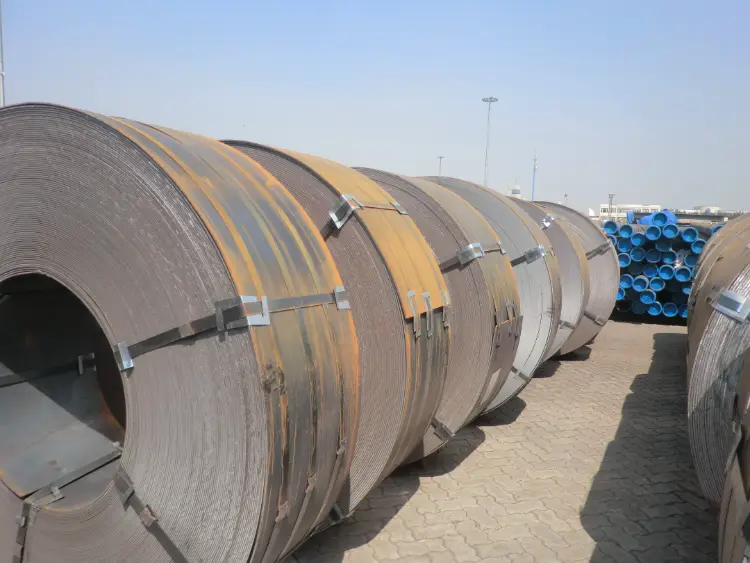
RINA E36 Shipbuilding Steel Coil
RINA E36 Shipbuilding Steel Coil - High Strength Marine Grade Steel for Hull Structures
Comprehensive material data for RINA E36 shipbuilding steel coil, including chemical composition, mechanical and thermal properties, international equivalents, and application guide for marine structures.
Hot rolling, cold rolling, normalizing, TMCP, cutting, forming, welding
- Phone : +8618037372205
- Email : [email protected]
- WhatsApp: Contact via Whtsapp
- WeChat: +8618037372205
RINA E36 Shipbuilding Steel Coil Introduction
RINA E36 is a high-strength shipbuilding structural steel grade certified by the Registro Italiano Navale (RINA), an Italian classification society. It belongs to the series of normalized or thermo-mechanically rolled fine-grain steels with a minimum yield strength of 355 MPa, designed for hull and marine structure applications. This grade offers a balanced combination of high tensile strength, excellent weldability, and good toughness at low temperatures, making it suitable for critical components exposed to dynamic loads and harsh marine environments. The steel is typically supplied as coils or plates in normalized or TMCP (Thermo-Mechanical Controlled Process) condition, ensuring consistent mechanical properties and dimensional accuracy. RINA E36 complies with the IACS (International Association of Classification Societies) unified requirements for ordinary and higher-strength hull structural steels, ensuring global cross-recognition with equivalent grades from other major classification societies and international standards.
RINA E36 Shipbuilding Steel Coil Chemical Composition
The chemical composition of RINA E36 steel is controlled to ensure strength, toughness, and weldability. The limits below are as per RINA Rules and IACS UR W11 for grade E36. Micro-alloying elements like Nb, V, Ti may be present singly or in combination. The carbon equivalent (Ceq) is typically restricted to ensure good weldability, often Ceq ≤ 0.38% for thickness ≤ 50 mm. For TMCP conditions, lower carbon and alloy content may be applied.
- Single values are maximum unless otherwise stated.
- Elements such as Al, Nb, V, Ti are added for grain refinement and microalloying.
| Element | Standard Value (max %) | Remarks |
|---|---|---|
| Carbon (C) | 0.18 | See remark: Ceq ≤ 0.38% |
| Manganese (Mn) | 0.90-1.60 | Range depends on thickness |
| Silicon (Si) | 0.10-0.50 | Range |
| Phosphorus (P) | 0.035 | Maximum |
| Sulfur (S) | 0.035 | Maximum |
| Chromium (Cr) | 0.20 | Optional, max |
| Nickel (Ni) | 0.40 | Optional, max |
| Molybdenum (Mo) | 0.08 | Optional, max |
| Copper (Cu) | 0.35 | Optional, max |
| Aluminum (Al) total | ≥ 0.020 | Fine grain practice required |
| Niobium (Nb) | 0.02-0.05 | Optional microalloy |
| Vanadium (V) | 0.05-0.10 | Optional microalloy |
| Titanium (Ti) | 0.007-0.05 | Optional microalloy |
| Nitrogen (N) | 0.009 (if Al present) | Or 0.012 if no Al |
RINA E36 Shipbuilding Steel Coil Physical and Electrical Properties
The physical properties below are typical reference values for low-carbon low-alloy structural steels comparable to S355 or E36 grades. Actual values may exhibit slight variations due to precise composition and heat treatment. Properties such as thermal expansion and conductivity are essential for design in welded structures and fire resistance calculations. Data based on EN 10025 references for similar S355 grades.
- Density may be taken as 7850 kg/m³ for most structural calculations.
- Thermal conductivity and electrical resistivity are sensitive to alloy content and temperature.
| Property | Standard Value | Unit | Test Condition / Remarks |
|---|---|---|---|
| Density (ρ) | 7850 | kg/m³ | Approximate at 20°C |
| Elastic Modulus (E) | 210 | GPa | At 20°C |
| Shear Modulus (G) | 81 | GPa | At 20°C |
| Poisson's Ratio (ν) | 0.3 | – | At 20°C, typical for steel |
| Thermal Expansion Coefficient (α) | 12.0 | ×10⁻⁶/K | 20-100°C |
| Thermal Expansion Coefficient (α) | 12.5 | ×10⁻⁶/K | 20-200°C |
| Thermal Expansion Coefficient (α) | 13.0 | ×10⁻⁶/K | 20-300°C |
| Thermal Conductivity (λ) | 50 | W/m·K | At 20°C |
| Thermal Conductivity (λ) | 46 | W/m·K | At 250°C |
| Thermal Conductivity (λ) | 42 | W/m·K | At 500°C |
| Specific Heat Capacity | 460 | J/kg·K | At 20-100°C, approximate |
| Electrical Resistivity (ρ_e) | 0.20-0.25 | μΩ·m | At 20°C, typical for ferritic steels |
RINA E36 Shipbuilding Steel Coil Mechanical Properties
The mechanical properties are specified according to RINA Rules for rolled products in normalized or TMCP condition. Transverse test pieces are generally required unless otherwise agreed. Impact test temperatures and absorbed energy values are mandatory for grade E (-40°C). The properties apply to thicknesses up to 50 mm unless specified otherwise. For thicker sections, properties may be slightly reduced upon agreement. Note: Values may vary with final thickness and processing route.
- Yield strength is specified as minimum upper yield strength (ReH) or 0.2% proof stress (Rp0.2).
- Tensile strength is specified as a range.
| Property | Standard Value | Unit | Test Condition / Thickness |
|---|---|---|---|
| Yield Strength (ReH) min | 355 | MPa | t ≤ 16 mm |
| Yield Strength (ReH) min | 355 | MPa | 16 < t ≤ 25 mm |
| Yield Strength (ReH) min | 355 | MPa | 25 < t ≤ 35 mm |
| Yield Strength (ReH) min | 355 | MPa | 35 < t ≤ 50 mm |
| Tensile Strength (Rm) | 490-630 | MPa | t ≤ 50 mm |
| Elongation (A5) min | 22 | % | Longitudinal, t ≤ 50 mm |
| Elongation (A5) min | 20 | % | Transverse, t ≤ 50 mm |
| Impact Energy (KV) min at -40°C | 34 (27) | J | Longitudinal (Transverse), average of 3 tests |
| Bend Test (d = bend diameter, a = specimen thickness) | d = 3a (180°) | – | t ≤ 50 mm, no cracking |
RINA E36 Shipbuilding Steel Coil Exact Equivalents: Identical Material Standards and Substitution Grades
| Country / Region | Standard | Grade / Designation | Remarks |
|---|---|---|---|
| International | IACS UR W11 | E36 | Unified requirement for higher strength hull structural steel |
| European Union | EN 10025-4 | S355ML / S355MLO | Thermomechanical rolled fine grain structural steel, closest match for TMCP condition. O grade for offshore. |
| USA | ASTM A131/A131M | EH36 | Standard specification for structural steel for ships, grade EH36 with impact at -40°C |
| American Bureau of Shipping | ABS Rules | EH36 | ABS classification for high-strength steel, -40°C impact |
| DNV GL (Now DNV) | DNV Rules | E36 | DNV high strength structural steel, yield 355 MPa, -40°C impact |
| Lloyd's Register | LR Rules | EH36 | LR classification for hull structures |
| Bureau Veritas | BV Rules | E36 | BV classification for marine steel |
| China Classification Society | CCS Rules | E36 | CCS classification, equivalent properties |
| Nippon Kaiji Kyokai | ClassNK Rules | E36 | Japanese classification, recognized as equivalent |
| Korean Register | KR Rules | E36 | Korean classification, interchangeable with RINA E36 |
RINA E36 Shipbuilding Steel Coil Application Introduction
RINA E36 steel coil is specifically designed for use in shipbuilding and marine engineering where high strength and excellent weldability are required. The grade's low-temperature impact toughness makes it ideal for hull structures operating in cold waters. Typical applications include primary hull members, decks, and structural reinforcements. The material can be processed by cutting, bending, welding, and forming into various components.
Product Applications: Bulk carriers, tankers, container ships, cruise vessels, Offshore service vessels (OSVs), anchor handling tugs, Navy vessels and patrol boats, Barges and pontoons, Oil platforms, jack-up rig legs, spud cans, Wind turbine monopiles and transition pieces, Crane booms, heavy lifting beams, ship crane pedestals
Processed into products: Hull plates, shell plating, bottom plating, Decks and deck girders, hatch coamings, Longitudinal stiffeners, stringers, frames, Web frames, floors, girders, Bulkheads and transverse rings, Rudders and rudder horns, Stern frames, engine seatings, Mooring and towing fittings, pad eyes, Flanges, brackets, and large welded fabrications
Application industries: Shipbuilding and ship repair, Offshore oil and gas (platforms, jackets, FPSOs), Marine equipment and container construction, Bridge and heavy civil engineering, Pressure vessel and tank fabrication (where applicable), Renewable energy (offshore wind turbine foundations, transition pieces), Dredging and port equipment
RINA E36 Shipbuilding Steel Coil Similar / Compatible Substitute Materials
| Country / Region | Standard | Grade / Designation | Remarks |
|---|---|---|---|
| European Union | EN 10025-3 | S355N/NL | Normalized fine grain steel, similar strength, NL grade for low-temperature toughness (-50°C). Not ship classification specific but often interchangeable for structural parts. |
| European Union | EN 10225 | S355G7, G8, G10 | Weldable structural steels for fixed offshore structures, similar mechanical properties and toughness. |
| USA | ASTM A572/A572M | Grade 50 [345] (Type 2) | High-strength low-alloy columbium-vanadium structural steel, similar yield strength, but impact testing is supplementary unless specified. |
| USA | API 2H | Grade 50 | Specification for steel plates for offshore platforms, similar weldability and strength. |
| Russia | GOST 5520 | E36 (или 10ХСНД) | Russian shipbuilding steel, 10HSND often used as analog for high-strength hull steel, similar composition. |
| International | ISO 630-3 | S355W | Weatherable structural steel with similar mechanical properties, could be considered for non-marine structural applications. |
Notes:
Orders for RINA E36 steel coil should specify:
- Dimensional tolerances according to relevant standard (e.g., EN 10029 for plates, EN 10051 for coils).
- Surface condition: As-rolled or descaled; special requirements for surface quality may be agreed upon.
- Inspection certificate type: Usually RINA 3.2 certificate with surveyor's stamp is mandatory for classification.
- Welding consumables and procedures must be qualified in accordance with RINA rules and approved by the society.
- Post-weld heat treatment (PWHT) is generally not required for thicknesses up to 50 mm, but thicker sections or complex joints may require PWHT to relieve residual stresses.
- Magnetic particle or ultrasonic testing may be specified for critical applications.
- Zinc-rich primers or other shop primers are often applied to prevent corrosion during storage and fabrication.
- For sour service or hydrogen-induced cracking resistance, special HIC-tested grades should be specified; E36 is not inherently HIC-resistant.
- Share



