
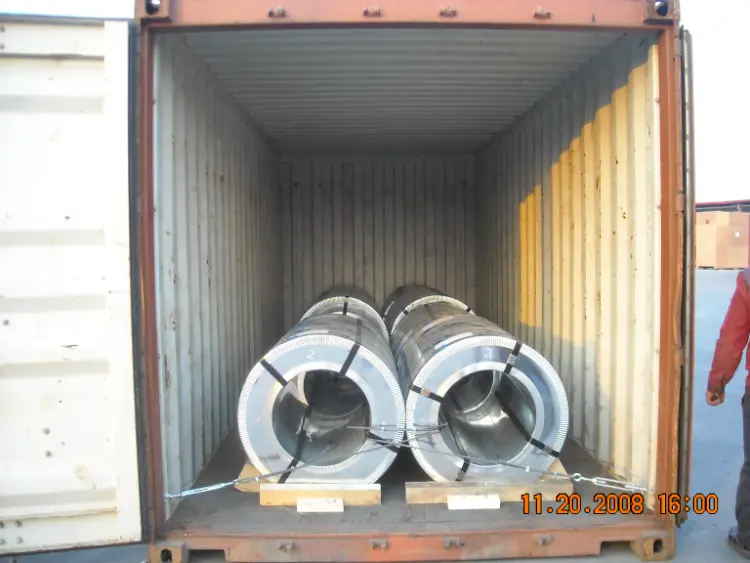
RINA D460 Shipbuilding Steel Coil
RINA D460 Shipbuilding Steel Coil - High Strength Marine Structural Steel
Detailed material data for RINA D460 shipbuilding steel coil, including chemical composition, mechanical properties, thermal and electrical physical properties, equivalent grades, and applications.
Hot rolling, normalising, thermo-mechanical controlled processing (TMCP), welding, bending, forming
- Phone : +8618037372205
- Email : [email protected]
- WhatsApp: Contact via Whtsapp
- WeChat: +8618037372205
RINA D460 Shipbuilding Steel Coil Introduction
RINA D460 is a high strength hull structural steel grade specified by the Registro Italiano Navale (RINA) rules for the classification of ships. It is designed for use in the construction of ships and offshore structures requiring a minimum yield strength of 460 MPa. The "D" designation indicates that the steel has been tested for impact toughness at -20°C. This grade belongs to the family of normalised or thermo-mechanically rolled fine-grain steels with excellent weldability and good resistance to brittle fracture. Typical delivery condition is normalised or TMCP, and it is supplied as plates, coils, sections, and bars.
- Minimum yield strength: 460 MPa
- Good notch toughness at -20°C
- Suitable for welded structures
- Compliant with IACS UR W11
RINA D460 Shipbuilding Steel Coil Chemical Composition
Typical ladle analysis according to RINA Rules for D460 grade. The steel is fully killed and fine grain treated. Microalloying elements such as niobium, vanadium, or titanium may be added singly or in combination. Carbon equivalent (CEV) is controlled to ensure good weldability.
- CEV = C + Mn/6 + (Cr+Mo+V)/5 + (Ni+Cu)/15 typically max 0.45-0.50% depending on thickness.
| Element | Standard Value (max %) | Remarks |
|---|---|---|
| Carbon (C) | 0.20 | Increased control for thicker plates |
| Silicon (Si) | 0.10 - 0.50 | Killed steel practice |
| Manganese (Mn) | 0.90 - 1.60 | High Mn for strength and toughness |
| Phosphorus (P) | 0.025 | Maximises cleanliness |
| Sulfur (S) | 0.025 | Maximises cleanliness |
| Niobium (Nb) | 0.02 - 0.05 | Grain refinement; optional |
| Vanadium (V) | 0.05 - 0.10 | Grain refinement; optional |
| Titanium (Ti) | 0.02 max | Deoxidation and grain control |
| Aluminium (Al) total | 0.015 min | For fine grain practice |
| Chromium (Cr) | 0.25 | Residual element |
| Nickel (Ni) | 0.40 | Residual element |
| Molybdenum (Mo) | 0.08 | Residual element |
| Copper (Cu) | 0.30 | Residual element |
| Nitrogen (N) | 0.012 | Maximised for microalloying |
RINA D460 Shipbuilding Steel Coil Thermal and Electrical Physical Properties
Physical properties are representative for high strength low alloy steel in the normalised or TMCP condition. Actual values may vary slightly with chemical composition and heat treatment.
- Density and elastic moduli are virtually independent of processing.
- Thermal properties are given at room temperature unless otherwise noted.
| Property | Standard Value | Unit | Test Condition / Remarks |
|---|---|---|---|
| Density (ρ) | 7,850 | kg/m³ | At 20°C |
| Elastic Modulus (E) | 205 | GPa | At 20°C |
| Shear Modulus (G) | 80 | GPa | At 20°C |
| Poisson's Ratio (ν) | 0.3 | - | At 20°C |
| Thermal Expansion Coefficient (α) | 11.5 - 12.5 | 10⁻⁶/K | 20°C to 100°C |
| Thermal Expansion Coefficient (α) | 12.5 - 13.5 | 10⁻⁶/K | 20°C to 200°C |
| Thermal Conductivity (λ) | 48 - 52 | W/(m·K) | At 20°C |
| Specific Heat Capacity (c) | 460 - 500 | J/(kg·K) | At 20°C |
| Electrical Resistivity (ρ_e) | 0.20 - 0.25 | μΩ·m | At 20°C |
RINA D460 Shipbuilding Steel Coil Mechanical Properties
Mechanical properties according to RINA Rules for D460, thickness range typically up to 150 mm. Values are for normalised or TMCP condition. Impact test temperature: -20°C.
- Elongation requirement applies to gauge length 5.65√So.
- Bend test mandrel diameter depends on thickness and specification: typically 3t for transverse test.
| Property | Standard Requirement | Unit | Test Condition / Remarks |
|---|---|---|---|
| Yield Strength (ReH) | ≥ 460 | MPa | Ambient, thickness ≤ 50 mm |
| Yield Strength (ReH) | ≥ 440 | MPa | Ambient, 50 < t ≤ 100 mm |
| Yield Strength (ReH) | ≥ 400 | MPa | Ambient, 100 < t ≤ 150 mm |
| Tensile Strength (Rm) | 570 - 720 | MPa | Ambient, all thicknesses |
| Elongation (A) | ≥ 17 | % | 5.65√So, longitudinal, t ≤ 50 mm |
| Elongation (A) | ≥ 16 | % | 5.65√So, longitudinal, 50 < t ≤ 100 mm |
| Elongation (A) | ≥ 15 | % | 5.65√So, longitudinal, 100 < t ≤ 150 mm |
| Impact Energy (KV) | ≥ 50 (avg) / 34 (single) | J | Charpy V-notch, -20°C, longitudinal |
| Impact Energy (KV) | ≥ 34 (avg) / 24 (single) | J | Charpy V-notch, -20°C, transverse |
| Bend Test (mandrel diameter) | No cracks | - | 180° bend, d = 3a (a = thickness), transverse |
RINA D460 Shipbuilding Steel Coil Fully Equivalent Material Standards and Replaceable Grades
| Country/Region | Standard | Grade | Remarks |
|---|---|---|---|
| Italy / International | RINA Rules | D460 | Base specification |
| Norway / Germany | DNV GL Rules | D460 | DNV D460, identical technical delivery conditions |
| United Kingdom | Lloyd's Register Rules | D460 | LR D460, IACS UR W11 compliant |
| USA | ABS Rules | D460 | ABS D460, equivalent for marine use |
| France | Bureau Veritas Rules | D460 | BV D460, same strength and toughness |
| China | CCS Rules | D460 | CCS D460, recognised for newbuilding |
| Japan | ClassNK Rules | NK D460 | Nippon Kaiji Kyokai equivalent |
| South Korea | Korean Register Rules | KR D460 | KR D460, used in shipyards |
RINA D460 Shipbuilding Steel Coil Application Introduction
RINA D460 steel coils and plates are extensively used in the shipbuilding and offshore industry where high strength, good weldability, and low-temperature toughness are essential. Typical applications include:
Product Applications: Merchant ships (bulk carriers, tankers, container vessels), Offshore platforms and jack-up rigs, Floating production storage and offloading (FPSO) units, Ship deck and hull sections, Offshore wind turbine foundations (monopiles, transition pieces), Pressure vessels for marine service
Processed into products: Hull plates, shell plating, and stiffeners, Deck stringers and bottom longitudinals, Bulkheads and watertight doors, Crane pedestals and heavy-lift structures, Padeyes and mooring components, Welded tubular joints and nodes, Skid beams and helideck supports, Pile sleeves and grouted connections
Application industries: Shipbuilding, Offshore Oil & Gas, Renewable Energy (Offshore Wind), Port and Harbour Infrastructure, Naval and Defence, Heavy Machinery
RINA D460 Shipbuilding Steel Coil Similar / Alternative Material Recommendations
| Country/Region | Standard | Grade | Remarks |
|---|---|---|---|
| European | EN 10025-6 | S460Q | Similar strength but for general structural use; not rated for -20°C impact unless specified; may need qualification for marine. |
| European | EN 10025-6 | S460QL | Enhanced low-temperature toughness; -40°C option, higher than D460 requirements. |
| European | EN 10025-4 | S460ML | Thermomechanically rolled; -50°C toughness; often used offshore. |
| USA | ASTM A572 / A572M | Grade 65 | Yield 450 MPa, lower strength; not specifically for marine, but usable with extra testing. |
| USA | ASTM A709 / A709M | Grade HPS 70W | 485 MPa yield, weathering; for bridges; may require evaluation for marine environment. |
| International | API 2W / 2Y | Grade 60 | Offshore structural steels with 414-550 MPa yield; close performance under certain conditions. |
Notes:
Additional requirements: RINA D460 must be produced from fully killed steel with fine grain practice. The manufacturer must supply documentation including mill test certificates (EN 10204 3.1 or 3.2) verifying chemical analysis, mechanical properties, and impact test results.
- Ultrasonic testing may be required as per class rules or purchaser specification (e.g., EN 10160 class S1E1).
- Weldability tests (e.g., carbon equivalent, CET) often limited to CEV ≤ 0.43% for thicknesses ≤ 50 mm to avoid cold cracking.
- For thicknesses above 30 mm, post-weld heat treatment (PWHT) may not be required if TMCP condition is used.
- Surface condition and dimensional tolerances shall comply with EN 10029 or equivalent.
- Share



