
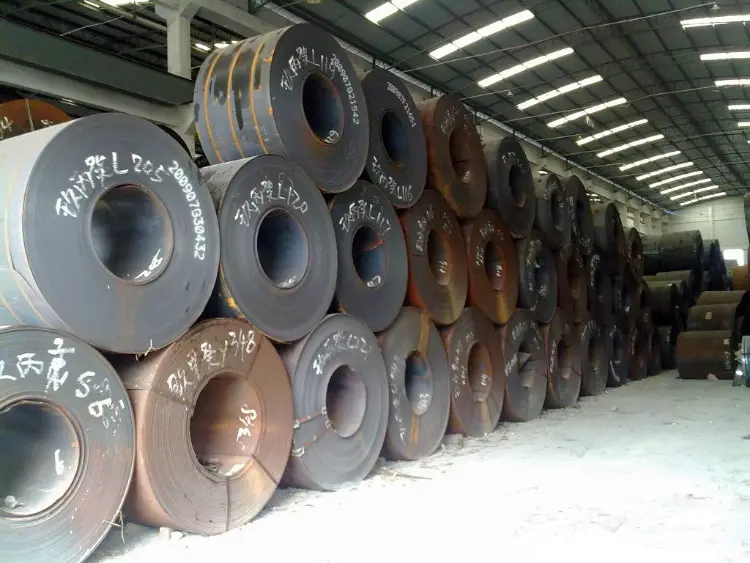
RINA D420 Shipbuilding Steel Coil
RINA D420 Shipbuilding Steel Coil: Data, Equivalents & Applications
Complete material data sheet for RINA D420 shipbuilding steel coil: chemical composition, mechanical and thermal properties, international equivalents (EN 10025-4 S420ML, ABS DH420), similar grades and application guide.
Hot rolling, normalizing, thermomechanical rolling (TMCP), cutting, cold forming, welding, shot blasting
- Phone : +8618037372205
- Email : [email protected]
- WhatsApp: Contact via Whtsapp
- WeChat: +8618037372205
RINA D420 Shipbuilding Steel Coil Introduction
RINA D420 is a high-strength hull structural steel grade certified by the Registro Italiano Navale (RINA) for shipbuilding and offshore applications. It combines a minimum yield strength of 420 MPa with good toughness at -20 °C (D-grade impact requirement). The steel is delivered mainly as hot-rolled coil, plate, or strip in either normalized (N) or thermomechanically rolled (M) condition. Its balanced chemical composition, with controlled additions of niobium, vanadium, and titanium, ensures excellent weldability, formability, and resistance to brittle fracture.
- Typical uses include primary hull structures, deck plating, stiffeners, and compartments exposed to moderate/low temperatures.
- Carbon equivalent is limited to guarantee field weldability without excessive preheat.
- The grade is internationally recognized and directly cross-referenced to other classification society grades like ABS DH420, DNV D420, and EN 10025-4 S420ML.
RINA D420 Shipbuilding Steel Coil Chemical Composition
The ladle analysis limits according to RINA Rules Part D, Chapter 2 for high-strength ship steels grade D420 (as-rolled/normalized/thermomechanical). Al is required as grain refiner. Microalloying elements (Nb, V, Ti) may be added singly or in combination. CEV must not exceed the specified maximum for the relevant thickness range.
| Element | Standard Value (wt%) | Remarks |
|---|---|---|
| Carbon (C) | ≤ 0.20 | Base hardenability element |
| Manganese (Mn) | 0.90 – 1.70 | Strength and toughness balance |
| Silicon (Si) | ≤ 0.50 | Deoxidation |
| Phosphorus (P) | ≤ 0.035 | Maximum allowed for flat products |
| Sulfur (S) | ≤ 0.035 | Maximum allowed for flat products |
| Aluminum (Al, acid soluble) | ≥ 0.015 | Grain refinement |
| Niobium (Nb) | ≤ 0.05 | Microalloying – grain refining & precipitation strengthening |
| Vanadium (V) | ≤ 0.10 | Microalloying – precipitation strengthening |
| Titanium (Ti) | ≤ 0.02 | Microalloying – grain refinement and nitride formation |
| Nitrogen (N) | ≤ 0.012 | Maximum allowed to avoid strain ageing |
| Copper (Cu) | ≤ 0.35 | Residual element |
| Chromium (Cr) | ≤ 0.20 | Residual element |
| Nickel (Ni) | ≤ 0.40 | Residual element |
| Molybdenum (Mo) | ≤ 0.08 | Residual element |
| Carbon Equivalent (CEV) | ≤ 0.43 (t ≤ 50 mm) | CEV = C + Mn/6 + (Cr+Mo+V)/5 + (Ni+Cu)/15 |
RINA D420 Shipbuilding Steel Coil Thermal & Electrical Properties
The following data represent typical physical properties for microalloyed shipbuilding structural steel at room temperature, unless otherwise stated. These values are not part of the mandatory RINA specification but are based on published authoritative sources for similar HSLA steels.
| Property | Typical Value | Unit | Test Conditions |
|---|---|---|---|
| Density (ρ) | 7.85 | g/cm³ | Room temperature (20 °C) |
| Modulus of elasticity (E) | 205 | GPa | Room temperature |
| Shear modulus (G) | ≈ 80 | GPa | Room temperature, estimated from E and ν |
| Poisson's ratio (ν) | 0.30 | — | Elastic range |
| Thermal expansion coefficient (α) | 12.5 × 10⁻⁶ | K⁻¹ | 20–100 °C |
| Thermal conductivity (λ) | ≈ 52 | W/(m·K) | Room temperature |
| Specific heat capacity (cp) | ≈ 460 | J/(kg·K) | Room temperature |
| Electrical resistivity (ρe) | ≈ 0.13 × 10⁻⁶ | Ω·m | Room temperature |
RINA D420 Shipbuilding Steel Coil Mechanical Properties
The tensile and impact properties are extracted from the RINA Rules for high-strength hull steels, grade D420, for product thicknesses up to 50 mm. The impact test temperature corresponds to the D-quality level (-20 °C). Bend test is performed at 180° with the prescribed former diameter. All test pieces are taken from parent plate/coil and tested in accordance with ISO or EN standards.
| Property | Specified Value | Unit | Test Conditions |
|---|---|---|---|
| Yield Strength (ReH) | ≥ 420 | MPa | Thickness ≤ 50 mm, longitudinal direction |
| Tensile Strength (Rm) | 530 – 680 | MPa | Thickness ≤ 50 mm, longitudinal direction |
| Elongation after fracture (A5) | ≥ 19 | % | Gauge length L0 = 5.65√S0, longitudinal |
| Bend Test (180°) | No cracks after bending | — | Former diameter = 2a (a = specimen thickness) |
| Charpy V-notch impact energy (KV2) | ≥ 27 | J | -20 °C, longitudinal, 10×10 mm full-size specimen |
RINA D420 Shipbuilding Steel Coil Fully Equivalent International Grades
| Country / Region | Standard | Grade | Remarks |
|---|---|---|---|
| Italy | RINA Rules Part D | D420 | Original certification; also available as DH420 |
| European Union | EN 10025-4 | S420ML | TMCP delivery; matches mechanical requirements for thickness ≤50 mm |
| USA / International | ABS Rules | DH420 | American Bureau of Shipping equivalent, Charpy at -20 °C |
| France | BV Rules | DH420 | Bureau Veritas equivalent for hull structural steel |
| Norway / Germany | DNV Rules | DV D420 | DNV high-strength hull steel, D-level toughness |
| United Kingdom | LR Rules | DH420 | Lloyd's Register equivalent |
| Japan | NK Rules | K420 | ClassNK high-strength ship steel, D-grade |
| China | CCS Rules | DH420 | China Classification Society equivalent |
RINA D420 Shipbuilding Steel Coil Application Introduction
RINA D420 is extensively used in shipbuilding and offshore construction where high strength-to-weight ratio and guaranteed low-temperature toughness are essential.
- It can be processed by all common workshop practices: flame/plasma/laser cutting, cold forming, welding (SMAW, SAW, GMAW/FCAW), and shot blasting for surface preparation.
- Typical welded fabrications follow IACS recommendations for preheat and interpass temperature.
Product Applications: Hull plates and coils, Deck and bottom plates, Longitudinals and stiffeners, Transverse webs and frames, Bulkhead panels, Foundation plates for deck machinery
Processed into products: Longitudinal and transverse frames, Bulkheads and watertight compartments, Deck plating and stringer plates, Hull side shells and bottom shells, Brackets and connecting pieces, Ice belt plating (for polar vessels)
Application industries: Shipbuilding (commercial & naval), Offshore oil & gas platforms, Marine renewable energy structures (wind turbine foundations), Polar vessels and icebreakers, Heavy marine equipment
RINA D420 Shipbuilding Steel Coil Similar / Alternative Materials with Comparable Properties
| Country / Region | Standard | Grade | Remarks |
|---|---|---|---|
| European Union | EN 10025-4 | S420M | Thermomechanical rolled; equivalent strength but impact toughness may be specified for different temperature |
| European Union | EN 10025-4 | S420N | Normalized; suitable where TMCP is not accepted |
| European Union | EN 10025-4 | S420NL | Normalized low-temperature toughness; impact at -50 °C |
| USA | ASTM A572/A572M | Grade 50 [345 MPa] | Lower yield strength (345 MPa) but widely available; may replace D420 only after redesign |
| USA | ASTM A709/A709M | Grade 50W | Weathering steel, 345 MPa; not direct replacement unless corrosion resistance required |
Notes:
All values are taken from the latest edition of RINA Rules for the Classification of Ships, Part D (Materials and Welding).
The carbon equivalent (CEV) limit is critical for weldability and must be verified for each heat.
For thicknesses exceeding 50 mm, special agreement may be required; mechanical properties and CEV limits can be adjusted accordingly.
- Share



