
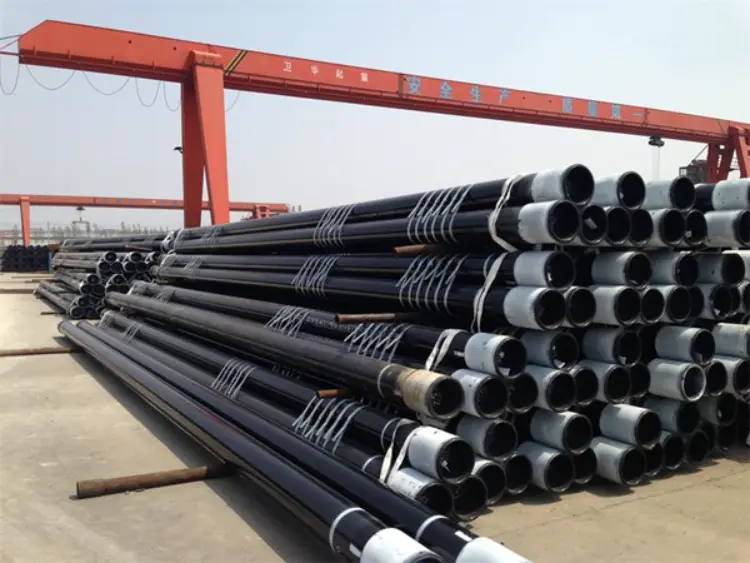
DIN 17400 1.4845 Stainless Steel Pipe
DIN 17400 1.4845 Stainless Steel Pipe - High-Temp Austenitic Alloy for Furnace & Heat Exchanger Applications
Explore DIN 17400 1.4845 stainless steel pipe: a fully austenitic, heat-resistant grade (X8CrNi25-21) with excellent oxidation resistance up to 1100°C, good creep strength, and weldability. Ideal for furnace components, heat exchangers, and thermal processing equipment.
Hot forming, cold forming, machining, welding (TIG, MIG, SAW, etc.), solution annealing
- Phone : +8618037372205
- Email : [email protected]
- WhatsApp: Contact via Whtsapp
- WeChat: +8618037372205
DIN 17400 1.4845 Stainless Steel Pipe Introduction
DIN 17400 1.4845 is a heat-resistant austenitic stainless steel (designation X8CrNi25-21) widely used for elevated-temperature applications up to 1100°C in oxidizing or carburizing atmospheres. Its high chromium (24–26%) and nickel (19–22%) content provides outstanding resistance to scaling and sulfidation, while maintaining good structural stability. The steel offers moderate strength at high temperatures, excellent weldability, and may be supplied in solution-annealed condition. Typical applications include furnace parts, radiant tubes, muffle, and pipework for heat-treatment equipment. Under the modern EN 10088 system, it is designated 1.4845 and corresponds to AISI 310S / UNS S31008. The alloy is non-magnetic in the annealed state and can be formed and machined by conventional methods, though high work-hardening rates require adequate tooling.
DIN 17400 1.4845 Stainless Steel Pipe Chemical Composition
Mass fraction as per DIN 17400 / EN 10088-1 for grade 1.4845 (X8CrNi25-21). The composition is balanced to ensure full austenitic microstructure and excellent oxidation resistance. Trace elements are controlled to meet product specifications.
| Element | Nominal Value (wt.%) | Notes |
|---|---|---|
| Carbon (C) | ≤ 0.10 | Lower carbon improves intergranular corrosion resistance after welding |
| Silicon (Si) | ≤ 1.50 | Enhances scaling resistance at high temperatures |
| Manganese (Mn) | ≤ 2.00 | Austenite stabilizer, aids deoxidation |
| Phosphorus (P) | ≤ 0.045 | Residual element, kept low for toughness |
| Sulfur (S) | ≤ 0.015 | Low sulfur for improved hot workability |
| Chromium (Cr) | 24.0 – 26.0 | Primary element for oxidation and corrosion resistance |
| Nickel (Ni) | 19.0 – 22.0 | Stabilizes austenite, enhances high-temperature strength |
| Nitrogen (N) | ≤ 0.11 | Increases strength slightly; controlled to maintain ductility |
| Iron (Fe) | Balance | Base element |
DIN 17400 1.4845 Stainless Steel Pipe Thermal and Electrical Properties
Physical data for 1.4845 (X8CrNi25-21) compiled from standard references and typical product specifications. Properties vary slightly with composition and processing; values are representative for engineering calculations.
| Property | Value | Unit | Test Condition / Remarks |
|---|---|---|---|
| Density (ρ) | 7.9 | g/cm³ | Room temperature |
| Modulus of Elasticity (E) | 200 | GPa | Room temperature |
| Shear Modulus (G) | 77 | GPa | Calculated from E and Poisson's ratio |
| Poisson's Ratio (ν) | 0.30 | – | In elastic range |
| Coefficient of Thermal Expansion (α) | 16.0 | 10⁻⁶/K | 20–100°C |
| Coefficient of Thermal Expansion (α) | 17.0 | 10⁻⁶/K | 20–200°C |
| Coefficient of Thermal Expansion (α) | 18.0 | 10⁻⁶/K | 20–400°C |
| Coefficient of Thermal Expansion (α) | 19.0 | 10⁻⁶/K | 20–600°C |
| Coefficient of Thermal Expansion (α) | 20.0 | 10⁻⁶/K | 20–800°C |
| Thermal Conductivity (λ) | 15 | W/(m·K) | At 20°C |
| Thermal Conductivity (λ) | 18 | W/(m·K) | At 500°C |
| Specific Heat Capacity (cp) | 500 | J/(kg·K) | At 20°C |
| Electrical Resistivity (ρe) | 0.85 | μΩ·m | At 20°C |
| Melting Range | 1400 – 1450 | °C | Approximate |
DIN 17400 1.4845 Stainless Steel Pipe Mechanical Properties
Mechanical properties for solution-annealed 1.4845 pipe and other product forms according to DIN 17400 / EN 10088-2, EN 10088-3, and EN 10216-5. Values depend on section thickness and product type. The alloy exhibits good ductility and moderate strength, typical of austenitic stainless steels.
| Property | Value | Unit | Test Condition / Remarks |
|---|---|---|---|
| 0.2% Yield Strength (Rp0.2) | ≥ 210 | MPa | Solution annealed, thickness ≤ 75 mm |
| Tensile Strength (Rm) | 500 – 700 | MPa | Solution annealed |
| Elongation (A) | ≥ 35 | % | A5 for thickness > 3 mm; A80 ≥ 35% for thin sheet/strip |
| Bend test | No cracks | – | 180° bend over mandrel with diameter = 3× thickness (standard) for tubes |
| Impact energy (KV) room temp. | ≥ 60 (long.) | J | For sections ≥ 10 mm; not mandatory for all product forms |
| Hardness (HB) | ≤ 192 | HB | Typical maximum for annealed condition |
DIN 17400 1.4845 Stainless Steel Pipe Fully Equivalent Material Standards and Alternative Designations
| Country / Region | Standard | Grade / Designation | Remarks |
|---|---|---|---|
| European Union | EN 10088-1/2/3, EN 10216-5 (seamless tubes), EN 10217-7 (welded tubes) | 1.4845 / X8CrNi25-21 | Direct successor to DIN 17400 grade 1.4845 |
| USA | ASTM A240 / A312 / A213 | UNS S31008 (310S) | Identical composition; 310S is the low-carbon variant of 310 |
| International | ISO 4955:2005 | X8CrNi25-21 | Heat-resisting steels – same designation |
| China | GB/T 20878, GB/T 1221, GB/T 14976 | 06Cr25Ni20 (S31008) | C ≤ 0.08; closely matches 1.4845 |
| Japan | JIS G4304 / G4305 / G3459 | SUS 310S | Same composition range; used for high-temperature service |
DIN 17400 1.4845 Stainless Steel Pipe Application Introduction
Thanks to its excellent oxidation resistance up to 1100°C, good creep strength, and ease of fabrication, 1.4845 (X8CrNi25-21) finds use across many high-temperature industrial sectors. The following industries, products, and specific components are typical:
Product Applications: Seamless and welded pipes/tubes for furnace atmospheres, Radiant tubes and muffles, Heat exchanger tubing, Recuperators and air preheaters, Furnace burner nozzles and thermocouple protection tubes, Kiln furniture and grids, Automotive exhaust flex pipes and EGR coolers
Processed into products: Furnace rollers and conveyor belts, Annealing and hardening boxes, Distillation columns and reactor internals, Expansion joints and bellows, Forged flanges and fittings, Thermocouple sheaths, Pyrometer tubes
Application industries: Heat treatment and furnace manufacturing, Petrochemical and refining, Power generation (gas turbines, boilers), Cement and lime production, Glass manufacturing, Automotive (exhaust systems, turbochargers), Food processing (oven conveyors)
DIN 17400 1.4845 Stainless Steel Pipe Similar / Closely Related Alternative Materials
| Country / Region | Standard | Grade / Designation | Remarks |
|---|---|---|---|
| EU | EN 10088-1 | 1.4841 / X15CrNiSi25-21 | Higher carbon (≤0.15) and silicon (1.5-2.5) for improved scaling resistance; slightly reduced ductility |
| USA | ASTM A240 / A312 | UNS S31009 (310H) | Carbon 0.04–0.10, higher creep strength for structural applications above 600°C |
| EU | EN 10095 | 1.4864 / X10CrNiSi25-21 | Contains Si 1.5–2.5; better scaling resistance but lower creep ductility |
| China | GB/T 1221 | 16Cr25Ni20Si2 (1Cr25Ni20Si2) | Si content 1.5–2.5, used for furnace parts needing extra oxidation resistance |
| EU | EN 10088-1 | 1.4833 / X12CrNi23-13 | Lower Cr (22-24%) and Ni (12-14%), scaled down temperature capability to ~1000°C |
Notes:
Welding: 1.4845 exhibits good weldability by all common processes. Filler metal ER 310 (AWS A5.9) or matching EN composition is recommended. No post-weld heat treatment is normally required, but solution annealing can restore maximum intergranular corrosion resistance if needed.
Machining: Due to work hardening, use rigid setups, sharp tools, and heavy feeds. High-speed steel or carbide tools with suitable coolants are advised.
Pickling/Passivation: Standard nitric-hydrofluoric acid mixtures are effective for removing heat tint and scaling. Passivation in nitric acid enhances corrosion resistance.
Supply Forms: Tubes/pipes are available in outer diameters from 6 mm to 610 mm and wall thicknesses from 0.5 mm to 30 mm, as per common standards.
- Share



