
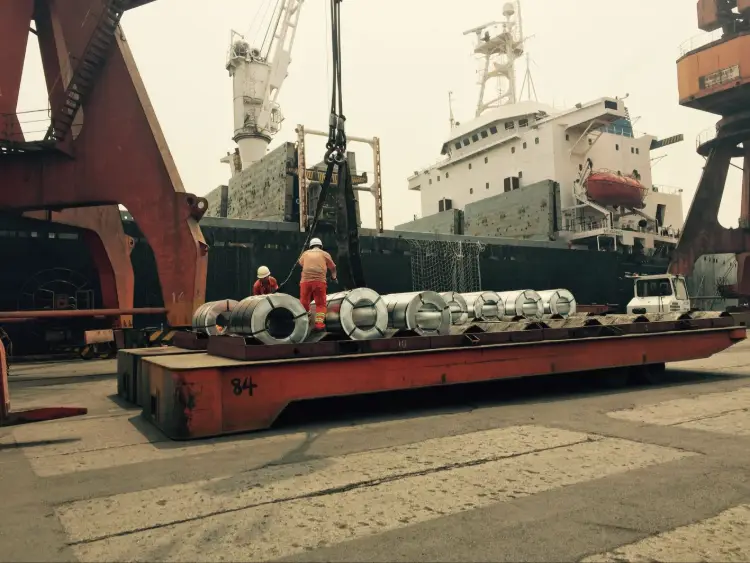
RINA A420 Shipbuilding Steel Coil
RINA A420 Shipbuilding Steel Coil: High-Strength Marine Structural Steel for Extreme Environments
Comprehensive data on RINA A420 shipbuilding steel coil, including chemical composition, mechanical and thermal properties, international equivalents, and application guidance. A high-strength structural steel with minimum yield strength of 420 MPa, certified by Registro Italiano Navale.
Hot rolling, TMCP, Normalizing, Cold forming (mild), Welding (all common methods), Cutting, Bending
- Phone : +8618037372205
- Email : [email protected]
- WhatsApp: Contact via Whtsapp
- WeChat: +8618037372205
RINA A420 Shipbuilding Steel Coil Introduction
RINA A420 is a high-strength, low-alloy structural steel primarily used in shipbuilding and offshore constructions. It is certified by Registro Italiano Navale (RINA) in accordance with the IACS Unified Requirement W11 for normal and higher strength hull structural steels. The grade A420 corresponds to the AH420 designation, offering a minimum yield strength of 420 MPa and excellent weldability with controlled carbon equivalent.
- Typical delivery condition: TMCP (thermo-mechanical controlled process) or normalized
- Superior toughness at 0°C with minimum Charpy V-notch impact energy of 42 J
- Excellent resistance to brittle fracture in marine environments
- Used for critical structural components like hull plates, decks, and stiffeners
- Available as coils, plates, and sections for efficient shipyard processing
RINA A420 Shipbuilding Steel Coil Chemical Composition
Requirements based on RINA Rules and IACS UR W11 for AH420 grade steel. For thicknesses up to 50 mm unless otherwise noted. Carbon equivalent (Ceq) is typically controlled to ensure weldability and is often ≤0.40% for thicknesses ≤ 50 mm. Micro-alloying elements such as Nb, V, and Ti may be added to refine grain size and improve strength.
- Acid-soluble aluminum (Alsol) content is required when aluminum is used as a grain-refining element.
- Residual elements (Cu, Cr, Ni, Mo) have maximum limits to avoid adverse effects on toughness.
| Element | Standard Value (max, unless range) | Remarks |
|---|---|---|
| C (Carbon) | ≤ 0.21% | For thickness ≤ 50 mm |
| Si (Silicon) | ≤ 0.50% | Deoxidation and strength |
| Mn (Manganese) | 0.80 - 1.70% | For strength and toughness |
| P (Phosphorus) | ≤ 0.035% | Maximum for all grades |
| S (Sulfur) | ≤ 0.035% | Maximum for all grades |
| Al (Aluminum, acid soluble) | ≥ 0.015% (if added) | Grain refinement |
| Nb (Niobium) | 0.02 - 0.05% | Micro-alloying for strengthening |
| V (Vanadium) | 0.05 - 0.10% | Micro-alloying for strengthening |
| Ti (Titanium) | ≤ 0.02% | Grain refinement and deoxidation |
| Cu (Copper) | ≤ 0.35% | Residual element |
| Cr (Chromium) | ≤ 0.20% | Residual element |
| Ni (Nickel) | ≤ 0.40% | Residual element |
| Mo (Molybdenum) | ≤ 0.08% | Residual element |
| N (Nitrogen) | ≤ 0.012% (if sampled) | Not always specified |
| Ceq (Carbon Equivalent) | Typically ≤ 0.40% | Based on IIW formula: Ceq = C + Mn/6 + (Cr+Mo+V)/5 + (Ni+Cu)/15 |
RINA A420 Shipbuilding Steel Coil Thermal and Electrical Physical Properties
Typical properties for a low-alloy high-strength steel similar to AH420 grade at room temperature (20°C) unless otherwise specified. Actual values may vary slightly based on exact chemical composition and heat treatment. These are provided for general engineering calculations and are not part of the mandatory specification.
- Density is typical for carbon-manganese steels.
- Thermal expansion coefficient given in the range 20-100°C.
- Electrical resistivity depends on alloying content and temperature.
| Property | Typical Value | Unit | Conditions / Remarks |
|---|---|---|---|
| Density (ρ) | 7.85 | g/cm³ | At 20°C |
| Elastic Modulus (E) | 205 | GPa | Tensile modulus, room temperature |
| Shear Modulus (G) | 80 | GPa | Calculated from E and Poisson's ratio |
| Poisson's Ratio (ν) | 0.3 | - | In the elastic range |
| Thermal Expansion Coefficient (α) | 12.0 | ×10⁻⁶/K | 20-100°C range |
| Thermal Conductivity (λ) | 45 | W/(m·K) | At 20°C, typical for low-alloy steel |
| Specific Heat Capacity (c) | 460 | J/(kg·K) | At 20°C |
| Electrical Resistivity (ρₑ) | 0.22 | μΩ·m | At 20°C |
RINA A420 Shipbuilding Steel Coil Mechanical Properties
Mechanical properties as per RINA Rules for AH420 grade, tested in the transverse direction (longitudinal for impact). Values apply for thicknesses ≤ 50 mm. Tensile test specimen: flat or round per ISO 6892-1. Impact test: Charpy V-notch on longitudinal specimens.
- For thicknesses > 50 mm, values may differ and require agreement.
- Impact test temperature: 0°C for A420 (AH420).
- Bend test: 180° mandrel diameter 3t for t ≤ 25 mm; 4t for 25 < t ≤ 50 mm, without cracking.
| Property | Minimum / Range | Unit | Test Conditions |
|---|---|---|---|
| Yield Strength (ReH) | 420 | MPa | t ≤ 50 mm, transverse |
| Tensile Strength (Rm) | 530 - 680 | MPa | t ≤ 50 mm, transverse |
| Elongation (A) | 18 | % | Gauge length 5.65√So, transverse, t ≤ 50 mm |
| Bend Test | 3t (t≤25mm); 4t (25| - | 180° mandrel, no cracks, ambient temperature | |
| Impact Energy (KV, longitudinal) | 42 (average of 3) | J | 0°C, Charpy V-notch, longitudinal |
RINA A420 Shipbuilding Steel Coil Completely Equivalent Material Standards and Replaceable Grades
| Country / Region | Standard | Grade | Remarks |
|---|---|---|---|
| International | IACS UR W11 | AH420 | Base requirement for all IACS members |
| USA | ABS Rules | AH420 | Identical to IACS AH420 |
| Norway/Germany | DNV Rules | AH420 | Also known as NV A420 |
| UK | LR Rules | AH420 | Lloyd's Register grade AH420 |
| France | BV Rules | AH420 | Bureau Veritas grade AH420 |
| China | CCS Rules | AH420 | China Classification Society |
| Japan | NK Rules | AH420 | ClassNK grade AH420 |
| Korea | KR Rules | AH420 | Korean Register grade AH420 |
RINA A420 Shipbuilding Steel Coil Application Introduction
RINA A420 (AH420) steel is engineered for demanding marine and offshore structures where high strength-to-weight ratio and excellent weldability are critical. It is suitable for heavy plate components in ship hulls, decks, and superstructures that are subjected to high static and dynamic loads. The steel can be processed into various products using conventional hot and cold forming methods, and is compatible with all standard welding techniques. Its enhanced resistance to brittle fracture at 0°C ensures reliable performance in cold sea environments.
- Often used as coil for efficient automated panel line production.
- Can be delivered pre-primed to reduce surface treatment in the yard.
Product Applications: Ship hull plates and shell plating, Longitudinal and transverse stiffeners, Strength decks and bulkheads, Hatch coamings and crane pedestals, Offshore module support structures, Jack-up rig legs and spudcans
Processed into products: Bottom and side shell plates (coil processed), Deck stringer plates, Web frames and girder webs, Panting beams and stringers, Foundation plates for main engines and auxiliary equipment, Fatigue-critical connections in deck structures
Application industries: Shipbuilding and marine engineering, Offshore oil & gas platforms and FPSOs, Heavy machinery and structural engineering, Port and harbor infrastructure, Renewable energy (offshore wind turbine foundations)
RINA A420 Shipbuilding Steel Coil Recommendation of Similar / Approximate Alternative Materials
| Country / Region | Standard | Grade | Remarks |
|---|---|---|---|
| International | IACS UR W11 | AH40 (FH40, EH40, DH40) | Lower yield strength (390 MPa); good toughness but requires thicker sections for same load |
| International | IACS UR W11 | AH36 (DH36, EH36) | Yield strength 355 MPa; widely used but lower strength level |
| International | IACS UR W11 | DH420 / EH420 / FH420 | Same strength but improved low-temperature toughness (impact at -20°C, -40°C, -60°C respectively) |
| Europe | EN 10025-6 | S420QL/S420QL1 | Quenched and tempered structural steel, min ReH 420 MPa, similar strength but different delivery condition and application |
| USA | ASTM A709 / A710 | Grade 80 (550 MPa) | Higher strength weathering steel; not fully equivalent but can be considered for specific structural uses |
Notes:
Welding of RINA A420 steel should follow approved welding procedures considering the material's carbon equivalent (typically ≤ 0.40%). Low-hydrogen processes and appropriate preheat may be required for thicker sections (> 30 mm). Post-weld heat treatment (PWHT) is generally not required for thicknesses up to 50 mm in TMCP condition, but should be assessed if extensive cold forming has been applied. The steel is not intended for use at design temperatures below 0°C unless impact-tested at the specific temperature. For structural design, the specified minimum yield strength may be used in accordance with RINA Rules, with due consideration for safety factors and buckling limits.
- Share



