
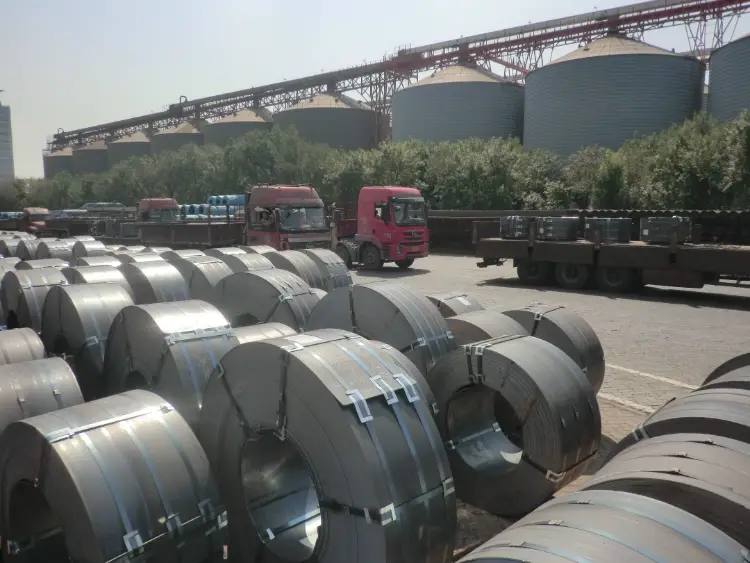
RINA D36 Shipbuilding Steel Coil
RINA D36 Shipbuilding Steel Coil: Chemical, Mechanical & Physical Properties Data
Comprehensive material data for RINA D36 shipbuilding steel coil, covering chemical composition, mechanical and physical properties, international equivalents, and application guidelines.
Hot rolling, TMCP (Thermo-Mechanical Controlled Processing), Normalizing, Cutting, Welding, Forming, Bending
- Phone : +8618037372205
- Email : [email protected]
- WhatsApp: Contact via Whtsapp
- WeChat: +8618037372205
RINA D36 Shipbuilding Steel Coil Introduction
RINA D36 is a high-strength hull structural steel grade defined by the Italian Naval Register (RINA) under its Rules for the Classification of Ships. It is widely used in shipbuilding and offshore engineering where high toughness, good weldability, and reliable strength at low temperatures are essential. The steel is typically supplied as coils, plates, or sections in normalized or thermo-mechanically controlled processed (TMCP) condition. Key properties include a minimum yield strength of 355 MPa, tensile strength in the range 490–620 MPa, and guaranteed impact energy of 34 J at -20 °C. Controlled chemical composition with microalloying elements ensures fine-grained microstructure and good weldability. It conforms to the requirements of IACS UR W11 for high-strength structural steels, ensuring global acceptance across classification societies.
RINA D36 Shipbuilding Steel Coil Chemical Composition
The chemical composition of RINA D36 steel is strictly controlled to achieve the required mechanical properties and weldability. Typical ladle analysis limits according to RINA rules and IACS UR W11. Microalloying elements such as niobium, vanadium, and titanium are often added to refine grain size and improve strength while maintaining toughness.
Carbon equivalent (CE) is usually limited to ≤ 0.38% to ensure good weldability for typical thicknesses.
| Element | Standard Value (wt%) | Remarks |
|---|---|---|
| C (Carbon) | ≤ 0.18 | Ladle analysis; lower carbon enhances weldability |
| Mn (Manganese) | 0.90 – 1.60 | Main strengthening element |
| Si (Silicon) | ≤ 0.50 | Deoxidizer; high silicon may affect toughness |
| P (Phosphorus) | ≤ 0.035 | Maximum limit to avoid brittleness |
| S (Sulfur) | ≤ 0.035 | Maximum limit for ductility and lamellar tearing resistance |
| Al (Aluminum) | ≥ 0.015 (acid soluble) | Grain refinement through deoxidation |
| Nb (Niobium) | ≤ 0.05 | Microalloying for grain refinement and precipitation strengthening |
| V (Vanadium) | ≤ 0.10 | Optional microalloying for strength |
| Ti (Titanium) | ≤ 0.02 | Grain refinement and nitride formation |
| Cu (Copper) | ≤ 0.35 (residual) | Residual element; may be specified for atmospheric corrosion resistance |
| Cr (Chromium) | ≤ 0.20 (residual) | Residual; not intentionally added |
| Ni (Nickel) | ≤ 0.40 (residual) | Residual; may be present in scrap |
| Mo (Molybdenum) | ≤ 0.08 (residual) | Residual element |
| CE (Carbon Equivalent) | ≤ 0.38 (typical) | For weldability control when specified by purchaser |
RINA D36 Shipbuilding Steel Coil Thermal and Electrical Physical Properties
Physical properties are typical for low-carbon structural steels and may vary slightly depending on actual composition and heat treatment. These values apply at room temperature unless noted. Thermal conductivity and electrical resistivity are approximate and useful for heat transfer and electrical design calculations. The coefficient of thermal expansion is linear over the indicated temperature range.
| Property | Typical Value | Unit | Test Condition / Remarks |
|---|---|---|---|
| Density (ρ) | 7850 | kg/m³ | At 20 °C |
| Elastic Modulus (E) | 210 | GPa | At 20 °C, tension |
| Shear Modulus (G) | 81 | GPa | Calculated from E and Poisson's ratio |
| Poisson's Ratio (ν) | 0.3 | — | Within elastic range |
| Thermal Expansion (α) | 12.0 × 10⁻⁶ | K⁻¹ | 20–100 °C average linear coefficient |
| Thermal Conductivity (λ) | 50 | W/(m·K) | At 20 °C |
| Specific Heat Capacity (cp) | 480 | J/(kg·K) | At 20 °C |
| Electrical Resistivity (ρe) | 0.2 × 10⁻⁶ | Ω·m | At 20 °C |
RINA D36 Shipbuilding Steel Coil Mechanical Properties
Mechanical properties for RINA D36 steel coil are determined in accordance with RINA Rules Part D. Tensile and impact tests are performed on specimens taken transverse to the rolling direction unless otherwise agreed. The values below apply to thicknesses up to 50 mm; for greater thicknesses, slight adjustments may apply. Bend test: specimens must withstand 180° bending around a former without cracking.
Impact test temperature is -20 °C, with minimum average absorbed energy of 34 J (longitudinal specimens).
| Property | Standard Requirement Value | Unit | Test Condition |
|---|---|---|---|
| Yield Strength (ReH) | ≥ 355 | MPa | Transverse, thickness ≤ 50 mm; room temperature |
| Tensile Strength (Rm) | 490 – 620 | MPa | Transverse, thickness ≤ 50 mm; room temperature |
| Elongation (A) | ≥ 21 | % | Transverse, gauge length 5.65√S₀; thickness ≤ 50 mm |
| Bend Test (180°) | d = 3a | — | a = specimen thickness; no cracks after 180° bending |
| Impact Energy (KV₂) | ≥ 34 (average) | J | -20 °C, longitudinal Charpy V-notch; single min. 24 J |
RINA D36 Shipbuilding Steel Coil Exact Equivalent Grades from Major Classification Societies
| Country / Region | Standard | Grade | Remarks |
|---|---|---|---|
| United States | ABS Rules for Materials and Welding | ABS D36 | Chemically and mechanically identical; IACS mutual recognition |
| France | BV Rules Part 2 | BV D36 | Bureau Veritas equivalent |
| Norway / Germany | DNV Rules Pt.2 Ch.1 | DNV D36 | DNV GL (now DNV) equivalent |
| United Kingdom | LR Rules for the Manufacture, Testing and Certification of Materials | LR D36 | Lloyd's Register equivalent |
| China | CCS Rules for Materials and Welding | CCS D36 | China Classification Society equivalent |
| Japan | NK Rules for the Survey and Construction of Steel Ships | NK D36 | Nippon Kaiji Kyokai equivalent |
| South Korea | KR Rules for the Classification of Steel Ships | KR D36 | Korean Register equivalent |
RINA D36 Shipbuilding Steel Coil Application Introduction
RINA D36 steel coils are designed primarily for ship and offshore structures where high strength, reliable low-temperature toughness, and excellent weldability are mandatory. The material can be formed, cut, and welded using conventional shipyard practices. Key applications include:
Product Applications: Hull shell plates, Main deck and strength deck panels, Transverse and longitudinal bulkheads, Web frames and stiffeners, Hatch coamings and corner pieces, Offshore module structural parts, Crane pedestals and booms
Processed into products: Ship hull sections (flat and curved panels), Deck stringers and sheer strakes, Bottom plating and bilge keels, Watertight doors and hatch covers, Brackets, tripping brackets, and connection plates, Stiffener profiles (T-bars, angles, bulb flats), Crab rails and guide rails for lifeboats
Application industries: Shipbuilding (merchant ships, naval vessels), Offshore oil and gas platforms (topsides, jackets), Marine and coastal engineering (piers, breakwaters), Pressure vessel construction for low-temperature service, Heavy machinery and lifting equipment in port environments
RINA D36 Shipbuilding Steel Coil Similar / Alternative Materials with Compatible Performance
| Country / Region | Standard | Grade | Remarks |
|---|---|---|---|
| Europe | EN 10025-2 | S355J2 (+N) | Similar strength and -20 °C impact; requires project-specific approval for ship use |
| Europe | EN 10025-4 | S355ML | TMCP delivery with improved weldability; marine applications possible |
| ISO | ISO 630-2 | E355 (Fe510) | Structural steel with similar YS; not class-certified |
| USA | ASTM A572 | Grade 50 (Type 1) | Equivalent strength (345 MPa YS); not class-approved but sometimes accepted |
| China | GB/T 712 | DH36 | Chinese shipbuilding steel; equivalent to IACS D36 |
Notes:
RINA D36 steel is typically produced with fine-grain practice and fully killed. The carbon equivalent is controlled when specified by the purchaser to ensure good weldability without preheating up to moderate thicknesses. Supplementary requirements such as ultrasonic testing, through-thickness tensile testing (Z-properties), and stricter dimensional tolerances can be agreed upon at the time of enquiry and order. Coils may be supplied in pickled and oiled or un-pickled hot-rolled condition according to the intended downstream processing. When comparing with other classification societies, the technical delivery conditions are harmonized under IACS UR W11, so substitution is straightforward subject to the individual society's certification rules.
- Share



