
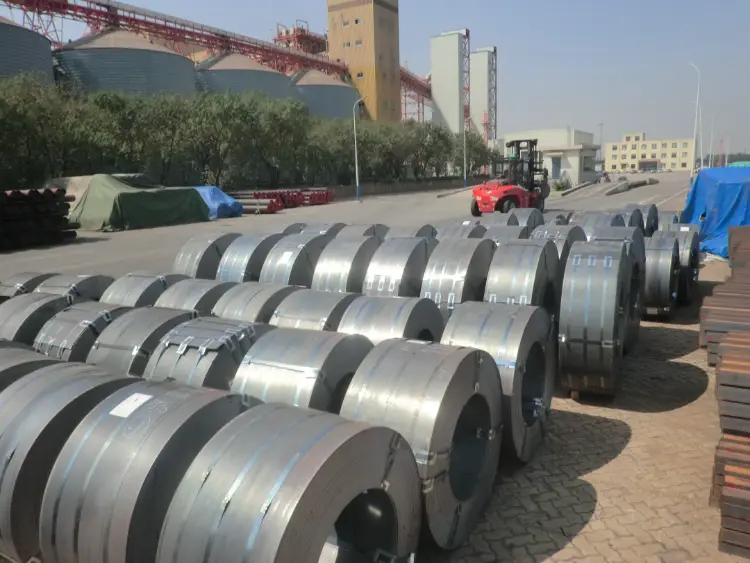
RINA D32 Shipbuilding Steel Coil
RINA D32 Shipbuilding Steel Coil: Full Property Specification & Equivalents
Complete material data for RINA D32 shipbuilding steel coil including chemical composition, mechanical and physical properties, international equivalents, and application guidelines.
Hot rolling, controlled rolling (TMCP), normalizing
- Phone : +8618037372205
- Email : [email protected]
- WhatsApp: Contact via Whtsapp
- WeChat: +8618037372205
RINA D32 Shipbuilding Steel Coil Introduction
RINA D32 is a high-strength low-alloy shipbuilding structural steel certified by the Registro Italiano Navale (RINA), Italy. It is designed for critical ship hull and offshore structure construction, offering a minimum yield strength of 315 MPa and excellent low-temperature toughness. The steel is typically supplied in the form of hot-rolled coils or plates, deliverable in normalized or thermomechanical controlled rolled (TMCP) condition.
- Excellent weldability and formability
- Good toughness at sub-zero temperatures (−20°C impact test)
- Widely accepted under IACS unified requirements
- Equivalent to ABS D32, DNV D32, BV D32, LR D32 and other classification society grades
RINA D32 Shipbuilding Steel Coil Chemical Composition
The chemical composition of RINA D32 is controlled to ensure high strength, weldability, and notch toughness. Carbon equivalent (CEV) is typically limited to improve weldability. The following are the typical standard requirements according to RINA Rules Part D. Microalloying elements like Nb, V, Ti may be added singly or in combination.
- CEV = C + Mn/6 + (Cr+Mo+V)/5 + (Ni+Cu)/15 is often max 0.38% for TMCP condition.
- If aluminum is used for grain refinement, acid-soluble Al ≥ 0.015%.
| Chemical Element | Standard Value | Remarks |
|---|---|---|
| Carbon (C) | ≤ 0.18 % | Maximum |
| Silicon (Si) | ≤ 0.50 % | Maximum |
| Manganese (Mn) | 0.90 – 1.60 % | Range |
| Phosphorus (P) | ≤ 0.035 % | Maximum |
| Sulfur (S) | ≤ 0.035 % | Maximum |
| Aluminum (Al) total | ≥ 0.015 % | If used for grain refinement |
| Niobium (Nb) | 0.02 – 0.05 % | Optional microalloying element |
| Vanadium (V) | 0.05 – 0.10 % | Optional microalloying element |
| Titanium (Ti) | 0.01 – 0.05 % | Optional microalloying element |
| Copper (Cu) | ≤ 0.35 % | Maximum |
| Chromium (Cr) | ≤ 0.20 % | Maximum |
| Nickel (Ni) | ≤ 0.40 % | Maximum |
| Molybdenum (Mo) | ≤ 0.08 % | Maximum |
| CEV (Carbon Equivalent) | ≤ 0.38 % (typical TMCP) | Depends on thickness and delivery condition |
RINA D32 Shipbuilding Steel Coil Thermal and Electrical Physical Properties
Physical properties of RINA D32 are representative of low-carbon low-alloy steels. They are not explicitly specified in classification rules but are given as typical values for design calculations.
- Values may vary slightly with actual composition and heat treatment.
- Thermal expansion is average for structural steels.
| Property | Standard Requirement Value | Unit | Test Condition |
|---|---|---|---|
| Density (ρ) | 7.85 | g/cm³ | Ambient temperature |
| Modulus of elasticity (E) | 210 | GPa | Ambient temperature |
| Shear modulus (G) | 80 | GPa | Ambient temperature |
| Poisson's ratio (ν) | 0.3 | – | Ambient temperature |
| Coefficient of thermal expansion (α) | 12.0 | 10⁻⁶/K | 20°C to 100°C |
| Thermal conductivity (λ) | 52 (approx.) | W/(m·K) | Ambient temperature |
| Specific heat capacity (cp) | 460 (approx.) | J/(kg·K) | Ambient temperature |
| Electrical resistivity (ρe) | 0.13 – 0.16 | 10⁻⁶ Ω·m | Ambient temperature |
RINA D32 Shipbuilding Steel Coil Mechanical Properties
The mechanical properties of RINA D32 are specified at ambient temperature for plates/coils up to 100 mm thickness. Tensile tests are performed transversely. Impact test at −20°C is mandatory for thicknesses ≥ 6 mm.
- Bend test: 180° bending on a mandrel with diameter related to thickness.
- Through-thickness properties (Z-quality) may be specified according to RINA additional requirements.
| Property | Standard Requirement Value | Unit | Test Condition |
|---|---|---|---|
| Yield Strength (ReH) | ≥ 315 | MPa | Thickness ≤ 100 mm, transverse |
| Tensile Strength (Rm) | 440 – 590 | MPa | Transverse |
| Elongation after fracture (A) | ≥ 22 | % | Gauge length 5.65√So, transverse |
| Charpy V-Notch Impact (KV2) | ≥ 31 (longitudinal) | J | At −20°C, thickness ≥ 6 mm |
| Charpy V-Notch Impact (KV2) | ≥ 22 (transverse) | J | At −20°C, thickness ≥ 6 mm |
| Bend Test (180°) | d = 3a (thickness ≤ 25 mm) | – | No cracks; d = mandrel diameter, a = thickness |
| Bend Test (180°) | d = 4a (thickness > 25 mm) | – | No cracks |
RINA D32 Shipbuilding Steel Coil Fully Equivalent Material Standards & Substitute Grades
| Country/Region | Standard | Grade | Remarks |
|---|---|---|---|
| USA | ABS Rules (American Bureau of Shipping) | ABS D32 | Identical mechanical and impact properties (IACS UR W11) |
| France | BV Rules (Bureau Veritas) | BV D32 | Same requirements under IACS unified standard |
| China | CCS Rules (China Classification Society) | CCS D32 | Fully equivalent |
| Norway/Germany | DNV Rules (Det Norske Veritas) | DNV D32 | Equivalent with minor chemical variations allowed |
| UK | LR Rules (Lloyd's Register) | LR D32 | IACS unified grade |
| South Korea | KR Rules (Korean Register) | KR D32 | Equivalent |
| Japan | NK Rules (Nippon Kaiji Kyokai) | NK D32 | Equivalent |
RINA D32 Shipbuilding Steel Coil Application Introduction
RINA D32 steel coil is processed into plates and sections for primary structural components in shipbuilding and marine construction. Due to its good balance of strength, ductility, and toughness, it can be formed, welded, and machined using standard fabrication techniques. It is suitable for both plate and profile applications.
- Adequate preheat may be required for thick sections during welding.
- Can be used as flat products or further processed into stiffeners, frames, and girders.
Product Applications: Hull shell plating and bottom plates, Deck plates and stringer plates, Watertight bulkheads and tank boundaries, Stiffeners, web frames, and longitudinals, Offshore module support structures and helidecks
Processed into products: Ship hulls and superstructures (cut and formed from coil/plate), Brackets, gussets, and collar plates, Built-up T-beams and I-girders, Dished heads and pipe supports, Fabricated nodes and shear keys for offshore platforms
Application industries: Shipbuilding (commercial vessels, naval ships), Offshore oil & gas platforms, Marine equipment and port infrastructure, Renewable energy (offshore wind turbine foundations), Bridge and structural engineering (where class-approved steel is needed)
RINA D32 Shipbuilding Steel Coil Similar / Near-Equivalent Material Recommendations
| Country/Region | Standard | Grade | Remarks |
|---|---|---|---|
| International (IACS) | All major classification societies | D36 | Higher strength (yield ≥ 355 MPa), otherwise similar weldability and toughness. May be substituted if design allows. |
| International (IACS) | All major classification societies | E32 | Same strength, but guaranteed impact at −40°C. Suitable for colder environments. |
| International (IACS) | All major classification societies | A32 | Same strength, impact test at 0°C (less tough). Check service temperature requirements. |
| Europe | EN 10225 | S355G2+N / S355G2+M | Weldable structural steels for offshore structures, similar strength but different certification regime. |
| Europe | EN 10025-3 | S355N/NL / S355M/ML | Fine grain structural steels; requires additional engineering assessment for direct substitution. |
Notes:
Additional Remarks:
- All deliveries must be accompanied by RINA inspection certificates (3.1 or 3.2 according to EN 10204).
- For thicknesses above 25 mm, ultrasonic testing may be required per classification society rules.
- Zn-coated or shop-primed surfaces are often supplied for shipyard conditions.
- When ordering, specify desired impact test orientation (longitudinal or transverse) and sampling location.
- This steel is not intended for high-temperature service; prolonged exposure above 400°C may alter properties.
- Share



