
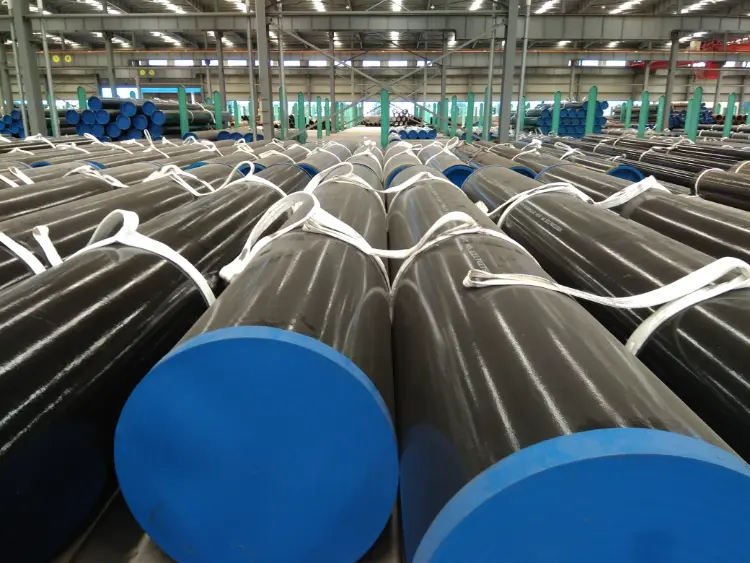
ASTM A511 MT 304 Stainless Steel Pipe
ASTM A511 MT 304 Stainless Steel Pipe: Seamless Mechanical Tubing Data Sheet & Equivalents
Complete material profile for ASTM A511 MT 304 stainless steel mechanical tubing, including chemical composition, mechanical and thermal properties, international equivalents, and application guidance.
Seamless hot-finished or cold-finished with final annealing and pickling; suitable for cold drawing, bending, machining, welding and precision cutting.
- Phone : +8618037372205
- Email : [email protected]
- WhatsApp: Contact via Whtsapp
- WeChat: +8618037372205
ASTM A511 MT 304 Stainless Steel Pipe Introduction
ASTM A511 MT 304 is a seamless austenitic stainless steel mechanical tubing grade conforming to ASTM A511/A511M. It is produced from UNS S30400 material, widely known as 18-8 stainless steel, offering an excellent combination of corrosion resistance, formability, and weldability. Key characteristics:
- Good strength and ductility in the annealed condition, with tensile strength min. 75 ksi (515 MPa) and yield strength min. 30 ksi (205 MPa).
- Outstanding resistance to a wide range of corrosive environments, including atmospheric, food, and mild chemical media.
- Can be readily fabricated by cold working processes such as bending, flaring, and drawing due to its high elongation (30–35% min.).
- Not hardenable by heat treatment; generally supplied in annealed or light cold-worked condition.
- Typical applications include automotive exhaust components, structural supports, kitchen equipment, instrumentation tubing, and general mechanical parts.
This tubing is primarily intended for mechanical and structural applications where close dimensional tolerances and consistent mechanical properties are required.
ASTM A511 MT 304 Stainless Steel Pipe Chemical Composition
Chemical requirements for ASTM A511 MT 304 seamless stainless steel mechanical tubing as defined by ASTM A511/A511M. The composition is identical to grade 304 (UNS S30400). Analyses are based on product (check) analysis unless otherwise specified. Key elements: chromium (18.0–20.0 %) and nickel (8.0–11.0 %) provide austenitic structure and corrosion resistance. Carbon is limited to 0.08 % maximum to avoid intergranular corrosion after welding in thin sections. Manganese, silicon, phosphorus, and sulfur are controlled as residuals.
| Element | Standard Value (%) | Remarks |
|---|---|---|
| Carbon (C) | ≤ 0.08 | Max. for corrosion resistance and welding |
| Manganese (Mn) | ≤ 2.00 | Deoxidizer; max. limit |
| Phosphorus (P) | ≤ 0.045 | Max. limit |
| Sulfur (S) | ≤ 0.030 | Max. limit |
| Silicon (Si) | ≤ 1.00 | Max. limit |
| Chromium (Cr) | 18.0 - 20.0 | Primary corrosion resistance element |
| Nickel (Ni) | 8.0 - 11.0 | Austenite stabilizer and corrosion enhancer |
| Iron (Fe) | Balance | Remainder |
ASTM A511 MT 304 Stainless Steel Pipe Typical Thermal & Electrical Physical Properties
Reference physical properties for 304 (UNS S30400) stainless steel in the annealed condition at room temperature unless otherwise noted. These values are typical and not part of ASTM A511 mechanical requirements. Data sourced from ASM and producer literature. Important: properties can vary with cold work and exact composition.
- Density: 8.0 g/cm³.
- Modulus of elasticity ~193 GPa.
- Thermal expansion coefficient ~17.2 µm/m·°C at 0–100°C.
- Thermal conductivity ~16.2 W/m·K at 100°C.
| Property | Typical Value | Unit | Test Condition / Temperature |
|---|---|---|---|
| Density (ρ) | 8.0 | g/cm³ | Room temperature |
| Modulus of Elasticity (E) | 193 | GPa | Tension, room temperature |
| Shear Modulus (G) | 77 | GPa | Calculated, room temperature |
| Poisson's Ratio (ν) | 0.29 | — | Room temperature |
| Thermal Expansion Coefficient (α) | 17.2 | µm/m·°C | 0 – 100 °C |
| Thermal Expansion Coefficient (α) | 17.8 | µm/m·°C | 0 – 315 °C |
| Thermal Expansion Coefficient (α) | 18.4 | µm/m·°C | 0 – 538 °C |
| Thermal Conductivity (λ) | 16.2 | W/m·K | 100 °C |
| Thermal Conductivity (λ) | 21.5 | W/m·K | 500 °C |
| Specific Heat Capacity | 500 | J/kg·K | 0 – 100 °C |
| Electrical Resistivity (ρ_e) | 0.72 | µΩ·m | 20 °C |
ASTM A511 MT 304 Stainless Steel Pipe Mechanical Properties
Tensile and elongation requirements for ASTM A511 MT 304 in the annealed condition at room temperature according to ASTM A511/A511M. Notes:
- Values apply to longitudinal strip tests from tubing.
- Yield strength is determined by the 0.2% offset method.
- Elongation is measured on a gauge length of 2 in. (50 mm).
- Reduced elongation applies for wall thicknesses below 5/16 in. (7.94 mm).
- Hardness is not a standard requirement per ASTM A511, but typical annealed hardness is Rockwell B 90 max / Brinell 201 max.
| Property | Standard Value | Unit | Test Condition |
|---|---|---|---|
| Tensile Strength (Rm) | ≥ 75 (515) | ksi (MPa) | Room temperature, as per ASTM A370 |
| Yield Strength (ReH, 0.2% offset) | ≥ 30 (205) | ksi (MPa) | Room temperature |
| Elongation (A), wall ≥ 5/16 in. (7.94 mm) | ≥ 35 | % | Gauge length 2 in. or 50 mm |
| Elongation (A), wall < 5/16 in. (7.94 mm) | ≥ 30 | % | Gauge length 2 in. or 50 mm |
ASTM A511 MT 304 Stainless Steel Pipe Exact Equivalent Material Standards & Replaceable Grades
| Country/Region | Standard | Grade | Remarks |
|---|---|---|---|
| USA | ASTM A511/A511M | MT304 | Original specification; seamless mechanical tubing |
| USA | ASTM A269/A312/A213/A240 | 304 (UNS S30400) | General service tubing, pipe, and plate; comparable chemistry and properties |
| Europe | EN 10216-5 / EN 10305-1 | 1.4301 (X5CrNi18-10) | Seamless stainless tubes for pressure and precision mechanical applications |
| Japan | JIS G3459 / G3463 | SUS304TP / SUS304TB | Stainless steel pipes for general service and boiler/heat exchanger |
| China | GB/T 14976 | 06Cr19Ni10 (S30408) | Seamless stainless steel pipes for fluid transport |
| International | ISO 9327-5 | X5CrNi18-10 | Seamless steel tubes for mechanical purposes |
ASTM A511 MT 304 Stainless Steel Pipe Application Introduction
ASTM A511 MT 304 seamless tube is suitable for a broad spectrum of mechanical and structural applications where corrosion resistance and moderate strength are required. It is not intended for pressure-containing service unless supplemented by other standards (e.g., ASTM A269). Typical guidance:
- Machining: Good machinability in annealed condition; improved with cold work or free-machining variants (303) if allowed.
- Welding: Excellent weldability by all common processes; post-weld annealing recommended for thick sections when carbon >0.03%.
- Forming: Readily formed by bending, flaring, and swaging; work hardening must be considered for multi-stage operations.
Product Applications: Automotive exhaust pipes and muffler tubing, Structural tubes for railings, furniture, and display systems, Instrumentation and control lines in chemical plants, Dairy and food-grade transport conduits, Machine components requiring corrosion-protected hollow sections
Processed into products: Bushings and bearing sleeves, Shaft extensions and hollow axles, Bent tubular frames and brackets, Handrails and guardrails, Dip tubes and thermowell components, Precision spacers and standoffs
Application industries: Automotive (exhaust systems, structural components), Architecture and construction (handrails, support columns, decorative tubing), Food and beverage processing (conveyors, frames, indirect food contact parts), Chemical and petrochemical (instrument tubing, structural supports in mildly corrosive environments), Medical devices (guide tubes, surgical instruments when biocompatibility is acceptable), General mechanical engineering (shafts, bushings, spacers, rollers)
ASTM A511 MT 304 Stainless Steel Pipe Similar / Substitute Material Recommendations
| Country/Region | Standard | Grade | Remarks |
|---|---|---|---|
| USA | ASTM A511 | MT304L (UNS S30403) | Lower carbon (≤0.03%) for improved as-welded corrosion resistance; slightly lower strength, similar elongation. |
| USA | ASTM A511 | MT316 (UNS S31600) | Contains 2–3% Mo for enhanced pitting resistance; suitable for more aggressive environments. |
| USA | ASTM A511 | MT321 (UNS S32100) | Titanium-stabilized grade; better resistance to sensitization and intergranular attack at elevated temperatures. |
| Europe | EN 10216-5 | 1.4307 (X2CrNi18-9) | Corresponds to 304L; often interchangeable with 304 in non-welded conditions. |
| Japan | JIS G3459 | SUS304LTP | Low carbon version of SUS304; minimizes weld decay. |
Notes:
ASTM A511 MT 304 tubing can be supplied with supplementary requirements such as eddy-current testing, special surface finishes, or tighter dimensional tolerances. When intended for use in mildly corrosive water systems or cosmetic applications, surface conditions (e.g., pickled, bright annealed, polished) should be specified. If welding is required without post-weld heat treatment, consider using MT 304L to reduce the risk of intergranular corrosion. Health and safety: fine dust or fumes from machining/grinding may be hazardous; proper ventilation and PPE are recommended.
- Share



