
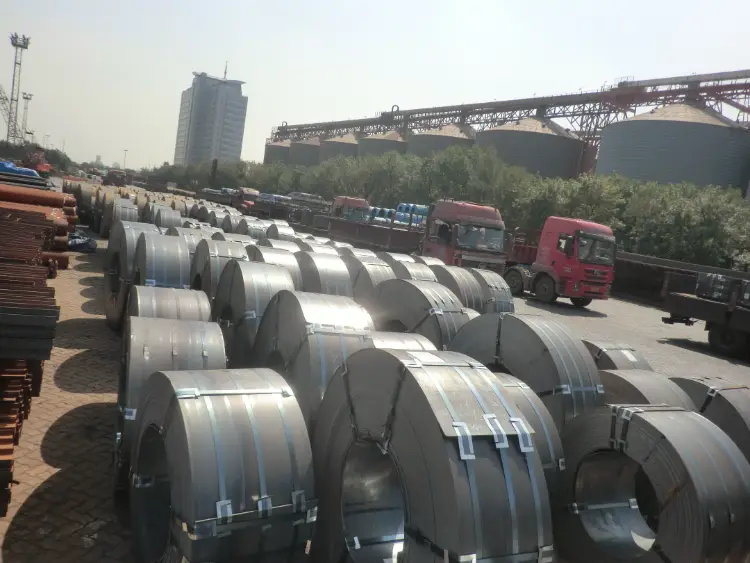
RINA A36 Shipbuilding Steel Coil
RINA A36 Shipbuilding Steel Coil: Properties, Equivalents & Welded Structure Applications
Explore the chemical composition, mechanical and physical properties of RINA A36 shipbuilding steel coil. Find equivalent grades (ABS/DNV/LR), typical delivery conditions and approved processing for marine construction.
Suitable for welding (all common arc processes), flame/plasma/laser cutting, cold forming, bending, edge rolling and machining. Preheating typically not required for thicknesses up to 30 mm when CEV ≤ 0.38%.
- Phone : +8618037372205
- Email : [email protected]
- WhatsApp: Contact via Whtsapp
- WeChat: +8618037372205
RINA A36 Shipbuilding Steel Coil Introduction
RINA A36 is a high-strength hull structural steel certified by the Italian Classification Society (Registro Italiano Navale). It belongs to the AH36 grade category under IACS UR W11, designed for welded ship structures with guaranteed notch toughness at 0 °C. The steel combines fine grain practice with controlled microalloying to achieve minimum yield strength of 355 MPa, excellent weldability and good ductility. Typical delivery condition is normalised or thermo-mechanically controlled rolled (TMCP), supplied as coils, plates and wide flats. RINA A36 is extensively used in deck plates, bottom shell plating, bulkheads and stiffeners for newbuilding and repair of merchant, naval and offshore vessels.
RINA A36 Shipbuilding Steel Coil Chemical Composition
The chemical composition of RINA A36 complies with the IACS Unified Requirement W11 for AH36 grade. Maximum limits are given below; lower values may be achieved depending on deoxidation practice (fully killed, fine grain treated). Microalloying elements such as Nb, V or Ti may be present singly or in combination to improve strength and toughness. Carbon equivalent (CEV) is commonly restricted to ≤ 0.38% for good weldability.
| Element | max. % (unless range) | Remarks |
|---|---|---|
| C | ≤ 0.18 | Typical aim 0.12–0.16 |
| Mn | 0.70 – 1.60 | Higher Mn for thicker sections |
| Si | ≤ 0.50 | Usually 0.15–0.40 |
| P | ≤ 0.035 | |
| S | ≤ 0.035 | |
| Al (total) | ≥ 0.015 | Aluminium killed; soluble Al ≥ 0.010 |
| Nb | ≤ 0.05 | Optional microalloy |
| V | ≤ 0.10 | Optional microalloy |
| Ti | ≤ 0.02 | Optional microalloy |
| Cr* | ≤ 0.25 | Residual, not specified but controlled |
| Ni* | ≤ 0.40 | Residual, not specified but controlled |
| Cu* | ≤ 0.35 | Residual, not specified but controlled |
| Mo* | ≤ 0.08 | Residual, not specified but controlled |
| N | ≤ 0.012 | If microalloyed, N may be bound by Al/Ti/V |
| CEV | ≤ 0.38 | CEV = C + Mn/6 + (Cr+Mo+V)/5 + (Ni+Cu)/15 |
RINA A36 Shipbuilding Steel Coil Physical Properties
The physical properties given are typical for a normalised low-carbon-manganese structural steel. They are not mandatory per RINA rules but are widely accepted for design calculations, thermal expansion analysis and welding engineering. The values are valid at room temperature unless a temperature range is noted. Thermal conductivity decreases, while specific heat capacity and electrical resistivity increase with rising temperature.
| Property | Typical value | Unit | Condition / Temperature |
|---|---|---|---|
| Density (ρ) | 7850 | kg/m³ | 20 °C |
| Elastic modulus (E) | 205 | GPa | 20 °C |
| Shear modulus (G) | 79 | GPa | 20 °C |
| Poisson's ratio (ν) | 0.3 | – | 20 °C |
| Coefficient of thermal expansion (α) | 11.7 × 10⁻⁶ | K⁻¹ | 20 – 100 °C |
| Coefficient of thermal expansion (α) | 12.5 × 10⁻⁶ | K⁻¹ | 20 – 200 °C |
| Coefficient of thermal expansion (α) | 13.5 × 10⁻⁶ | K⁻¹ | 20 – 400 °C |
| Thermal conductivity (λ) | 52 | W/(m·K) | 20 °C |
| Thermal conductivity (λ) | 45 | W/(m·K) | 200 °C |
| Specific heat capacity (с) | 486 | J/(kg·K) | 20 °C |
| Specific heat capacity (с) | 530 | J/(kg·K) | 200 °C |
| Electrical resistivity (ρₑ) | 0.17 × 10⁻⁶ | Ω·m | 20 °C |
RINA A36 Shipbuilding Steel Coil Mechanical Properties
Mechanical properties are determined on test pieces taken in the longitudinal or transverse direction as specified. For thicknesses ≤ 50 mm, the minimum yield strength (ReH) is 355 MPa. Charpy V-notch impact tests are performed at 0 °C with an average absorbed energy ≥ 34 J (longitudinal). For thinner material (< 10 mm), impact sub-size specimens are used and minimum values are proportional to specimen width. Bending tests are required to prove ductility; smaller bend ratios apply when testing transverse specimens.
| Property | Value | Unit | Test conditions |
|---|---|---|---|
| Yield strength (ReH) | ≥ 355 | MPa | Thickness ≤ 50 mm, transverse |
| Yield strength (ReH) | ≥ 335 | MPa | Thickness > 50 mm ≤ 70 mm, transverse |
| Yield strength (ReH) | ≥ 315 | MPa | Thickness > 70 mm ≤ 100 mm, transverse |
| Tensile strength (Rm) | 490 – 620 | MPa | Thickness ≤ 100 mm |
| Elongation (A5) | ≥ 21 | % | Gauge length 5.65√S₀, thickness ≤ 50 mm, longitudinal |
| Elongation (A5) | ≥ 19 | % | Gauge length 5.65√S₀, thickness > 50 ≤ 70 mm |
| Elongation (A5) | ≥ 16 | % | Gauge length 5.65√S₀, thickness > 70 ≤ 100 mm |
| Bend test (180°) | d = 3a | – | Bend diameter d, specimen thickness a, thickness ≤ 25 mm |
| Bend test (180°) | d = 4a | – | Thickness > 25 mm ≤ 50 mm |
| Impact energy (KV₂) | ≥ 34 (avg.) / ≥ 24 (single) | J | 0 °C, longitudinal, 10×10 mm specimen |
| Impact energy (KV₂) | ≥ 27 / ≥ 20 | J | 0 °C, transverse, 10×10 mm specimen (where specified) |
| Through-thickness (Z-quality) | Z25 or Z35 as per option | %RA | Only if ordered with Z-grade |
RINA A36 Shipbuilding Steel Coil Fully Equivalent Material Standards / Substitutability
| Country / Region | Standard / Class | Grade | Remarks |
|---|---|---|---|
| International | IACS UR W11 | AH36 | Foundation specification; all IACS members accept |
| USA | ASTM A131 / ABS Rules | AH36 | ABS AH36, same mechanical/chemical limits |
| France | BV Rules | AH36 | Bureau Veritas AH36 |
| China | CCS Rules | AH36 | China Classification Society AH36 |
| Norway/Germany | DNV Rules | AH36 | DNV AH36 (now DNV VL AH36) |
| South Korea | KR Rules | AH36 | Korean Register AH36 |
| United Kingdom | LR Rules | AH36 | Lloyd's Register AH36 |
| Japan | NK Rules | AH36 | Nippon Kaiji Kyokai AH36 |
| Italy | RINA Rules | A36 | The reference grade covered by this data sheet |
RINA A36 Shipbuilding Steel Coil Application Introduction
RINA A36 steel coil is primarily intended for welded ship structures where notch toughness at 0 °C is required. It can be processed into plates, strips and welded beams. The material is widely adopted in newbuilding, conversion and repair yards worldwide because of its international IACS recognition.
Typical processing sequence: Decoiling → levelling → shot blasting → CNC cutting → edge preparation → forming (press brake/rolling) → assembly by welding → NDT inspection → painting.
Product Applications: Main deck plating and stringer plates, Bottom and side shell plating, Transverse and longitudinal bulkheads, Hatch coamings and covers, Superstructure panels and accommodation blocks, Structural stiffeners (flat bars, angles, bulb profiles), Offshore platform topside floor plates and girders
Processed into products: Shipbuilding: long curved panels, developed profiles, strength deck inserts, Offshore: tubular joint cans (after rolling and welding), pad eyes, stiffener rings, Wind: transition piece flanges, internal platforms, door frames, General: heavy-duty floor plates for mobile harbour cranes, excavator booms (with class endorsement)
Application industries: Merchant shipbuilding (bulk carriers, tankers, container vessels), Naval surface ships (frigates, patrol boats – secondary structure), Offshore oil & gas (jacket legs, decks, flare booms), Offshore wind energy (monopiles, transition pieces, access platforms), Port & harbour infrastructure (sheet piling, fender panels), Heavy fabrication of crane booms and mining dump bodies (when class approval recognised)
RINA A36 Shipbuilding Steel Coil Similar / Closely Related Materials
| Country / Region | Standard | Grade | Remarks |
|---|---|---|---|
| EU | EN 10025-3 | S355N / S355NL | Fine-grain weldable structural steel; NL grade guarantees impact at –50 °C, strength range overlaps. Not directly ship class approved but often used for non-class marine parts. |
| EU | EN 10025-4 | S355M / S355ML | Thermo-mechanically rolled equivalent; M/ML grades mirror AH36 mechanical properties. |
| USA | ASTM A572 | Grade 50 [345] | Minimum yield 345 MPa, similar chemistry; Charpy requirements can be added. Commonly used in offshore structural profiles. |
| China | GB/T 712 | AH36 | Chinese standard for shipbuilding steel; AH36 fully equivalent to RINA A36. |
| Russia | GOST 5521 | А36 or 10ХСНД | Russian shipbuilding steel with comparable yield (≥ 355 MPa); modified chemistry (Cr, Ni, Cu). |
| Japan | JIS G 3106 | SM490A / SM490YA | Higher tensile range (490–610 MPa), but for structural purposes with similar weldability. Non-classed general structural. |
Notes:
Welding recommendation: Use low-hydrogen processes (SMAW with basic electrodes, SAW with neutral fluxes, FCAW/GMAW) and consumables matching the minimum yield strength. Preheat may be required for thicknesses above 30 mm or when combined thickness exceeds 50 mm; typically 50–100 °C depending on CEV and hydrogen control.
NDT: Ultrasonic testing to EN 10160 or class rules is often required for plates ≥ 10 mm in way of critically stressed areas. Surface crack detection (MT/PT) may be specified for cut edges and weld toes.
Corrosion protection: As-delivered mill scale should be removed by abrasive blasting (Sa 2½) before application of marine coating systems. Anodes or impressed current systems are designed separately.
- Share



