
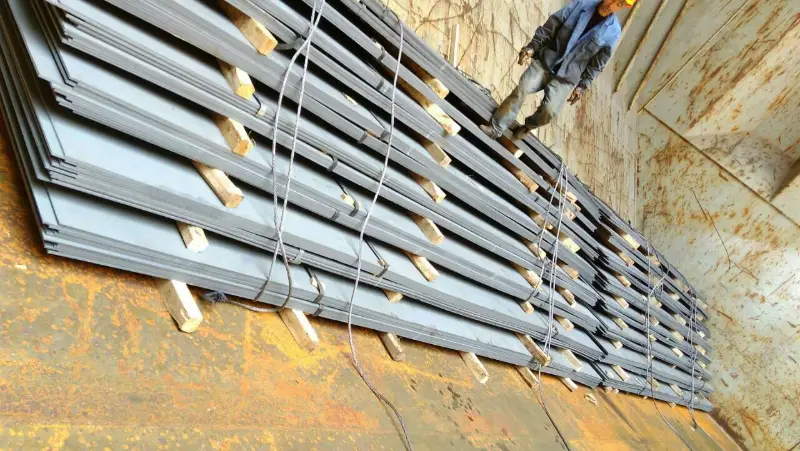
QStE500TM Hot Rolled Fine Grain Structural Steel
QStE500TM Hot Rolled Fine Grain Structural Steel for Automotive Cold Forming
QStE500TM is a hot-rolled, thermomechanically rolled fine grain structural steel with minimum yield strength of 500 MPa, designed for cold forming applications in the automotive industry. It offers excellent weldability and fatigue resistance.
Cold forming (bending, drawing, stretch forming), punching, shearing, laser/plasma cutting, welding (resistance, MIG/MAG, laser), and limited hot forming if re-austenitized.
- Phone : +8618037372205
- Email : [email protected]
- WhatsApp: Contact via Whtsapp
- WeChat: +8618037372205
QStE500TM Hot Rolled Fine Grain Structural Steel Introduction
QStE500TM is a microalloyed structural steel specified in SEW 092 (superseded by EN 10149-2) and intended primarily for automotive chassis and structural components requiring high strength and good cold formability. The "TM" designation indicates thermomechanical rolling, a controlled process that refines the grain structure without the need for normalizing, achieving enhanced mechanical properties. Key characteristics:
- Minimum yield strength of 500 MPa for all thicknesses
- Good weldability due to low carbon equivalent
- Suitable for bending, profiling, and moderate drawing operations
- Excellent fatigue performance under dynamic loads
- Available as hot-rolled strip, sheet, and plate
QStE500TM Hot Rolled Fine Grain Structural Steel Chemical Composition
The chemical composition of QStE500TM is designed to achieve high strength through grain refinement and precipitation hardening. All values are maximum unless stated otherwise. Microalloying elements such as Nb, V, and Ti are used to control grain size and provide fine precipitates. The sum of Nb+V+Ti is restricted to ensure consistent properties.
| Element | Standard Value (max %) | Remarks |
|---|---|---|
| Carbon (C) | ≤ 0.12 | For weldability and formability |
| Silicon (Si) | ≤ 0.50 | Higher Si may increase strength but reduces surface quality |
| Manganese (Mn) | ≤ 1.70 | Primary solid solution strengther |
| Phosphorus (P) | ≤ 0.025 | Controlled for toughness |
| Sulfur (S) | ≤ 0.015 | Low S for cleanliness and formability |
| Aluminum (Al) total | ≥ 0.015 | Minimum for grain refinement and deoxidation |
| Niobium (Nb) | ≤ 0.09 | Grain refiner and precipitation hardener |
| Vanadium (V) | ≤ 0.20 | Provides additional precipitation strengthening |
| Titanium (Ti) | ≤ 0.15 | Forms carbonitrides for grain refinement |
| Molybdenum (Mo) | ≤ 0.50 | Optional; enhances hardenability and strength |
| Nb + V + Ti | ≤ 0.22 | Sum of microalloying elements |
QStE500TM Hot Rolled Fine Grain Structural Steel Thermal and Electrical Physical Properties
Physical properties are typical for low-carbon microalloyed steel at room temperature unless stated otherwise. These values are for reference only and can vary slightly with actual composition and processing history. Elastic modulus and thermal expansion are essential for design simulations.
| Property | Typical Value | Unit | Condition / Remarks |
|---|---|---|---|
| Density (ρ) | 7.85 | g/cm³ | At 20°C |
| Modulus of elasticity (E) | 210 | GPa | At 20°C, dynamic method |
| Shear modulus (G) | ~ 81 | GPa | Calculated based on E and ν |
| Poisson's ratio (ν) | 0.3 | – | Elastic range |
| Coefficient of thermal expansion (α) | 12.0 × 10⁻⁶ | /K | Between 20°C and 100°C |
| Coefficient of thermal expansion (α) | 12.8 × 10⁻⁶ | /K | Between 20°C and 300°C |
| Thermal conductivity (λ) | 53 | W/(m·K) | At 20°C, typical for low-alloy steel |
| Specific heat capacity (cp) | 460 | J/(kg·K) | At 20°C |
| Electrical resistivity (ρ_e) | 0.17 – 0.25 | μΩ·m | At 20°C, depends on alloying |
QStE500TM Hot Rolled Fine Grain Structural Steel Mechanical Properties
Mechanical properties are guaranteed in the thermomechanically rolled condition. Testing is performed in accordance with EN ISO 6892-1 on transverse specimens. Yield strength and tensile strength are given for different thickness ranges. The strain after fracture uses gauge length A80 for thickness < 3 mm and A5 for thickness ≥ 3 mm. Bend test is also a common requirement.
| Property | Standard Requirement | Unit | Test Condition / Thickness (t) |
|---|---|---|---|
| Yield strength (ReH) | ≥ 500 | MPa | t ≤ 3 mm |
| Yield strength (ReH) | ≥ 500 | MPa | 3 < t ≤ 6 mm |
| Yield strength (ReH) | ≥ 500 | MPa | 6 < t ≤ 12 mm |
| Tensile strength (Rm) | 550 – 700 | MPa | t ≤ 3 mm |
| Tensile strength (Rm) | 550 – 700 | MPa | 3 < t ≤ 6 mm |
| Tensile strength (Rm) | 550 – 700 | MPa | 6 < t ≤ 12 mm |
| Elongation after fracture (A80) | ≥ 12 | % | t < 3 mm, gauge length 80 mm |
| Elongation after fracture (A5) | ≥ 14 | % | t ≥ 3 mm, gauge length 5.65√S0 |
| Bend test (mandrel diameter) | 0.5 t | – | 180° bend, tensile face crack-free |
QStE500TM Hot Rolled Fine Grain Structural Steel Direct Equivalent Standards and Replaceable Grades
| Country / Region | Standard | Grade | Remarks |
|---|---|---|---|
| European Union | EN 10149-2:2013 | S500MC | Direct equivalent; both thermomechanically rolled with identical chemical and mechanical requirements. |
| Germany (superseded) | DIN EN 10149-2 | S500MC | Replaces SEW 092 QStE500TM in practice. |
QStE500TM Hot Rolled Fine Grain Structural Steel Application Introduction
QStE500TM is optimized for cold-formed structural parts in vehicles where high strength and good weldability are required. Typical usage includes:
- Chassis frames and subframes
- Suspension control arms and linkages
- Wheel rims and disks
- Bumper reinforcements
- Safety cage components
The steel can be manufactured into complex geometries by bending, roll forming, and blanking. Post-processing often includes trimming, punching, and resistance spot welding.
Product Applications: Hot-rolled pickled and oiled coils, Slit strip for tube making, Cut-to-length sheets for stamping, Tubular sections (ERW or HF welded)
Processed into products: Longitudinal frame rails, Cross members and engine cradles, Suspension arms, twist beams, Wheel rims and center disks, Bumper beams and energy absorbers, Seat frames and backrest structures, Door impact beams, Transmission brackets and mounts
Application industries: Automotive and light truck manufacturing, Commercial vehicle (buses, trailers), Material handling equipment (forklifts, racks), Construction machinery (light structural parts), Agricultural equipment
QStE500TM Hot Rolled Fine Grain Structural Steel Similar / Approximately Equivalent Materials
| Country / Region | Standard | Grade | Remarks |
|---|---|---|---|
| European Union | EN 10149-2 | S460MC | Lower minimum yield strength (460 MPa), otherwise very similar chemical and forming characteristics; may be used where slightly lower strength is acceptable. |
| European Union | EN 10149-2 | S550MC | Higher minimum yield strength (550 MPa), similar elongation; can replace QStE500TM in weight-optimized applications if forming limits allow. |
| Japan | JIS G3134 | SPFH 540 | Hot-rolled high strength steel sheet with improved formability for automobile structural uses; tensile strength ≥ 540 MPa, yield strength ~ 355-500 MPa (depending on thickness); not a direct match but overlaps in strength range. |
| United States | ASTM A1011 / A1011M | HSLAS Grade 340 Class 2 | High-strength low-alloy steel; yield strength 340 MPa is lower, but can be specified in higher grades (e.g., Grade 410, 480). No exact 500 MPa grade exists in this standard. |
Notes:
Processing considerations: Cold forming operations should account for the material's springback and work hardening. When stretch flanging or hemming, minimum forming radii are typically 1.5–2.0 × sheet thickness to avoid cracking. Welding: All common arc and resistance welding processes are applicable; equivalent carbon content is low (≤ 0.25% CEV), so preheating is generally not required. Surface protection: Suitable for cathodic electrocoating (KTL), galvanizing, or painting. For hot-dip galvanizing, silicon content near 0.5% may result in increased zinc-iron reactivity; a suitable galvanizing practice should be selected. Note: This information is based on SEW 092 and its replacement EN 10149-2. Always refer to the latest standard edition and the supplier's material certificate for precise specification limits.
- Share



