
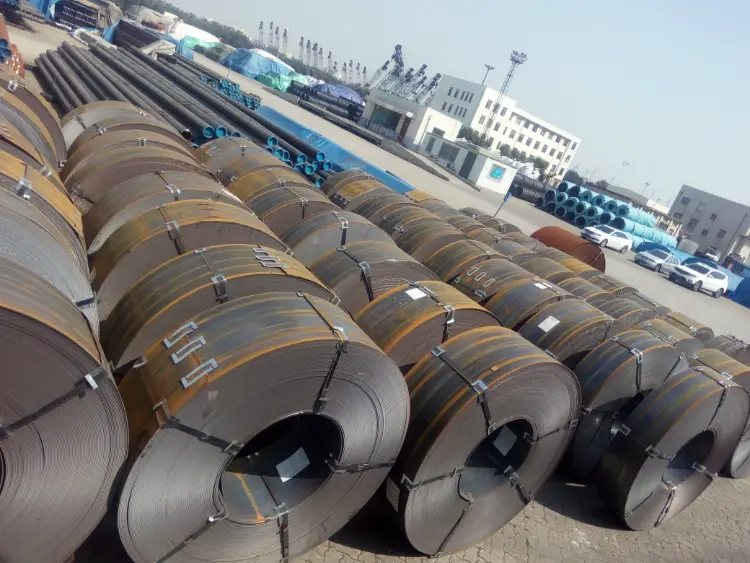
Q/BQB 310-2009 SPFH540 Hot Rolled Steel Coil
SPFH540 Hot Rolled Steel Coil – High Strength Automotive Steel Grade per Q/BQB 310-2009
Comprehensive material data for SPFH540 hot rolled steel coil according to Baosteel standard Q/BQB 310-2009. Includes chemical composition, mechanical properties, thermal & electrical properties, equivalent grades, and application guidance.
Hot rolling, controlled rolling; suitable for cold forming, bending, drawing, stamping, welding
- Phone : +8618037372205
- Email : [email protected]
- WhatsApp: Contact via Whtsapp
- WeChat: +8618037372205
Q/BQB 310-2009 SPFH540 Hot Rolled Steel Coil Introduction
SPFH540 is a hot rolled high strength low alloy (HSLA) steel grade primarily used in automotive structural applications. It is defined by Baosteel's enterprise standard Q/BQB 310-2009, which aligns with the Japanese JIS G 3134 specification for hot rolled high strength steel plates, sheets and strips for automobile structural uses.
- High tensile strength ≥540 MPa and minimum yield strength of 325 MPa
- Good formability for cold bending and moderate drawing operations
- Available as as-rolled or controlled-rolled coils with thicknesses typically up to 6 mm
- Superior weldability due to low carbon equivalent
The material is extensively used in chassis components, reinforcements, wheels, and other parts that require a balance of strength and ductility.
Q/BQB 310-2009 SPFH540 Hot Rolled Steel Coil Chemical Composition
Ladle analysis according to Q/BQB 310-2009. The steel is produced as a low carbon-manganese grade with microalloying additions (e.g., Nb, Ti) to achieve the required strength level without sacrificing formability. The limits shown are maximum values unless a range is specified.
| Element | Value (wt%) | Remarks |
|---|---|---|
| Carbon (C) | ≤0.15 | |
| Silicon (Si) | ≤0.50 | |
| Manganese (Mn) | ≤1.60 | |
| Phosphorus (P) | ≤0.030 | |
| Sulfur (S) | ≤0.025 | |
| Total Aluminum (Alt) | ≥0.010 | Sufficient for grain refining |
Q/BQB 310-2009 SPFH540 Hot Rolled Steel Coil Thermal and Electrical Physical Properties
The standard Q/BQB 310-2009 does not specify physical properties. The values listed are typical for low-carbon high-strength steels of similar composition and microstructure (ferrite-pearlite or bainitic). They serve as engineering reference for design calculations.
| Property | Typical Value | Unit | Test Condition / Remarks |
|---|---|---|---|
| Density (ρ) | 7.85 | g/cm³ | At 20 °C |
| Elastic Modulus (E) | 210 | GPa | Tensile modulus at room temperature |
| Shear Modulus (G) | 80 | GPa | Calculated from E and ν |
| Poisson's Ratio (ν) | 0.30 | — | Typical for ferritic steel |
| Coefficient of Thermal Expansion (α) | 12.5 | ×10⁻⁶/K | 20–100 °C |
| Thermal Conductivity (λ) | 45 | W/(m·K) | At 20 °C |
| Specific Heat Capacity (cp) | 460 | J/(kg·K) | At 20 °C |
| Electrical Resistivity (ρe) | 0.25 | μΩ·m | At 20 °C |
Q/BQB 310-2009 SPFH540 Hot Rolled Steel Coil Mechanical Properties
Transverse test specimens, tensile test at room temperature in accordance with Q/BQB 310-2009. The properties are guaranteed for the hot rolled and skin-passed condition. Bending test is carried out with 180° bend. The following values apply for material thickness up to 6.0 mm.
| Property | Value | Unit | Test Condition / Remarks |
|---|---|---|---|
| Yield Strength (ReH) | ≥ 325 | MPa | Upper yield point, applicable for thickness ≤ 6.0 mm |
| Tensile Strength (Rm) | ≥ 540 | MPa | Minimum requirement; typical range 540–700 MPa |
| Elongation (A80) | ≥ 21 | % | Gauge length 80 mm, thickness < 3.0 mm |
| Elongation (A) | ≥ 23 | % | Gauge length 50 mm, thickness ≥ 3.0 mm |
| Bend Test (180°) | d = 1a | No cracks on outside of bend, thickness ≤ 2.5 mm | |
| Bend Test (180°) | d = 2a | No cracks on outside of bend, thickness > 2.5 mm |
Q/BQB 310-2009 SPFH540 Hot Rolled Steel Coil Identical/Equivalent International Standards and Alternative Grades
| Country/Region | Standard | Grade | Remarks |
|---|---|---|---|
| Japan | JIS G 3134 | SPFH540 | Equivalent hot rolled high strength steel for automobile structural uses |
| Europe | EN 10149-2 | S550MC | Thermo-mechanically rolled high yield strength steel for cold forming; comparable strength level |
| International | ISO 6930-1 | FeE550 | High yield strength steel for cold forming, directly aligned with SPFH540 |
| USA | ASTM A1011/A1011M | Grade 550 (HSLAS-F) | High-strength low-alloy steel, slightly different manganese limits but equivalent mechanicals |
Q/BQB 310-2009 SPFH540 Hot Rolled Steel Coil Application Introduction
SPFH540 is specifically designed for automotive applications where weight reduction and durability are essential. Its excellent weldability and good cold formability make it ideal for manufacturing complex stamped and welded assemblies.
- Typically used in thicknesses from 1.2 mm to 6.0 mm
- Can be hot-dip galvanized or coated for corrosion protection
- Suitable for resistance spot welding, arc welding, and laser welding
Product Applications: Automotive body-in-white reinforcements, Chassis members and sub-frames, Suspension arms and trailing arms, Steel wheels and wheel rims, Cross members and longitudinal beams
Processed into products: Engine cradles, Bumper reinforcement beams, Seat frame structures, Brake backing plates, Transmission mounts, Door impact beams
Application industries: Automotive manufacturing, Commercial vehicle production, Agricultural and construction machinery, General engineering
Q/BQB 310-2009 SPFH540 Hot Rolled Steel Coil Similar/Close Substitute Materials
| Country/Region | Standard | Grade | Remarks |
|---|---|---|---|
| Japan | JIS G 3113 | SAPH440 | Lower strength grade (Rm ≥440 MPa), suitable for less demanding applications |
| Europe | EN 10149-2 | S500MC | Yield strength ≥500 MPa; slightly lower tensile but similar formability |
| Germany | DIN EN 10149-2 | QStE550TM | Thermo-mechanically rolled fine-grain steel, equivalent to S550MC |
| China | GB/T 20887.1 | HR550F | Hot rolled high strength steel with similar strength, used in automotive structure |
Notes:
For actual procurement, the exact chemical composition and mechanical properties may be further restricted by agreement between the supplier and the purchaser. Controlled rolling practices (TMCP) can be applied to improve toughness and formability beyond the minimum requirements. This material is fully recyclable and complies with ELV (End-of-Life Vehicles) directives.
- Share



