
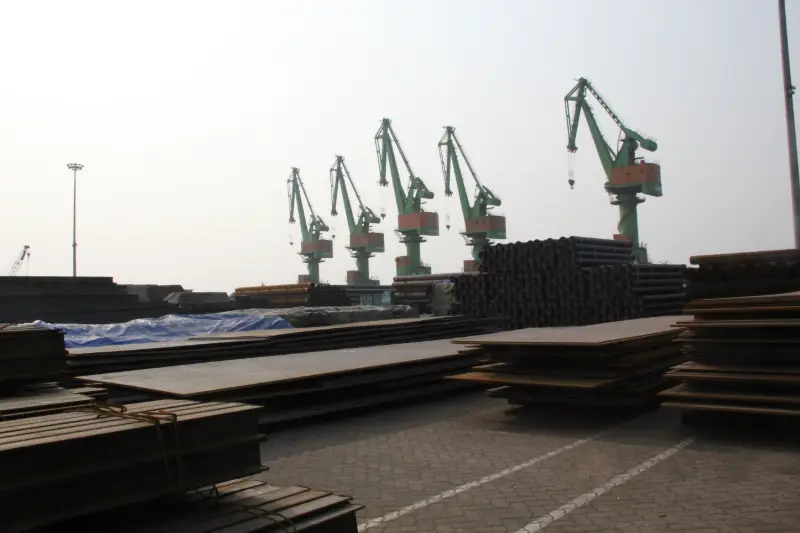
Q960F Quenched and Tempered High-Strength Steel Plate/Coil
Q960F Quenched and Tempered High-Strength Steel Plate/Coil - GB/T 16270
Q960F is a low-alloy high-strength structural steel with minimum yield strength 960 MPa, excellent toughness at -60°C, and good weldability under controlled conditions, widely used in heavy machinery, mining equipment, and bridges.
Quenching + tempering (Q+T), welding (with preheat/interpass control), flame/plasma/laser cutting, cold forming (limited), machining
- Phone : +8618037372205
- Email : [email protected]
- WhatsApp: Contact via Whtsapp
- WeChat: +8618037372205
Q960F Quenched and Tempered High-Strength Steel Plate/Coil Introduction
Q960F is a quenched and tempered carbon and low-alloy high-strength structural steel specified in the Chinese standard GB/T 16270-2009. It belongs to the Q960 strength class and the F quality grade, which demands guaranteed Charpy V-notch impact energy at -60°C. The steel is produced by electric arc furnace or converter melting, followed by precise control of rolling and heat treatment (quenching + tempering) to achieve a fine-grained microstructure with a minimum yield strength of 960 MPa and tensile strength in the range of 980–1150 MPa.
The alloy design features low carbon content (≤0.20%) with additions of Mn, Cr, Ni, Mo, and microalloying elements (Nb, V, Ti, B) to promote deep hardenability and precipitation strengthening while maintaining good toughness. Q960F is especially suitable for welded heavy-duty structures operating in severe cold climates or under high dynamic loads.
- High strength-to-weight ratio
- Excellent low-temperature impact toughness (≥27 J at -60°C)
- Good weldability with proper preheating and low-hydrogen processes
- Available in plate, strip, and coil form
Q960F Quenched and Tempered High-Strength Steel Plate/Coil Chemical Composition
The limits below are in accordance with GB/T 16270-2009 for grade Q960F. All values are maximum unless a range or minimum is indicated. Microalloying elements are added for grain refinement and precipitation hardening. The steel shall have a sufficient aluminum or other nitrogen-binding element content to ensure fine grain practice.
| Element | Standard Value (wt%) | Remarks |
|---|---|---|
| C | ≤ 0.20 | Carbon equivalent CEV typically limited to ≤0.65% (thickness ≤50 mm) |
| Si | ≤ 0.80 | Deoxidation element |
| Mn | ≤ 1.70 | Main strengthening and toughness enhancer |
| P | ≤ 0.020 | Impurity, controlled for toughness |
| S | ≤ 0.010 | Impurity, kept very low for ductility |
| Cr | ≤ 1.20 | Hardenability element |
| Ni | ≤ 2.00 | Improves toughness and hardenability, especially at low temperature |
| Mo | ≤ 0.70 | Hardenability and temper resistance |
| Cu | ≤ 0.50 | Residual element; may be added for weather resistance |
| Nb | ≤ 0.06 | Grain refiner and precipitation strengthener |
| V | ≤ 0.12 | Precipitation strengthener, also refines grain |
| Ti | ≤ 0.05 | Grain refiner, nitrogen fixer |
| B | ≤ 0.005 | Strong hardenability agent in trace amounts |
| N | ≤ 0.015 | Controlled to avoid detrimental effects |
| Als (total Al) | ≥ 0.015 | Minimum required for fine grain practice |
Q960F Quenched and Tempered High-Strength Steel Plate/Coil Thermal and Electrical Physical Properties
These values are not specified in GB/T 16270 and are compiled from typical data for quenched and tempered high-strength steels with similar composition (e.g., S960QL/Weldox 960). They are provided for engineering calculations and simulations. Actual properties may vary slightly depending on exact heat treatment and product form.
| Property | Typical Value | Unit | Condition |
|---|---|---|---|
| Density (ρ) | 7.85 | g/cm³ | At 20°C |
| Elastic modulus (E) | 210 | GPa | At 20°C |
| Shear modulus (G) | 81 | GPa | At 20°C |
| Poisson's ratio (ν) | 0.3 | – | At 20°C |
| Thermal expansion coefficient (α) | 12.0 × 10⁻⁶ | 1/K | 20 °C – 100 °C |
| Thermal expansion coefficient (α) | 12.5 × 10⁻⁶ | 1/K | 20 °C – 200 °C |
| Thermal expansion coefficient (α) | 13.0 × 10⁻⁶ | 1/K | 20 °C – 400 °C |
| Thermal conductivity (λ) | 35 – 40 | W/(m·K) | At 20°C |
| Specific heat capacity | 460 – 480 | J/(kg·K) | At 20°C |
| Electrical resistivity (ρ_e) | 0.25 – 0.35 | µΩ·m | At 20°C |
Q960F Quenched and Tempered High-Strength Steel Plate/Coil Mechanical Properties
Data according to GB/T 16270-2009 for quenched and tempered condition. Tensile test orientation is longitudinal; impact specimens are taken in the transverse direction. For thicknesses above 100 mm, values shall be agreed upon. The impact test temperature for F grade is -60°C.
| Property | Specified Value | Unit | Test Condition |
|---|---|---|---|
| Yield strength (ReH) | ≥ 960 | MPa | Thickness ≤ 50 mm, longitudinal |
| Yield strength (ReH) | ≥ 920 | MPa | Thickness > 50 mm to ≤ 100 mm, longitudinal |
| Tensile strength (Rm) | 980 – 1150 | MPa | Thickness ≤ 50 mm |
| Tensile strength (Rm) | 950 – 1150 | MPa | Thickness > 50 mm to ≤ 100 mm |
| Elongation after fracture (A) | ≥ 10 | % | Thickness ≤ 50 mm, gauge length 5.65√S0, longitudinal |
| Elongation after fracture (A) | ≥ 9 | % | Thickness > 50 mm to ≤ 100 mm, gauge length 5.65√S0, longitudinal |
| Charpy-V impact energy (KV2) | ≥ 27 (average) | J | Transverse, -60°C, 10×10×55 mm specimen; individual min ≥ 70% of average |
| Hardness | 370 – 450 (typical) | HBW | Informative, not a requirement of the standard |
Q960F Quenched and Tempered High-Strength Steel Plate/Coil Fully Equivalent Material Standards and Replaceable Grades
| Country/Region | Standard | Grade | Remarks |
|---|---|---|---|
| China | GB/T 16270-2009 | Q960F | Reference grade |
| Europe | EN 10025-6 | S960QL1 | Charpy at -60°C; close match in composition and properties |
| Europe | EN 10025-6 | S960QL | Impact at -50°C, may need verification for -60°C application |
| International | ISO 4950-2 | S960QL1 | Adopted from European standard, identical to EN S960QL1 |
| Sweden | SSAB (proprietary) | Weldox 960 | Brand name, equivalent strength and -60°C toughness available (grade E/F) |
| Germany | Dillinger (proprietary) | DILLIMAX 960 | Comparable quenched & tempered steel |
| Japan | JIS G 3128 (historical) | SHY985N | Similar strength but rarely used; may not match -60°C impact |
Q960F Quenched and Tempered High-Strength Steel Plate/Coil Application Introduction
Q960F is designed for the most demanding structural applications where high static and dynamic loads, combined with extreme low‑temperature service, are expected. Its high yield strength allows significant weight reduction, while the guaranteed toughness at -60°C ensures safe operation in arctic and cold‑climate environments. Successful use requires attention to welding consumables, preheat/interpass temperatures, and post‑weld stress relief to avoid hydrogen cracking and to preserve mechanical properties.
Product Applications: Crane telescopic boom sections and lattice chords, Excavator front attachments (boom, arm, bucket linkages), Large‑capacity dump truck bodies and frames, Heavy‑duty trailer chassis and low‑loader beams, Bridge main girders, cross‑beams, and arch ribs, Offshore platform lifting devices and legs, Armoured vehicle hull plates and spall liners, Hydraulic press frames and high‑stress machine components
Processed into products: Cut and shaped flat parts (gussets, flanges, webs) by flame/plasma/waterjet cutting, Welded box‑section beams and tubular sections for crane booms, Rolled or press‑braked cold‑formed profiles (limited bending radii), Turned and milled parts (pins, bushings) when further heat treatment is applied, Drilled/routed plates for bolted connections in modular structures
Application industries: Heavy mobile and crawler cranes (telescopic booms, lattice booms), Mining and earthmoving machinery (excavator booms, arms, dump truck bodies), Heavy transport vehicles (trailers, low‑loaders, special transport equipment), Bridge construction (long‑span girders, truss members, orthotropic decks), Offshore and marine engineering (jack‑up rig legs, crane pedestals, hull reinforcements), Defence and military vehicles (armoured hulls, missile launchers), Pressure vessels and high‑pressure pipelines (with thickness limitations)
Q960F Quenched and Tempered High-Strength Steel Plate/Coil Near/Comparable Substitute Materials
| Country/Region | Standard | Grade | Remarks |
|---|---|---|---|
| China | GB/T 16270-2009 | Q960E | Same strength, but impact test at -40°C; not suitable for -60°C service |
| China | GB/T 28909 | Q960D/E | High strength steel for construction machinery; different delivery condition possible |
| Europe | EN 10149-2 | S960MC | Thermo-mechanically rolled (not QT), higher elongation but lower toughness at very low temperatures |
| Europe | EN 10025-6 | S890QL1 | Lower strength (890 MPa yield), higher toughness reserve, can be designed as alternative |
| USA | ASTM A1031/A1031M | Grade 100 [690] | Only 690 MPa yield, not a strength match; useful only if redesign is acceptable |
| USA | ASTM A514/A517 | Grade Q | 690 MPa yield, different performance class |
Notes:
Welding recommendations: Use low‑hydrogen consumables (E11018‑G or equivalent), preheat to 100–175°C depending on thickness, maintain interpass temperature ≤250°C. Post‑weld heat treatment is generally not required for thicknesses ≤50 mm, but if applied, tempering temperature must be below original tempering temperature.
Forming: Cold bending is possible with large radii (R/t ≥ 5), but hot forming or stress‑relief annealing may be necessary for small radii to avoid cracking. Surface protection: Can be coated with zinc‑rich primers; for heavy corrosion exposure, duplex systems are recommended.
Note on data: All listed chemical and mechanical values are taken from the official GB/T 16270-2009 standard. Physical properties are typical for this class of steel and should be confirmed with mill certificates for critical calculations.
- Share



