
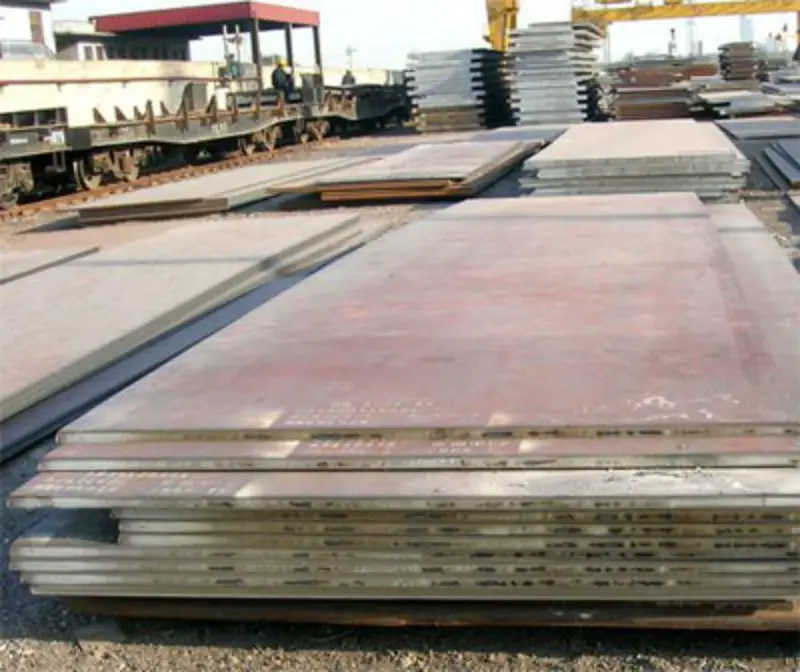
High Strength Quenched & Tempered Steel Q960D (GB/T 16270)
High Strength Quenched & Tempered Steel Q960D (GB/T 16270) - Premium Low-alloy Structural Steel Plate/Coil
Q960D is a high-strength low-alloy structural steel with minimum yield strength of 960 MPa, excellent toughness at -20°C, delivered in quenched and tempered condition. Ideal for demanding structural applications requiring high strength-to-weight ratio and good weldability.
Hot rolling followed by quenching and tempering; cold forming, hot forming (with temperature control), welding (preheat, interpass control, PWHT recommended), thermal cutting, machining.
- Phone : +8618037372205
- Email : [email protected]
- WhatsApp: Contact via Whtsapp
- WeChat: +8618037372205
High Strength Quenched & Tempered Steel Q960D Introduction
Q960D is a precipitation-hardening, quenched and tempered low-alloy high-strength structural steel specified in GB/T 16270-2009. It offers a minimum yield strength of 960 MPa and tensile strength ranging from 980 to 1150 MPa, combined with good ductility (elongation ≥10%) and reliable impact toughness at -20°C (min. 47 J). The steel exhibits excellent cold formability, weldability, and fatigue resistance when proper procedures are followed. Typical delivery condition is quenched and tempered (Q+T). It is widely used in heavy machinery, mining equipment, pressure vessels, and structural components where weight reduction and high load-bearing capacity are critical.
High Strength Quenched & Tempered Steel Q960D Chemical Composition
The chemical composition is designed to achieve high strength through quenching and tempering while maintaining good toughness and weldability. Microalloying elements Nb, V, Ti, and B refine grain size and increase precipitation hardening. Strict control of P and S ensures cleanliness and improves impact properties. All values are maximum unless otherwise indicated.
| Element | Standard Value (max, wt. %) | Remarks |
|---|---|---|
| Carbon (C) | 0.20 | Essential for strength; CEV control required for weldability |
| Silicon (Si) | 0.80 | Deoxidizer; improves strength |
| Manganese (Mn) | 2.00 | Enhances hardenability and strength |
| Phosphorus (P) | 0.020 | Controlled for toughness |
| Sulfur (S) | 0.010 | Low S for improved cleanliness and ductility |
| Chromium (Cr) | 1.50 | Increases hardenability and corrosion resistance |
| Nickel (Ni) | 2.00 | Improves toughness especially at low temperatures |
| Molybdenum (Mo) | 0.70 | Increases hardenability and temper resistance |
| Copper (Cu) | 0.50 | Optional for weathering; limited to avoid hot shortness |
| Niobium (Nb) | 0.06 | Grain refiner and precipitation hardener |
| Vanadium (V) | 0.12 | Precipitation strengthening |
| Titanium (Ti) | 0.05 | Grain refinement and nitrogen fixation |
| Boron (B) | 0.005 | Powerful hardenability agent in micro amounts |
| Nitrogen (N) | 0.015 | Typically bound by Ti or Al |
| Aluminum (total Al) | ≥0.015 | Deoxidizer and grain refiner; minimum required |
High Strength Quenched & Tempered Steel Q960D Thermal and Electrical Physical Properties
Physical properties are representative for quenched and tempered low-alloy high-strength steel at room temperature unless stated otherwise. These values can be used for design calculations and modeling. Thermal expansion and conductivity vary slightly with tempering temperature.
| Property | Typical Value | Unit | Test Condition |
|---|---|---|---|
| Density (ρ) | 7.85 | g/cm³ | 20°C |
| Elastic modulus (E) | 210 | GPa | Room temperature |
| Shear modulus (G) | 81 | GPa | Calculated from E and ν |
| Poisson's ratio (ν) | 0.29 – 0.31 | — | Room temperature |
| Thermal expansion coefficient (α) | 11.5 × 10⁻⁶ | K⁻¹ | 20–100°C average |
| Thermal expansion coefficient (α) | 12.2 × 10⁻⁶ | K⁻¹ | 20–200°C |
| Thermal conductivity (λ) | ~ 35 – 40 | W/(m·K) | At 20°C |
| Specific heat capacity (cp) | 460 – 480 | J/(kg·K) | 20°C |
| Electrical resistivity (ρ_e) | 0.25 – 0.30 | µΩ·m | 20°C |
High Strength Quenched & Tempered Steel Q960D Mechanical Properties
Mechanical properties are guaranteed after quenching and tempering. Values depend on thickness and test orientation. Tensile specimens are taken in transverse direction unless otherwise agreed. Impact tests are performed on longitudinal Charpy-V specimens at -20°C for D-grade. Note: For thickness >50 mm, a slightly reduced yield strength may apply as per the standard.
| Property | Standard Requirement | Unit | Testing Condition / Remarks |
|---|---|---|---|
| Yield Strength (ReH) | ≥ 960 | MPa | Thickness ≤ 50 mm, transverse |
| Yield Strength (ReH) | ≥ 930 | MPa | Thickness > 50–100 mm, transverse |
| Tensile Strength (Rm) | 980 – 1150 | MPa | Thickness ≤ 50 mm |
| Tensile Strength (Rm) | 900 – 1100 | MPa | Thickness > 50–100 mm |
| Elongation after fracture (A) | ≥ 10 | % | Gauge length 5.65√S₀ (proportional), thickness ≤ 50 mm |
| Elongation after fracture (A) | ≥ 10 | % | Thickness > 50–100 mm |
| Charpy Impact Energy (KV₂) | ≥ 47 | J | Longitudinal, -20°C, average of 3 specimens |
| Bend test (d = bending diameter) | d = 3t | - | 180° bend for plates up to 12 mm; tensile side free of cracks |
| Reduction of area (Z) | Not specified, typically ≥ 40 | % | For information only |
High Strength Quenched & Tempered Steel Q960D Recommended Equivalent Material Standards and Grades
| Country/Region | Standard | Grade | Remarks |
|---|---|---|---|
| International (ISO) | ISO 4950-2 | E960D | Yield ≥ 960 MPa, QT condition, impact at -20°C |
| European Union | EN 10025-6 | S960QL | Lower CVN requirement (27J min), often used interchangeably; check impact temperature (-40°C for L) |
| Germany (superseded) | DIN EN 10025-6 | S960Q | Same as EN; S960Q has no specified minimum impact temp., S960QL is -40°C |
| Japan | JIS G 3128 | SHY685NS | Higher tensile range (780-930 MPa), not direct match; similar concept |
| USA | ASTM A514 / A517 | Grade S | Yield ~690 MPa; Q960D is stronger; only similar in QT low-alloy concept |
| China | GB/T 16270 | Q960E | Tighter impact (-40°C) if lower temperature toughness is required |
High Strength Quenched & Tempered Steel Q960D Application Introduction
Q960D steel is engineered for weight-critical, high-stress applications where failure is not an option. It is supplied in quenched and tempered condition with excellent flatness and surface quality. Welding procedures must follow low hydrogen practices, adequate preheat (<100°C typically), and control of heat input to avoid softening in the heat-affected zone. Post-weld heat treatment may be required for thick sections. The steel can be cold-formed to tight radii with springback compensation. It is often used as a replacement for S690QL to reduce weight by 20-30%.
Product Applications: Crane booms, jibs, and telescopic sections, Excavator and loader buckets, cutting edges, Dump truck bodies and frames, Offshore crane pedestals and boom rests, Bridge box girders and orthotropic decks, High-pressure vessels and hydraulic cylinders, Armored plates for personal and vehicle protection
Processed into products: Welded structural beams and columns for high-rise buildings, Chassis frames for special vehicles, Sheaves, pulleys, and lifting eyes, Piston rods and cylinder barrels, Fatigue-critical welded joints in rotating machinery, Mining drill mast and A-frame components, Offshore wind turbine transition pieces
Application industries: Heavy mobile and crawler cranes, Mining and earthmoving equipment, Offshore and marine lifting equipment, Bridge construction (high-strength elements), Pressure vessel and boiler engineering, Defense and military vehicle structures (armored steels), General heavy engineering and machinery
High Strength Quenched & Tempered Steel Q960D Similar/Alternative Materials with Proximate Performance
| Country/Region | Standard | Grade | Remarks |
|---|---|---|---|
| China | GB/T 16270 | Q890D | Yield ≥ 890 MPa, slightly lower strength; same -20°C impact; may be substituted with thickness compensation |
| China | GB/T 16270 | Q960C | Same strength but impact at 0°C; acceptable if low-temperature toughness is not critical |
| European Union | EN 10025-6 | S890QL | Yield ≥ 890 MPa; good toughness at -40°C; an alternative when 960 MPa not required |
| Sweden | SSAB Strenx | Strenx 960 | Commercial brand with guaranteed properties similar to Q960D (often exceeding standard requirements) |
| International (ISO) | ISO 4950-2 | E890DD | Yield ≥ 890 MPa, impact -20°C; next lower grade in ISO system |
Notes:
- The steel is generally supplied with an inspection certificate to EN 10204 type 3.1 or 3.2 as agreed.
- Ultrasonic testing to GB/T 2970 or equivalent may be specified for plates.
- Heavy plates (>20 mm) require controlled preheating during welding (typically 50–100°C) and low hydrogen electrodes.
- Maximum recommended service temperature in quenched condition is usually below the tempering temperature (typically 550–600°C).
- For thicknesses above 100 mm, property reduction must be considered; alternative grades like Q960E may be required for through-thickness properties (Z-quality).
- Share



