
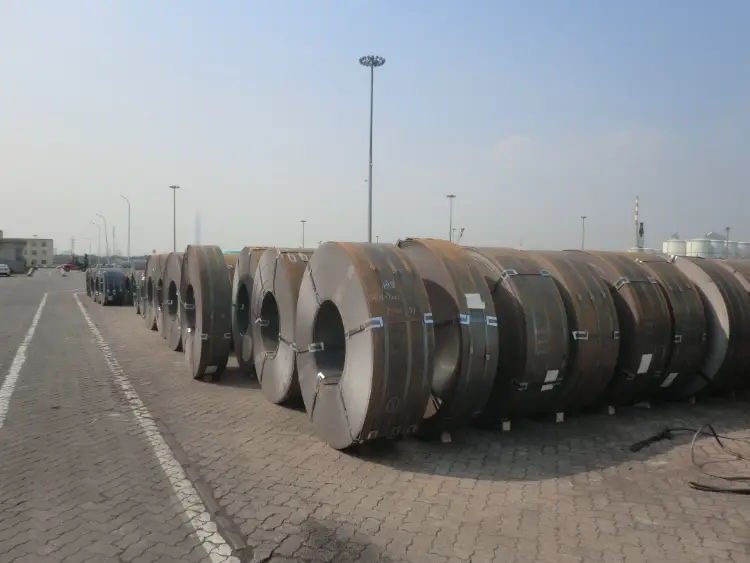
GB/T 16270 Q960C Carbon and Low-alloy High-strength Steel Coil
GB/T 16270 Q960C Carbon and Low-alloy High-strength Steel Coil - Technical Datasheet
In-depth material data for Q960C quenched and tempered structural steel coil according to Chinese standard GB/T 16270, including chemistry, mechanical properties, thermal/physical characteristics, and international equivalents.
Thermal cutting, plasma/laser cutting, cold forming, welding (SMAW, GMAW, SAW), machining, shot blasting
- Phone : +8618037372205
- Email : [email protected]
- WhatsApp: Contact via Whtsapp
- WeChat: +8618037372205
GB/T 16270 Q960C Carbon and Low-alloy High-strength Steel Coil Introduction
Q960C is a high-strength structural steel grade defined in GB/T 16270, supplied in the quenched and tempered (Q+T) condition. With a minimum yield strength of 960 MPa, it belongs to the carbon and low-alloy high-strength steel family. This microalloyed, fine-grain steel is designed for heavy-duty, weight-sensitive welded structures. Key attributes include:
- Exceptional yield and tensile strength, enabling lighter designs with high load-bearing capacity.
- Guaranteed toughness at 0°C (minimum 47 J Charpy-V impact energy).
- Good weldability when using low-hydrogen procedures and controlled heat input.
- Uniform mechanical properties across plate thickness up to 150 mm.
Typical applications encompass mobile crane booms, heavy vehicle frames, bridge girders, and offshore structures where strength, toughness, and fabrication reliability are essential. The steel complies with strict limits on phosphorus, sulfur, and residual elements to ensure consistent performance.
GB/T 16270 Q960C Carbon and Low-alloy High-strength Steel Coil Chemical Composition
The following table gives the permissible chemical composition for Q960C according to GB/T 16270-2009. All values are in weight percent. The steel is fully killed and fine grain treated. Carbon equivalent (CEV) and weld cracking parameter (Pcm) are agreed upon at time of ordering. Elements not listed shall not be intentionally added.
| Element | Standard Value | Remarks |
|---|---|---|
| C | ≤ 0.20 | |
| Si | ≤ 0.80 | |
| Mn | ≤ 2.00 | |
| P | ≤ 0.020 | |
| S | ≤ 0.010 | |
| Al (total) | ≥ 0.015 | Fine grain practice |
| Nb | ≤ 0.06 | |
| V | ≤ 0.12 | |
| Ti | ≤ 0.05 | |
| Cr | ≤ 1.50 | |
| Ni | ≤ 2.00 | |
| Mo | ≤ 0.70 | |
| Cu | ≤ 0.50 | |
| B | ≤ 0.0050 |
GB/T 16270 Q960C Carbon and Low-alloy High-strength Steel Coil Thermal and Electrical Properties
The following thermal and electrical properties are representative for low-alloy, high-strength steel of this type. These values are not specified in GB/T 16270 and are provided for general engineering calculations and design reference only. They may vary slightly depending on exact composition, heat treatment, and temperature.
| Property | Typical Value | Unit | Condition |
|---|---|---|---|
| Density (ρ) | 7850 | kg/m³ | At room temperature |
| Modulus of elasticity (E) | 210 | GPa | At room temperature |
| Shear modulus (G) | 80 | GPa | Calculated |
| Poisson's ratio (ν) | 0.3 | At room temperature | |
| Thermal expansion coefficient (α) | 11.5 × 10⁻⁶ | 1/K | 20–100°C |
| Thermal conductivity (λ) | 45 | W/(m·K) | At 20°C |
| Specific heat capacity | 460 | J/(kg·K) | At 20°C |
| Electrical resistivity (ρe) | 0.20 × 10⁻⁶ | Ω·m | At 20°C |
GB/T 16270 Q960C Carbon and Low-alloy High-strength Steel Coil Mechanical Properties
The mechanical properties listed below are the minimum requirements for Q960C steel plates in the quenched and tempered condition, in accordance with GB/T 16270-2009. Tensile testing is performed on transverse specimens unless otherwise agreed. Impact testing uses standard Charpy V-notch specimens taken in the longitudinal direction.
- Yield strength varies with plate thickness.
- Elongation requirements differ for proportional (A) and non-proportional (A50) gauge lengths.
- Impact energy is guaranteed at 0°C with 47 J average and 34 J individual minimum.
| Property | Standard Requirement | Unit | Test Condition |
|---|---|---|---|
| Yield strength (ReH) | ≥ 960 | MPa | Thickness ≤ 50 mm |
| Yield strength (ReH) | ≥ 920 | MPa | Thickness > 50 to 100 mm |
| Yield strength (ReH) | ≥ 900 | MPa | Thickness > 100 to 150 mm |
| Tensile strength (Rm) | 980 – 1150 | MPa | All thicknesses |
| Elongation (A) | ≥ 10 | % | Proportional test piece, L0=5.65√S0; thickness ≤ 50 mm |
| Elongation (A) | ≥ 9 | % | Proportional test piece, L0=5.65√S0; thickness > 50 to 100 mm |
| Elongation (A) | ≥ 8 | % | Proportional test piece, L0=5.65√S0; thickness > 100 to 150 mm |
| Elongation (A50) | ≥ 12 | % | Non-proportional test piece, gauge 50 mm; thickness ≤ 50 mm |
| Elongation (A50) | ≥ 11 | % | Non-proportional test piece, gauge 50 mm; thickness > 50 to 100 mm |
| Elongation (A50) | ≥ 10 | % | Non-proportional test piece, gauge 50 mm; thickness > 100 to 150 mm |
| Impact energy (KV2) | ≥ 47 | J | 0°C, longitudinal, average of three tests |
| Impact energy (KV2) | ≥ 34 | J | 0°C, longitudinal, single test minimum |
| Bend test | Not required / by agreement | – | – |
GB/T 16270 Q960C Carbon and Low-alloy High-strength Steel Coil Exact Equivalent Standards and Replacement Grades
| Country/Region | Standard | Grade | Remarks |
|---|---|---|---|
| China | GB/T 16270 | Q960C | Original grade; available in Q960D (‑20°C impact) and Q960E (‑40°C impact) for lower temperatures. |
| Europe | EN 10025-6 | S960Q | Quenched and tempered; impact at 0°C; closely matches composition and mechanical properties. |
| International | ISO 4951-2 | S960CN | N class typically room temperature, but can be ordered with 0°C impact; equivalent when agreed. |
| Japan | Proprietary | SCC960 / WEL-TEN 960 | Japanese steelmakers produce equivalent 960 MPa Q&T grades under proprietary trademarks. |
GB/T 16270 Q960C Carbon and Low-alloy High-strength Steel Coil Application Introduction
Q960C is engineered for demanding structural applications where high strength, excellent toughness, and reliable weldability are required. It enables significant weight reduction compared to lower strength grades while maintaining structural integrity. Typical uses span a wide range of heavy engineering sectors.
Product Applications: Telescopic crane booms and outrigger boxes, Truck chassis frames and lifting equipment, Welded bridge beams and girders, Excavator booms, arms and buckets, Mining dump truck bodies and shovel components, Offshore platform structural members
Processed into products: Welded box sections for crane jibs, Bolted and welded high-strength structural nodes, Wear-resistant liners and cutting edges (hardfaced), Pressure vessel shell courses and heads, Lifting lugs and heavy-duty brackets, Reinforcement plates for heavy equipment
Application industries: Mobile and crawler cranes, Heavy-duty trucks and trailers, Bridge engineering and civil structures, Mining and earthmoving machinery, Offshore and shipbuilding, Pressure vessels and energy equipment
GB/T 16270 Q960C Carbon and Low-alloy High-strength Steel Coil Similar and Alternative Material Recommendations
| Country/Region | Standard | Grade | Remarks |
|---|---|---|---|
| Europe | EN 10025-6 | S960QL | Impact at ‑20°C; superior low‑temperature toughness compared to Q960C, but otherwise analogous. |
| China | GB/T 16270 | Q890D | Yield strength 890 MPa; a cost‑effective alternative if the full 960 MPa strength is not needed. |
| China / Europe | GB/T 16270 / EN 10025-6 | Q/QST 690 | 700 MPa class steels (S690Q, Q690D) are widely available and often more formable/weldable for slightly lower loads. |
| USA | ASTM A514/A517 | Grade S / P | Quenched and tempered steels with typical yield strength 690 MPa; not directly equivalent but sometimes used in similar heavy equipment applications. |
Notes:
Welding: Use low-hydrogen processes (SMAW with basic electrodes, GMAW with solid wire, SAW). Preheat to 100–150°C depending on thickness and CEV; maintain interpass temperature below 200°C to preserve toughness. Post-weld heat treatment (PWHT) is generally not recommended as it can reduce strength and notch toughness.
Forming: Cold bending should be performed with a minimum bend radius of 4×t (transverse) to avoid cracking. Hot working may degrade the quenched and tempered microstructure and should be followed by re‑heat treatment.
Corrosion protection: As an unalloyed/low‑alloy steel, Q960C requires protective coatings (painting, galvanizing) for outdoor exposure. Due to its high strength, hydrogen embrittlement risk during pickling or electroplating must be assessed.
- Share



