
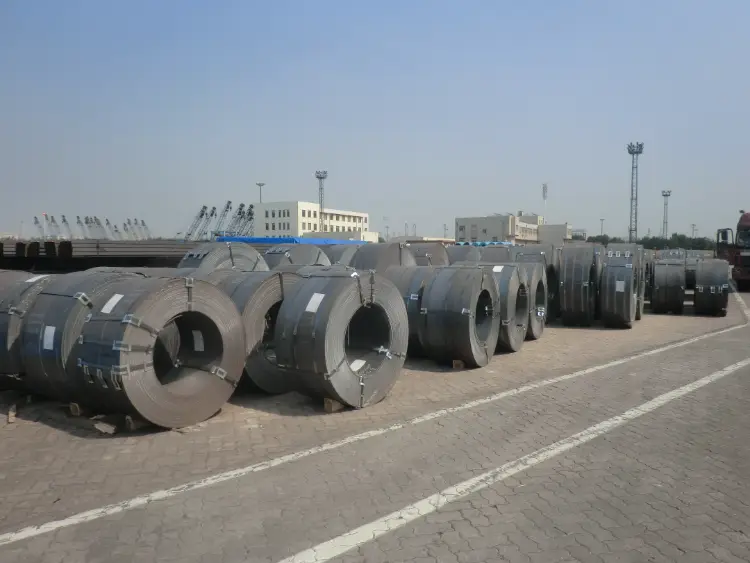
GB/T16270 Q960E High-Strength Quenched and Tempered Steel Coil
GB/T16270 Q960E High-Strength Quenched and Tempered Steel Coil
Chemical composition, mechanical properties, physical properties and equivalent grades of Q960E steel coil according to GB/T 16270.
Quenching and tempering (Q+T)
- Phone : +8618037372205
- Email : [email protected]
- WhatsApp: Contact via Whtsapp
- WeChat: +8618037372205
GB/T16270 Q960E High-Strength Quenched and Tempered Steel Coil Introduction
Q960E is a quenched and tempered high-strength low-alloy structural steel plate/coil specified in the Chinese standard GB/T 16270. It provides a minimum yield strength of 960 MPa combined with excellent low-temperature toughness down to -40°C. The steel offers good weldability when proper precautions are taken, and is widely used in demanding applications that require a high strength-to-weight ratio, such as heavy machinery, mining equipment, and high-rise structures. Its microalloyed composition ensures deep hardenability and consistent mechanical properties after heat treatment.
GB/T16270 Q960E High-Strength Quenched and Tempered Steel Coil Chemical Composition
The table below lists the chemical composition of Q960E according to GB/T 16270. Values are based on ladle analysis and represent the maximum limits unless a range is stated. The steel is low in carbon and finely balanced with microalloying elements (Nb, V, Ti, B) to achieve high strength through quench and temper hardening.
| Element | Standard Value (≤ %) | Remarks |
|---|---|---|
| C | 0.20 | max |
| Si | 0.80 | max |
| Mn | 1.70 | max |
| P | 0.020 | max |
| S | 0.010 | max |
| Cr | 1.50 | max |
| Ni | 2.00 | max |
| Mo | 0.70 | max |
| Cu | 0.50 | max |
| Nb | 0.06 | max |
| V | 0.12 | max |
| Ti | 0.05 | max |
| B | 0.005 | max |
GB/T16270 Q960E High-Strength Quenched and Tempered Steel Coil Thermal and Electrical Physical Properties
These physical properties are typical for quenched and tempered alloy structural steel and should be used for reference purposes. Actual values may vary slightly depending on the exact heat treatment condition and product form. Measurements are taken at room temperature unless stated otherwise.
| Property | Typical Value | Unit | Condition |
|---|---|---|---|
| Density (ρ) | 7.85 | g/cm³ | 20°C |
| Modulus of Elasticity (E) | 205 | GPa | 20°C |
| Shear Modulus (G) | 80 | GPa | 20°C |
| Poisson's Ratio (ν) | 0.3 | — | 20°C |
| Thermal Expansion Coefficient (α) | 11.3 | 10⁻⁶/K | 20–100°C |
| Thermal Conductivity (λ) | 42 | W/(m·K) | 20°C |
| Specific Heat Capacity (c) | 460 | J/(kg·K) | 20°C |
| Electrical Resistivity (ρe) | 0.23 | 10⁻⁶ Ω·m | 20°C |
GB/T16270 Q960E High-Strength Quenched and Tempered Steel Coil Mechanical Properties
Mechanical properties for quenched and tempered Q960E steel are tested in the transverse direction unless otherwise noted. The values below apply to product thickness ≤ 50 mm. For greater thicknesses, slight reductions in strength may be permitted according to the standard. Impact energy is determined using Charpy V-notch specimens (KV2).
| Property | Required Value | Unit | Test Condition |
|---|---|---|---|
| Yield Strength (ReH) | ≥ 960 | MPa | t ≤ 50 mm |
| Tensile Strength (Rm) | 980 – 1150 | MPa | t ≤ 50 mm |
| Elongation (A) | ≥ 10 | % | t ≤ 50 mm, L0=5.65√S0 |
| Impact Energy (KV2) | ≥ 34 (average), ≥ 24 (single) | J | -40°C, longitudinal |
| Bend Test (180°) | d=3a, no cracks | — | t ≤ 50 mm |
GB/T16270 Q960E High-Strength Quenched and Tempered Steel Coil Fully Equivalent Standards and Alternative Grades
| Country/Region | Standard | Grade | Remarks |
|---|---|---|---|
| Europe | EN 10025-6 | S960QL (1.8933) | Quenched and tempered, very similar chemical and mechanical requirements, -40°C impact toughness |
| Europe | EN 10025-6 | S960QL1 (1.8938) | Variant with increased Ni content for superior low-temperature toughness |
| International | ISO 4950-2 | S960QL | Closely aligned with the European standard, same strength and toughness levels |
GB/T16270 Q960E High-Strength Quenched and Tempered Steel Coil Application Introduction
Q960E steel is designed for demanding structural applications where weight reduction is critical without compromising strength or safety. It is supplied in the quenched and tempered condition and can be fabricated by cutting, welding, and machining if proper procedures are followed.
- Preheat and interpass temperatures must be controlled during welding to reduce hydrogen cracking risk.
- Cold forming may require higher bending radii and careful springback compensation.
- Post-weld heat treatment is generally not recommended as it may reduce the joint's strength.
Product Applications: Steel plates for structural fabrication, High-strength coils for roll-formed sections and tubes, Laser-cut and plasma-cut blanks, Welded H-beams and box sections
Processed into products: Boom and jib sections for mobile and crawler cranes, Buckets, blades, and cutting edges for mining excavators and loaders, Structural frames for heavy-duty trucks and trailers, Shell courses and heads of pressure vessels, Articulated arm and chassis components, Bridge box girders and diaphragms
Application industries: Mining and earthmoving machinery, Crane and lifting equipment, Heavy transport vehicles, Bridge and structural engineering, Pressure vessels and penstocks, Offshore and marine structures
GB/T16270 Q960E High-Strength Quenched and Tempered Steel Coil Similar and Substitution Materials
| Country/Region | Standard | Grade | Remarks |
|---|---|---|---|
| Europe | EN 10149-2 | S960MC | Thermo-mechanically rolled, high elongation, excellent cold formability; not quenched and tempered |
| China | GB/T 16270 | Q890E | Lower yield strength (≥890 MPa) within same standard, similar delivery condition and toughness |
| Germany | DIN EN 10025-6 | S960Q/QL | Predecessor designations, technically equivalent to the current EN version |
Notes:
Welding: Use low-hydrogen processes (SMAW, GMAW, SAW) with suitable filler metals matching the 960 MPa class. Preheat to 100–150°C depending on thickness; maintain interpass temperature ≤ 200°C. Slow cooling after welding is beneficial. Hot forming: Not recommended after delivery because the quenched and tempered properties would be lost. Surface condition: Delivered with a blast-cleaned and primer-painted surface upon request.
- Share



