
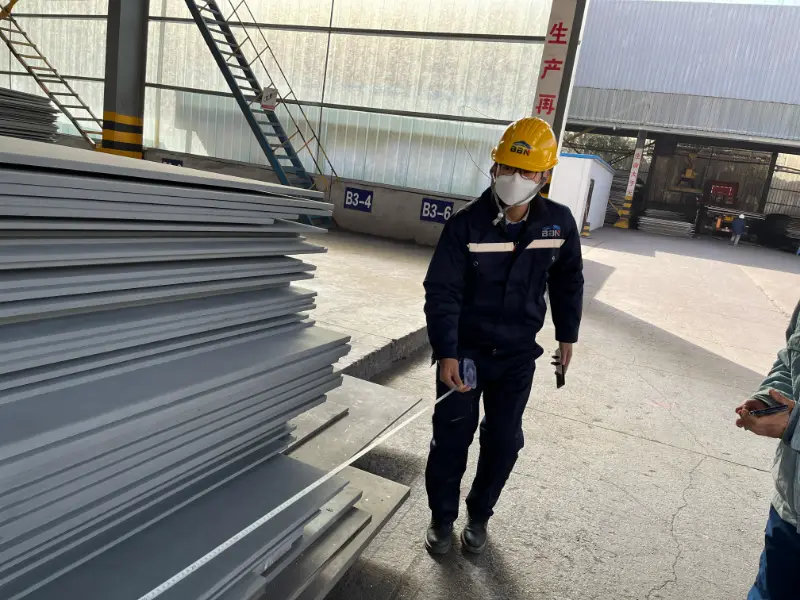
GB/T 16270 Q890E High-Strength Structural Steel
GB/T 16270 Q890E High-Strength Quenched and Tempered Steel – Properties & Equivalents
Comprehensive data sheet for Q890E structural steel according to GB/T 16270, covering chemical composition, mechanical and physical properties, international equivalents, and application guidance.
Hot rolling, Quenching and Tempering (Q+T), Cutting, Cold forming, Welding, Machining
- Phone : +8618037372205
- Email : [email protected]
- WhatsApp: Contact via Whtsapp
- WeChat: +8618037372205
GB/T 16270 Q890E High-Strength Structural Steel Introduction
Q890E is a premium carbon and low-alloy high-strength structural steel specified in the Chinese standard GB/T 16270. It is supplied in the quenched and tempered condition, achieving a minimum yield strength of 890 MPa. The "E" designation requires guaranteed impact energy at -40°C, making it suitable for severe low-temperature environments. This grade offers an excellent combination of high strength, good toughness, and weldability with proper procedures. It is widely used in heavy-duty machinery, mining equipment, pressure vessels, and structural components where weight reduction without sacrificing load capacity is critical. Typical forms include hot-rolled coils and plates that can be further cold-formed, cut, and welded.
GB/T 16270 Q890E High-Strength Structural Steel Chemical Composition
The chemical composition specified in GB/T 16270 for Q890E ensures deep hardenability and excellent mechanical properties after quenching and tempering. Low carbon content guarantees weldability, while microalloying elements such as Nb, V, Ti, and B refine grain size and improve strength/toughness balance. Phosphorus and sulfur are kept at very low levels to enhance ductility and resistance to brittle fracture.
| Element | Value (max, % unless noted) | Remarks |
|---|---|---|
| C | 0.20 | |
| Si | 0.80 | |
| Mn | 1.60 | |
| P | 0.020 | |
| S | 0.010 | |
| Cr | 1.20 | |
| Ni | 1.50 | |
| Mo | 0.70 | |
| Nb | 0.06 | |
| V | 0.12 | |
| Ti | 0.05 | |
| B | 0.005 | |
| Nb+V+Ti | 0.22 | Combined microalloying limit |
GB/T 16270 Q890E High-Strength Structural Steel Thermal and Electrical Physical Properties
The following physical properties are typical for low-alloy quenched and tempered steels like Q890E at room temperature and elevated temperatures. Data are based on standard engineering references and are not mandatory in GB/T 16270, but serve as a guide for design and processing calculations.
| Property | Typical Value | Unit | Test Condition |
|---|---|---|---|
| Density (ρ) | 7.85 | g/cm³ | 20°C |
| Modulus of elasticity (E) | 210 | GPa | 20°C |
| Shear modulus (G) | 80 | GPa | 20°C |
| Poisson's ratio (ν) | 0.3 | – | 20°C |
| Thermal expansion coefficient (α) | 12.0 × 10−⁸ | 1/K | 20–100°C |
| Thermal conductivity (λ) | 35 | W/(m·K) | 20°C |
| Specific heat capacity (c) | 460 | J/(kg·K) | 20°C |
| Electrical resistivity (ρe) | 0.20 | μΩ·m | 20°C |
GB/T 16270 Q890E High-Strength Structural Steel Mechanical Properties
Mechanical properties are guaranteed for plate/coil thickness typically ≤50 mm as per GB/T 16270. The minimum yield strength is 890 MPa, and the minimum impact energy of 27 J is tested at -40°C (longitudinal, Charpy V-notch). The bend test is performed with a mandrel diameter of 3 times the specimen thickness.
| Property | Required Value | Unit | Test Condition / Remarks |
|---|---|---|---|
| Yield strength (ReH) – min | 890 | MPa | Thickness ≤ 50 mm |
| Tensile strength (Rm) | 960 – 1130 | MPa | Thickness ≤ 50 mm |
| Elongation (A) – min | 11 | % | Thickness ≤ 50 mm, gauge length 5.65√So |
| Impact energy (KV2) – min | 27 | J | -40°C, longitudinal, Charpy V-notch |
| Bend test (180°) | d=3a | – | d = mandrel diameter, a = specimen thickness; no cracks |
GB/T 16270 Q890E High-Strength Structural Steel Directly Equivalent Standards and Substitutable Grades
| Country/Region | Standard | Grade | Remarks |
|---|---|---|---|
| Europe | EN 10025-6 | S890Q | Technical delivery conditions for flat products of high yield strength structural steels in the quenched and tempered condition; identical strength and toughness class (Q=quenched, Q=quality S890, -E impact at -40°C via S890QL1 or S890QL) – precise match depends on delivery condition. |
| International | ISO 4951-1 | S890Q | Equivalent high yield strength bar and flat steel; Q indicates quenched and tempered, with impact class at -40°C available. |
| Japan | JIS G 3128 | SHY685 | Similar high-strength steel, but yield strength ≥685 MPa; not a direct 890 MPa equivalent, though often used in comparable applications. |
| USA | ASTM A514 | Grade Q | Quenched and tempered alloy steel plate with min yield 690 MPa (100 ksi). Not exactly 890 MPa, but belongs to the same family of high-strength structural steels. |
GB/T 16270 Q890E High-Strength Structural Steel Application Introduction
Q890E is engineered for demanding structural applications where high strength-to-weight ratio, excellent low-temperature toughness, and good weldability are required. It is delivered in the quenched and tempered condition with guaranteed mechanical properties. Welding must be performed with low-hydrogen processes and appropriate preheat/interpass temperatures to avoid cold cracking. Cold forming is feasible but requires attention to the minimum bending radius. The steel can be used for welded, bolted, and riveted structures.
Product Applications: Excavator booms, arms, and buckets, Mobile crane telescopic booms and outriggers, Dump truck bodies and trailer frames, Heavy-duty structural frames and support beams, Offshore platform legs and bracings, Penstocks and pressure pipes, Armor plates for military vehicles
Processed into products: Welded structural members (H-beams, box sections), Machined pins, bushings, and thick plates, Cold-formed profiles (with relieving of residual stresses), Cut-to-shape wear plates and liners, Bent flanges and stiffeners
Application industries: Construction and Infrastructure (heavy steel structures, bridges), Mining and Earthmoving Equipment, Offshore Engineering and Shipbuilding, Mobile Cranes and Lifting Equipment, Pressure Vessels and Storage Tanks, Hydroelectric and Thermal Power Generation, Military and Armor Plating
GB/T 16270 Q890E High-Strength Structural Steel Similar / Alternative Grades with Slightly Different Strength Levels
| Country/Region | Standard | Grade | Remarks |
|---|---|---|---|
| China | GB/T 16270 | Q960E | Higher strength grade in the same standard; yield ≥960 MPa, similar toughness at -40°C. |
| China | GB/T 16270 | Q690E | Lower strength grade; yield ≥690 MPa, same impact temperature. Often used when slightly lower strength is acceptable with better formability. |
| Europe | EN 10025-6 | S960Q | European 960 MPa grade; quenched and tempered, impact down to -40°C available as S960QL1. |
| Europe | EN 10025-6 | S690Q | European 690 MPa grade, widely used for mobile cranes and structural applications. |
Notes:
- All mechanical property values are minimum required unless a range is indicated.
- Thicker sections may have slightly reduced strength and toughness; always refer to the latest GB/T 16270 standard for thickness-dependent reductions.
- Post-weld heat treatment (PWHT) is usually not required for thicknesses up to 50 mm if proper welding procedures are followed, but stress relieving may be applied as per design requirements.
- The boron addition (max 0.005%) significantly improves hardenability; therefore strict control of welding heat input is recommended.
- Ultrasonic testing in accordance with GB/T 2970 or equivalent is commonly specified to ensure internal soundness.
- Share



