
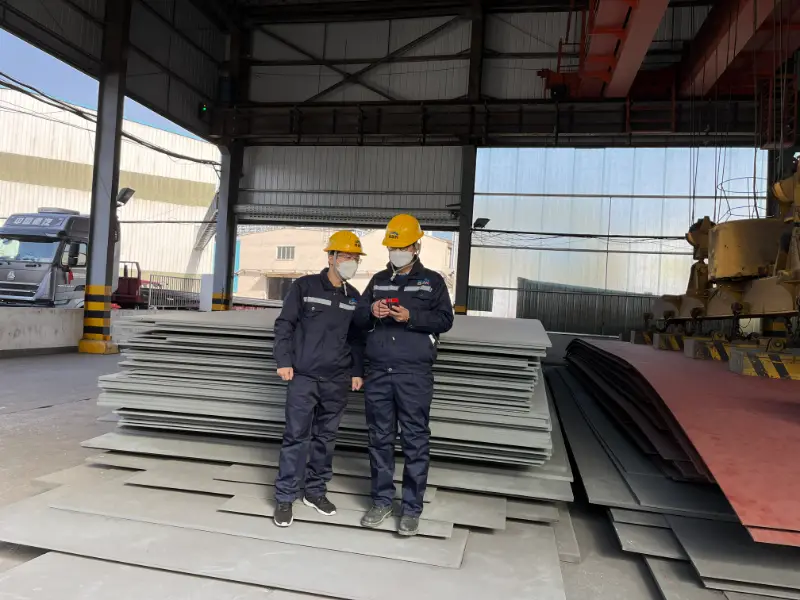
Q890D High-Strength Quenched & Tempered Steel Plate/Coil
Q890D High-Strength Quenched & Tempered Steel Plate/Coil - GB/T 16270
Q890D is a 890 MPa minimum yield strength quenched and tempered structural steel plate/coil governed by GB/T 16270, designed for heavy-duty structural applications requiring high strength, good toughness and weldability.
Hot rolling followed by quench and temper heat treatment; suited for thermal cutting, cold forming, machining, welding (with controlled heat input and preheat/interpass recommendations).
- Phone : +8618037372205
- Email : [email protected]
- WhatsApp: Contact via Whtsapp
- WeChat: +8618037372205
Q890D High-Strength Quenched & Tempered Steel Plate/Coil Introduction
Q890D is a carbon and low-alloy high-strength structural steel supplied in the quenched and tempered condition, conforming to GB/T 16270 – High Strength Structural Steel Plates in the Quenched and Tempered Condition. It provides a minimum yield strength of 890 MPa (for thickness ≤50 mm) and tensile strength in the range 940–1100 MPa, combined with excellent low-temperature impact toughness (guaranteed at -20 °C). Key features include:
- High yield-to-tensile ratio for predictable load-carrying capacity
- Good weldability with appropriate preheating and low-hydrogen procedures
- Fine-grained microstructure due to controlled additions of micro-alloying elements (Nb, V, Ti, B)
- Optimized carbon equivalent to balance strength and fabricability
- Available in plate and coil form, suitable for cutting, cold forming, welding and machining
This grade is mainly used in mobile cranes, mining equipment, heavy-duty trailers, pressure vessels, offshore structures and bridge construction where weight saving and high load-bearing capacity are essential.
Q890D High-Strength Quenched & Tempered Steel Plate/Coil Chemical Composition
The ladle analysis limits according to GB/T 16270 for Q890D. Micro-alloying elements such as Nb, V, Ti and B are added (singly or in combination) to achieve fine grain strengthening and hardenability. Aluminum is used as a deoxidizer and grain refiner. The carbon equivalent CEV ≤0.56% (typical) ensures acceptable weldability. All values are maximum unless a range is stated.
| Element | Specified Value (max, %) | Remarks |
|---|---|---|
| C | 0.20 | Carbon content for strength and hardenability |
| Si | 0.50 | Silicon for deoxidation |
| Mn | 1.60 | Manganese enhances strength and toughness |
| P | 0.020 | Phosphorus – low level for toughness |
| S | 0.010 | Sulfur – low level for cleanliness |
| Cr | 1.20 | Chromium improves hardenability and strength |
| Ni | 2.00 | Nickel enhances toughness at low temperature |
| Mo | 0.70 | Molybdenum for tempering resistance and strength |
| Cu | 0.50 | Residual element; can provide weathering resistance |
| Nb | 0.06 | Micro-alloy; grain refinement, precipitation strengthening |
| V | 0.12 | Micro-alloy; precipitation strengthening |
| Ti | 0.05 | Micro-alloy; grain refinement, nitride/carbide former |
| B | 0.005 | Boron increases hardenability at low additions |
| Alt (total aluminum) | ≥0.015 | Minimum total aluminum for grain refining |
Q890D High-Strength Quenched & Tempered Steel Plate/Coil Physical Properties
Physical properties are not specified in GB/T 16270 but are typical for quenched and tempered high-strength low-alloy steels. Actual values may vary slightly depending on heat treatment condition. These data are suitable for design calculations involving thermal loading or electrical applications.
| Property | Typical Value | Unit | Test Condition |
|---|---|---|---|
| Density (ρ) | 7.85 | g/cm³ | 20 °C |
| Elastic modulus (E) | 205 – 215 | GPa | Room temperature, static |
| Shear modulus (G) | 80 – 83 | GPa | Calculated from E and ν |
| Poisson's ratio (ν) | 0.28 – 0.30 | - | Elastic range |
| Thermal expansion coefficient (α) | 11.5 – 13.0 ×10⁻⁶ | /K | Between 20 °C and 200 °C |
| Thermal conductivity (λ) | 35 – 45 | W/(m·K) | 20 °C |
| Specific heat capacity (cp) | 450 – 480 | J/(kg·K) | 20 °C |
| Electrical resistivity (ρₑ) | 0.20 – 0.30 | μΩ·m | 20 °C |
Q890D High-Strength Quenched & Tempered Steel Plate/Coil Mechanical Properties
Mechanical properties of Q890D are tested after quenching and tempering. Values depend on thickness; below data are for plate/coil up to 50 mm (the most common delivery range). Longitudinal Charpy V-notch impact energy is guaranteed at -20 °C for D-grade designation. Bend test is performed with mandrel diameter according to plate thickness.
| Property | Specified Value | Unit | Test Condition |
|---|---|---|---|
| Yield Strength (ReH) | ≥ 890 | MPa | Thickness ≤ 50 mm, transverse |
| Tensile Strength (Rm) | 940 – 1100 | MPa | Thickness ≤ 50 mm, transverse |
| Elongation after fracture (A) | ≥ 11 | % | Gauge length L0 = 5.65√S0, longitudinal |
| Elongation after fracture (A) | ≥ 10 | % | Gauge length L0 = 5.65√S0, transverse |
| Charpy V-notch impact energy (KV2) | ≥ 34 | J | Longitudinal, -20 °C |
| Charpy V-notch impact energy (KV2) | ≥ 27 | J | Transverse, -20 °C |
| Bend test (180°) | d = 3a | - | Thickness ≤ 16 mm, width ≥ 50 mm |
| Bend test (180°) | d = 4a | - | Thickness > 16 mm to 50 mm |
Q890D High-Strength Quenched & Tempered Steel Plate/Coil Direct Equivalent Material Standards and Grades
| Country/Region | Standard | Grade | Remarks |
|---|---|---|---|
| Europe | EN 10025-6 | S890Q (+N or +QL1/QL2) | Similar chemistry and mechanical requirements; impact toughness classification (J0/J2/K2) may need alignment with D-grade (-20°C) |
| International | ISO 4950-3 | E890 DD or E890 E | Numerical designation: yield 890 MPa, DD for -20°C, direct equivalent |
| Japan | JIS G 3128 | SHY685N (nominal yield 685 MPa) | Not a full match; need grade with 890 MPa level, e.g. JFE-HITEN 890 or similar proprietary grades |
| USA | ASTM A514 / A517 | Grade S or equivalent modified | ASTM A514 only guarantees 690 MPa yield; achievable 890 MPa requires higher alloy content or proprietary grades |
| Germany (historical) | DIN EN 10025-6 | S890Q | Adopted as EN standard; equivalent |
Q890D High-Strength Quenched & Tempered Steel Plate/Coil Application Introduction
Q890D steel is designed for structural components subjected to high static and dynamic loads, where reduced weight and high strength are critical. Its quenched and tempered condition ensures uniform mechanical properties across thick sections. Typical applications span mobile equipment, heavy transport, lifting, mining and offshore industries. The material can be machined, cold formed (with sufficient bending radius), and welded using low-hydrogen techniques and controlled heat input. Post-weld heat treatment is generally not required for thickness ≤50 mm, but stress relieving may be applied for heavy sections. All design and fabrication should follow relevant engineering standards (e.g., GB 50017, EN 1993-1-12).
Product Applications: Telescopic crane booms and lattice sections, Excavator arms and bucket linkages, Heavy-duty truck chassis and subframes, Mining dump body liners, Offshore structural nodes and connections, Bridge girders and truss members, Penstocks and high-pressure pipelines
Processed into products: Welded structural members (I-beams, box sections), Cold-formed batten plates and stiffeners, Machined pins, brackets and lifting lugs, Flame-cut and drilled components for bolted connections, Turret rings and slewing bearings
Application industries: Construction machinery (cranes, excavators, bulldozers), Heavy transport and trailers (dump trucks, low-bed trailers), Mining and drilling equipment, Offshore and marine engineering (jack-up legs, shipbuilding), Bridge and infrastructure engineering, Pressure vessel and penstock manufacturing, Wind energy (tower and foundation inserts)
Q890D High-Strength Quenched & Tempered Steel Plate/Coil Similar/Alternative Materials with Close Performance
| Country/Region | Standard | Grade | Remarks |
|---|---|---|---|
| China | GB/T 16270 | Q890C | Lower impact toughness (0°C test); same strength range; may replace D-grade if low-temperature toughness not required |
| China | GB/T 16270 | Q890E | Higher impact toughness (-40°C); suitable for colder environments; can replace D-grade |
| China | GB/T 16270 | Q960D | Higher yield strength 960 MPa grade; may be used if higher strength needed but similar toughness |
| Europe | EN 10025-6 | S890QL1 | Similar to Q890D but with specified maximum carbon equivalent and improved transverse toughness |
| Japan | - | JFE-HITEN 890 | Proprietary high-strength steel with 890 MPa yield, good weldability; chemical composition tailored |
| USA | ASTM A709 | Grade HPS 100W | High-performance steel with yield up to 690 MPa; not a direct substitute but often used in similar bridge applications |
Notes:
- For thickness >50 mm, mechanical properties may be slightly reduced; consult the standard for exact values.
- Carbon equivalent CEV = C + Mn/6 + (Cr+Mo+V)/5 + (Ni+Cu)/15 ≤ 0.56% typical for this strength level.
- Preheating before welding is required depending on the combined thickness and heat input; typical preheat temperature 100–150°C.
- Post-weld heat treatment (PWHT) at 550–600°C may be applied for stress relief, but verify impact toughness after PWHT.
- Supply condition markings should include grade, heat number, and inspection stamp.
- Share



