
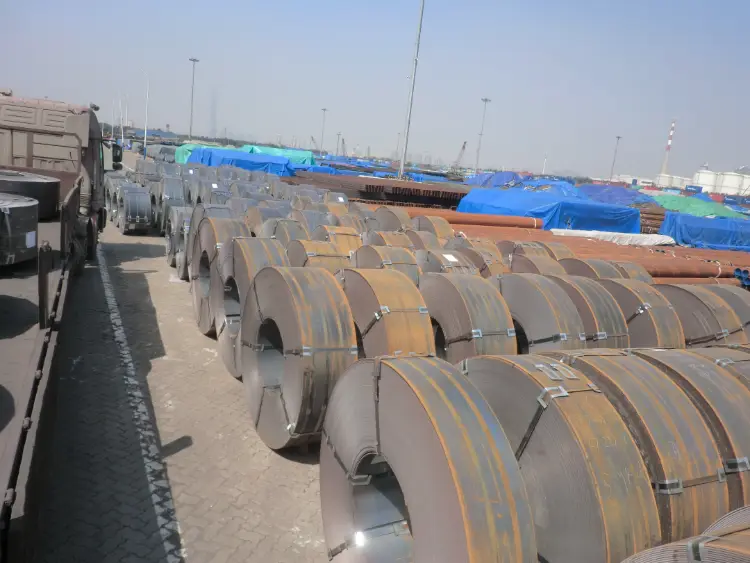
Q890C Ultra-High Strength Quenched & Tempered Structural Steel Coil
Q890C High-Strength Structural Steel Plate | GB/T 16270 Quenched & Tempered
Explore Q890C carbon and low-alloy high-strength steel under GB/T 16270, featuring min. yield strength of 890 MPa, good toughness at -20°C, and excellent weldability for heavy-duty structural applications.
Quenching and tempering, welding (with preheat), thermal cutting, cold bending, machining
- Phone : +8618037372205
- Email : [email protected]
- WhatsApp: Contact via Whtsapp
- WeChat: +8618037372205
Q890C Ultra-High Strength Quenched & Tempered Structural Steel Coil Introduction
Q890C is a high-strength, low-alloy quenched and tempered structural steel plate specified in GB/T 16270. It belongs to the group of weldable fine-grain steels with a minimum yield strength of 890 MPa in thicknesses up to 50 mm. The steel is characterized by a combination of high strength, good elongation, and reliable low-temperature impact toughness (guaranteed at -20°C). Typical applications include heavy-loaded welded structures such as crane booms, bridges, offshore platforms, and heavy machinery components where weight reduction and high load-bearing capacity are essential. Compared to traditional mild steels, Q890C enables lighter designs without sacrificing safety or durability. The material is supplied in the quenched and tempered (Q+T) condition, achieving its mechanical properties through controlled reheating and rapid cooling. Good weldability is maintained by a low carbon equivalent and controlled microalloying elements, although appropriate preheating and welding procedures are required.
Q890C Ultra-High Strength Quenched & Tempered Structural Steel Coil Chemical composition
The chemical composition conforms to GB/T 16270. Maximum values are given unless a range is specified. Microalloying elements V, Nb, and Ti are added singly or in combination to ensure fine grain size and high strength. The steel typically contains a minimum of 0.015% total aluminium or other grain-refining elements. Boron may be present to improve hardenability.
- Low carbon content ensures good weldability.
- Strict P and S limits enhance toughness and through-thickness properties.
| Element | Mass fraction (≤ %) | Notes |
|---|---|---|
| Carbon, C | ≤0.20 | Maximum |
| Silicon, Si | ≤0.80 | Maximum |
| Manganese, Mn | ≤1.80 | Maximum |
| Phosphorus, P | ≤0.025 | Maximum |
| Sulfur, S | ≤0.015 | Maximum |
| Chromium, Cr | ≤1.20 | Maximum |
| Nickel, Ni | ≤2.00 | Maximum |
| Molybdenum, Mo | ≤0.70 | Maximum |
| Copper, Cu | ≤0.50 | Maximum |
| Vanadium + Niobium + Titanium, V+Nb+Ti | ≤0.22 | Sum of microalloying elements |
| Boron, B | ≤0.005 | Optional for hardenability |
Q890C Ultra-High Strength Quenched & Tempered Structural Steel Coil Physical properties
The following physical properties are representative for Q890C in the quenched and tempered condition at room temperature, unless otherwise noted. These values are typical for low-alloy high-strength steels and may vary slightly depending on actual composition and heat treatment.
- The density used for calculation of weight is 7850 kg/m³.
- Thermal conductivity and specific heat capacity are measured at 20°C; values change with temperature.
| Property | Value | Unit | Test condition |
|---|---|---|---|
| Density (ρ) | 7850 | kg/m³ | Room temperature |
| Modulus of elasticity (E) | 210 | GPa | Room temperature |
| Shear modulus (G) | ≈81 | GPa | Calculated from E and ν |
| Poisson's ratio (ν) | 0.3 | — | Room temperature |
| Thermal expansion coefficient (α) | 11.5 × 10⁻⁶ | 1/K | 20–100°C |
| Thermal conductivity (λ) | 45 | W/(m·K) | At 20°C |
| Specific heat capacity (c) | 460 | J/(kg·K) | At 20°C |
| Electrical resistivity (ρₑ) | 0.20 × 10⁻⁶ | Ω·m | At 20°C |
Q890C Ultra-High Strength Quenched & Tempered Structural Steel Coil Mechanical properties
These properties are obtained on test pieces taken in the transverse direction for tensile testing and longitudinal direction for impact testing, in accordance with GB/T 16270. Values vary with plate thickness. The yield strength is specified as the upper yield strength (ReH). Impact energy is measured on Charpy V-notch specimens at -20°C.
- For thicknesses beyond 100 mm, properties shall be agreed upon.
- Bending tests are performed on transverse specimens with the axis of bending parallel to the rolling direction.
| Property | Value | Unit | Test condition |
|---|---|---|---|
| Yield strength (ReH) | ≥890 | MPa | Plate thickness ≤ 50 mm |
| Yield strength (ReH) | ≥830 | MPa | Plate thickness > 50–100 mm |
| Tensile strength (Rm) | 940–1100 | MPa | All thicknesses |
| Elongation after fracture (A) | ≥12 | % | Plate thickness ≤ 50 mm; gauge length 5.65√S₀ |
| Elongation after fracture (A) | ≥11 | % | Plate thickness > 50–100 mm |
| Charpy impact energy (KV₂) | ≥34 (single min.) | J | -20°C; longitudinal direction |
| Bend test (bend angle 180°) | d = 3a | — | Thickness ≤ 16 mm; transverse specimen, d = mandrel diameter, a = specimen thickness |
| Bend test (bend angle 180°) | d = 4a | — | Thickness > 16–50 mm |
Q890C Ultra-High Strength Quenched & Tempered Structural Steel Coil Fully equivalent standards & recommended substitute grades
| Country/Region | Standard | Grade | Remarks |
|---|---|---|---|
| Europe | EN 10025-6 | S890Q | Equivalent quenched and tempered steel; min. ReH 890 MPa (≤50 mm); impact at -20°C (27J) |
| Europe | EN 10025-6 | S890QL | Higher toughness at -40°C; otherwise similar strength levels |
| USA | ASTM A514/A514M | Grade E | Similar tensile strength range (approx. 760–895 MPa yield; 895 min tensile typical for thin-gauge). Suitable substitute with careful design check on yield strength. |
| International | ISO 4950-2 | S890Q | Similar designation and property requirements for high yield strength structural steel |
Q890C Ultra-High Strength Quenched & Tempered Structural Steel Coil Application Introduction
Q890C steel is primarily used in heavy structural engineering where high strength-to-weight ratios and reliable toughness at sub-zero temperatures are required. It can be formed, welded, and machined using standard practices with appropriate precautions.Key application sectors:
- Mobile cranes and crawler cranes – telescopic booms, lattice chords.
- Bridge engineering – main girders, arch ribs, box sections.
- Offshore and marine – jack-up rig legs, heavy lift crane pedestals.
- Mining and earthmoving – dump truck frames, excavator booms, high-wear structural parts.
- Pressure vessels and penstocks – when high strength allows thinner walls.
Product Applications: Telescopic crane booms, Bridge main girders and trusses, Offshore platform leg chords and racks, Large mining truck bodies and frames, Hydraulic excavator arms, High-pressure penstock pipes
Processed into products: Welded box sections and stiffened panels, Boom profiles and lattice members, Support beams and cross girders, Wear plates and reinforcement ribs, Flanges and web plates for welded I-beams
Application industries: Construction & heavy lifting, Infrastructure / Bridge, Offshore & marine, Mining & quarring, Hydropower & energy
Q890C Ultra-High Strength Quenched & Tempered Structural Steel Coil Similar/near-equivalent materials
| Country/Region | Standard | Grade | Remarks |
|---|---|---|---|
| China | GB/T 16270 | Q890D | Higher toughness at -40°C; identical chemical and tensile requirements |
| China | GB/T 16270 | Q960C | Higher yield strength class (≥960 MPa), similar impact test temperature (-20°C) |
| Europe | EN 10025-6 | S960Q | Next strength class (min. ReH 960 MPa); similar alloy design |
| Japan | JIS G3128 | SHY685 | Lower strength; yield 685 MPa class, not direct substitute but same family of high-strength steel |
Notes:
- Welding: Preheating (typically 100–150°C) and slow cooling are recommended to avoid hydrogen cracking; low-hydrogen consumables should be used. Post-weld heat treatment (PWHT) may be required for thick sections, but careful control is needed to avoid loss of strength.
- Forming: Cold bending radii should be generous – minimum 4t for transverse bending; hot forming may require re-tempering.
- Surface condition: Supplied as-rolled and descaled, or blasted and primed according to agreement.
- Ultrasonic testing: Often specified to EN 10160 Class S2/E2 or equivalent for demanding applications.
- Share



