
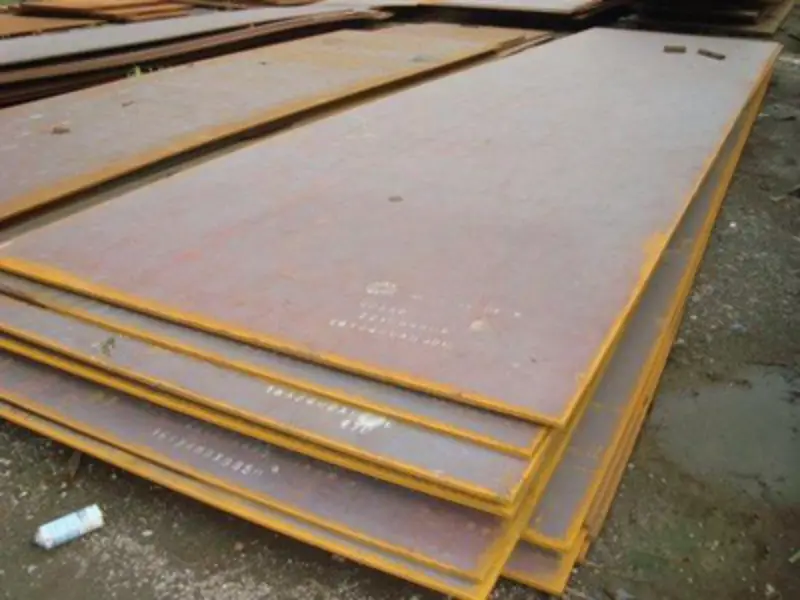
GB/T 16270 Q890F High-Strength Quenched and Tempered Steel Plate and Coil
GB/T 16270 Q890F High-Strength Quenched and Tempered Steel Plate and Coil
Q890F steel under GB/T 16270 is a low-alloy high-strength structural steel with minimum yield strength 890 MPa, supplied in quenched and tempered condition, featuring excellent low-temperature toughness down to -60°C.
Quenching and tempering (heat treatment), welding, bending, machining
- Phone : +8618037372205
- Email : [email protected]
- WhatsApp: Contact via Whtsapp
- WeChat: +8618037372205
GB/T 16270 Q890F High-Strength Quenched and Tempered Steel Plate and Coil Introduction
Q890F is a high-strength structural steel specified in Chinese standard GB/T 16270, designed for applications requiring superior strength and toughness. It belongs to the category of quenched and tempered low-alloy steels, offering a minimum yield strength of 890 MPa. The 'F' designation indicates fine-grain practice and ensures reliable impact energy absorption at -60°C, making it suitable for extreme environments. With carefully controlled chemical composition including carbon, manganese, and micro-alloying elements (V, Nb, Ti), Q890F exhibits excellent weldability and formability, combined with high resistance to brittle fracture. It is widely used in heavy-duty machinery, bridges, offshore structures, and pressure vessels.
GB/T 16270 Q890F High-Strength Quenched and Tempered Steel Plate and Coil Chemical Composition
The chemical composition of Q890F steel is carefully controlled to achieve high strength and toughness. Micro-alloying elements such as V, Nb, and Ti are added for grain refinement and precipitation hardening. Low phosphorus and sulfur levels ensure high purity and excellent impact properties. Carbon equivalent (CEV) is limited to provide good weldability; typically CEV ≤0.65 agreed between manufacturer and purchaser. Aluminium is required for fine-grain practice.
| Chemical Element | Standard Value (wt%) | Remarks |
|---|---|---|
| C | ≤0.20 | Max |
| Si | ≤0.80 | Max |
| Mn | ≤2.00 | Max |
| P | ≤0.020 | Max |
| S | ≤0.010 | Max |
| Cr | ≤1.50 | Max |
| Ni | ≤2.00 | Max |
| Mo | ≤0.70 | Max |
| Cu | ≤0.50 | Max |
| B | ≤0.005 | Max |
| V | ≤0.12 | Optional; V+Nb+Ti ≤0.22 |
| Nb | ≤0.06 | Optional; V+Nb+Ti ≤0.22 |
| Ti | ≤0.05 | Optional; V+Nb+Ti ≤0.22 |
| Al (total) | ≥0.015 | Min, for grain refinement |
GB/T 16270 Q890F High-Strength Quenched and Tempered Steel Plate and Coil Thermophysical and Electrical Properties
The physical properties listed are typical for quenched and tempered low-alloy high-strength steels and are representative for Q890F. Variations may occur depending on exact chemical composition and heat treatment. These values are useful for design calculations involving thermal expansion, heat transfer, and electrical applications.
| Property | Typical Value | Unit | Test Condition |
|---|---|---|---|
| Density (ρ) | 7.85 | g/cm³ | At 20°C |
| Elastic modulus (E) | 205 - 210 | GPa | At 20°C |
| Shear modulus (G) | ~80 | GPa | At 20°C |
| Poisson's ratio (ν) | 0.3 | — | At 20°C |
| Thermal expansion coefficient (α) | 11.7 × 10⁻⁶ | K⁻¹ | 20–100°C |
| Thermal expansion coefficient (α) | 12.6 × 10⁻⁶ | K⁻¹ | 20–200°C |
| Thermal expansion coefficient (α) | 13.5 × 10⁻⁶ | K⁻¹ | 20–300°C |
| Thermal conductivity (λ) | ~42 | W/(m·K) | At 20°C |
| Specific heat capacity (cp) | ~460 | J/(kg·K) | At 20°C |
| Electrical resistivity (ρe) | ~0.20 × 10⁻⁶ | Ω·m | At 20°C |
GB/T 16270 Q890F High-Strength Quenched and Tempered Steel Plate and Coil Mechanical Properties
Mechanical properties of Q890F depend on plate thickness. The data below are minimum requirements except where ranges are given. Impact testing uses Charpy V-notch specimens (longitudinal direction) at -60°C with a minimum absorbed energy of 27 J. Bending tests are performed with 180° bend angle and specified mandrel diameters to verify formability. All values comply with GB/T 16270 for quality level F.
| Property | Value | Unit | Test Condition / Thickness Range |
|---|---|---|---|
| Yield Strength (ReH) | ≥890 | MPa | Thickness ≤50 mm |
| Yield Strength (ReH) | ≥870 | MPa | 50 mm < thickness ≤100 mm |
| Yield Strength (ReH) | ≥850 | MPa | 100 mm < thickness ≤150 mm |
| Tensile Strength (Rm) | 940 - 1180 | MPa | Thickness ≤50 mm |
| Tensile Strength (Rm) | 920 - 1150 | MPa | 50 mm < thickness ≤100 mm |
| Tensile Strength (Rm) | 900 - 1150 | MPa | 100 mm < thickness ≤150 mm |
| Elongation (A) | ≥12 | % | Thickness ≤50 mm, L₀=5.65√S₀ |
| Elongation (A) | ≥11 | % | 50 mm < thickness ≤100 mm |
| Elongation (A) | ≥10 | % | 100 mm < thickness ≤150 mm |
| Impact energy (KV₂) at -60°C | ≥27 | J | Longitudinal, Charpy V-notch |
| Bend test (180°) | d=3a | — | Thickness ≤16 mm, no cracks |
| Bend test (180°) | d=4a | — | 16 mm < thickness ≤50 mm |
| Bend test (180°) | d=5a | — | 50 mm < thickness ≤100 mm |
| Bend test (180°) | d=6a | — | 100 mm < thickness ≤150 mm |
GB/T 16270 Q890F High-Strength Quenched and Tempered Steel Plate and Coil Fully Equivalent Material Standards and Substitute Grades
| Country/Region | Standard | Grade | Remarks |
|---|---|---|---|
| Europe | EN 10025-6 | S890QL1 | Quenched and tempered, minimum yield 890 MPa, impact at -60°C; closest international match, but verify chemical limits. |
| International | ISO 4950-3 | E890Q | Quenched and tempered, yield 890 MPa; impact test at -20°C (E890Q) or -50°C (E890QL); not fully equivalent to -60°C toughness. |
GB/T 16270 Q890F High-Strength Quenched and Tempered Steel Plate and Coil Application Introduction
Q890F steel is ideally suited for welded structures subjected to high static and dynamic loads in low-temperature environments. Its combination of high strength, good weldability, and excellent low-temperature toughness allows weight reduction and increased payload in mobile equipment. Proper welding procedures with controlled heat input, preheating, and interpass temperature are essential to maintain mechanical properties.
Product Applications: Mobile crane booms and outriggers, Heavy-duty truck frames and chassis, Offshore platform structural components, Hydraulic cylinders, High-pressure pipelines
Processed into products: Crane boom box sections, Pinned connection plates, Welded box girders, Support ribs and stiffeners, Base plates and flanges for heavy equipment
Application industries: Heavy machinery manufacturing, Bridge construction, Offshore and marine engineering, Mining and earthmoving equipment, Pressure vessel and storage tank fabrication
GB/T 16270 Q890F High-Strength Quenched and Tempered Steel Plate and Coil Applications of Similar or Alternative Steels
| Country/Region | Standard | Grade | Remarks |
|---|---|---|---|
| China | GB/T 16270 | Q890D | Same strength, impact at -20°C; for less demanding low-temperature applications. |
| China | GB/T 16270 | Q890E | Impact at -40°C; intermediate toughness between D and F. |
| China | GB/T 16270 | Q960F | Higher strength (min yield 960 MPa) with -60°C toughness; used when weight reduction is critical. |
| Europe | EN 10025-6 | S890QL | Impact at -50°C; similar strength but slightly lower toughness requirement. |
| USA | ASTM A514/A514M | Grade Q | Quenched and tempered alloy steel plate; minimum yield 690 MPa, tensile 760-895 MPa; lower strength but excellent weldability. |
| Japan | JIS G 3128 | SHY 685N | Yield 685 MPa, tensile 780-930 MPa; lower strength, commonly used in similar applications. |
Notes:
All data supplied conform to GB/T 16270 for grade Q890F. The steel shall be delivered in the quenched and tempered condition. Welding must follow approved procedures; preheating (typically 150–200°C) and slow cooling or post-weld heat treatment may be necessary depending on thickness and application. Surface quality and dimensional tolerances comply with the standard. For special requirements, such as ultrasonic testing or restricted chemical ranges, additional agreements between purchaser and manufacturer are recommended.
- Share



