
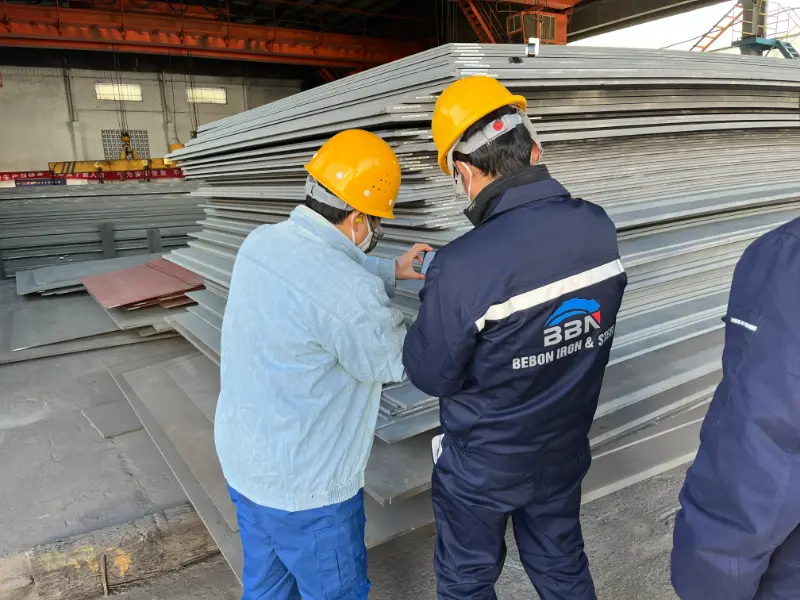
Q800F High Strength Quenched and Tempered Steel Plate
Q800F High Strength Quenched and Tempered Steel Plate | GB/T 16270
GB/T 16270 Q800F is a high-strength low-alloy steel plate supplied in quenched and tempered condition, offering a minimum yield strength of 620 MPa and excellent low-temperature impact toughness at -50°C.
Hot rolling, quenching and tempering, cutting, cold forming, welding (with preheat and post-weld treatment), machining
- Phone : +8618037372205
- Email : [email protected]
- WhatsApp: Contact via Whtsapp
- WeChat: +8618037372205
Q800F High Strength Quenched and Tempered Steel Plate Introduction
GB/T 16270 Q800F is a high-strength structural steel plate produced according to the Chinese standard GB/T 16270 High strength structural steel plates in the quenched and tempered condition. It belongs to the category of carbon and low-alloy high-strength steels, with a minimum specified yield strength of 620–670 MPa (depending on thickness) and tensile strength in the range of 800–950 MPa. The suffix 'F' denotes quality class F, which guarantees Charpy V-notch impact energy of at least 34 J at -50°C, ensuring reliable brittle fracture resistance in severe cold environments.
The steel is supplied in the quenched and tempered (Q+T) condition, which provides an optimized balance of strength, toughness, and weldability. Thanks to its fine grain microstructure and microalloying elements such as Nb, V, Ti, and B, Q800F exhibits good formability, ductility, and fatigue performance. It is extensively used in heavy-duty machinery, mining equipment, bridges, offshore structures, and pressure vessels where high load-bearing capacity and safety under dynamic stresses are crucial.
- High yield and tensile strength
- Excellent low-temperature toughness (-50°C)
- Good weldability with proper preheating
- Suitable for heavy structural applications
Q800F High Strength Quenched and Tempered Steel Plate Chemical Composition
The chemical composition of Q800F steel is controlled within the limits of GB/T 16270 to achieve desired mechanical properties after quenching and tempering. Microalloying with Nb, V, Ti, and B refines the grain and improves hardenability.
- Residual elements like Cr, Ni, Mo, Cu may be present but are not guaranteed unless agreed.
- Carbon equivalent (CEV) is typically limited to ensure weldability.
| Element | Specified Value (max, %) | Remarks |
|---|---|---|
| C | ≤ 0.20 | Carbon |
| Si | ≤ 0.50 | Silicon |
| Mn | ≤ 1.70 | Manganese |
| P | ≤ 0.020 | Phosphorus |
| S | ≤ 0.010 | Sulfur |
| Cr | ≤ 1.00 | Chromium (optional) |
| Ni | ≤ 2.00 | Nickel (optional) |
| Mo | ≤ 0.70 | Molybdenum (optional) |
| Cu | ≤ 0.50 | Copper (optional) |
| Nb | ≤ 0.06 | Niobium |
| V | ≤ 0.12 | Vanadium |
| Ti | ≤ 0.05 | Titanium |
| B | ≤ 0.005 | Boron |
Q800F High Strength Quenched and Tempered Steel Plate Thermal and Electrical Physical Properties
The following physical properties are typical for low-alloy high-strength quenched and tempered steels similar to Q800F. They are not specified in GB/T 16270 but are provided for engineering design purposes.
- Values may vary slightly depending on exact composition and heat treatment.
- Thermal expansion coefficient is given for a temperature range of 20–200°C.
| Property | Typical Value | Unit | Test Condition |
|---|---|---|---|
| Density (ρ) | 7.85 | g/cm³ | Room temperature |
| Elastic Modulus (E) | 200 – 210 | GPa | Room temperature |
| Shear Modulus (G) | ~80 | GPa | Room temperature |
| Poisson's Ratio (ν) | 0.3 | – | Room temperature |
| Thermal Expansion Coefficient (α) | 10.5 – 12.0 ×10⁻⁶ | 1/K | 20–200°C |
| Thermal Conductivity (λ) | 38 – 45 | W/(m·K) | Room temperature |
| Specific Heat Capacity (c) | 460 – 480 | J/(kg·K) | Room temperature |
| Electrical Resistivity (ρ_e) | 0.14 – 0.20 | μΩ·m | Room temperature |
Q800F High Strength Quenched and Tempered Steel Plate Mechanical Properties
Mechanical properties are tested on quenched and tempered specimens taken in the transverse direction unless otherwise agreed. The values below are minimum required according to GB/T 16270 for quality class F (impact at -50°C).
- Yield strength (ReH) decreases with increasing plate thickness.
- Elongation is measured on a gauge length of 5.65√S₀ (A5).
- Bend test: 180° bending, no cracks allowed.
- Charpy V‑notch impact test: longitudinal specimen (KV₂) ≥34 J at -50°C.
| Property | Standard Value | Unit | Test Condition |
|---|---|---|---|
| Yield Strength (ReH) | ≥ 670 | MPa | Thickness ≤ 50 mm, transverse |
| Yield Strength (ReH) | ≥ 650 | MPa | 50 mm < thickness ≤ 100 mm, transverse |
| Yield Strength (ReH) | ≥ 620 | MPa | 100 mm < thickness ≤ 150 mm, transverse |
| Tensile Strength (Rm) | 800 – 950 | MPa | All thicknesses, transverse |
| Elongation (A) | ≥ 12 | % | Thickness ≤ 100 mm, gauge 5.65√S₀ |
| Elongation (A) | ≥ 11 | % | 100 mm < thickness ≤ 150 mm, gauge 5.65√S₀ |
| Bend Test (180°) – bending diameter d = 3a | No cracks | – | Thickness ≤ 16 mm |
| Bend Test (180°) – bending diameter d = 4a | No cracks | – | Thickness > 16 mm |
| Charpy Impact Energy (KV₂) | ≥ 34 (average of 3 specimens) | J | Longitudinal, -50°C |
Q800F High Strength Quenched and Tempered Steel Plate Fully Equivalent Material Standards and Replaceable Grades
| Country/Region | Standard | Grade | Remarks |
|---|---|---|---|
| China | GB/T 16270 | Q800F | Original specification, -50°C impact |
| Europe | EN 10025-6 | S890QL | Closest European equivalent, min. YS 890 MPa, impact -40°C (QL) or -60°C (QL1) – strength slightly higher but often used as substitute. |
| International | ISO 4950-2 | E890QL | Similar to EN S890QL, yield 890 MPa, low-temperature toughness |
| Japan | JIS G 3128 | SHY685 | Yield 685 MPa, lower strength but similar application; may be used with design adjustment |
| USA | ASTM A514/A517 | Grade S | Yield 690 MPa, tensile 760–895 MPa, thickness dependent; not directly matching but widely recognized high‑strength grade |
Q800F High Strength Quenched and Tempered Steel Plate Application Introduction
Q800F combines high strength and outstanding low-temperature toughness, making it ideal for load-bearing structures operating in harsh climatic conditions. It can be processed by cutting, cold forming, and especially welding (with proper preheating and consumables). It is not recommended for direct hot-forming unless followed by re‑tempering.
- Preheating (typically 100–200°C) is advised during welding depending on thickness.
- Post-weld heat treatment is generally avoided to prevent loss of strength.
- Surface protection (painting, coating) is necessary for corrosive environments.
Product Applications: Crane booms, mobile crane chassis, truck frames, Excavator buckets, dump truck bodies, wear plates, Offshore platform legs, jack-up rig components, Bridge girders and structural nodes, High-pressure vessel shells and heads, Armor plates for light tactical vehicles
Processed into products: Welded I-beams, box girders, hollow sections, Load-bearing brackets and welded frame assemblies, Cut and machined pins, bushings, and shafts, Support rings, bearing plates, flange connections, Cold-formed stiffeners and reinforcements, Bolted splice plates and gusset plates
Application industries: Heavy machinery and earthmoving equipment, Mining and quarrying, Offshore and marine engineering, Bridge construction, Pressure vessels and storage tanks, Military and armored vehicles, Wind turbine towers and foundations
Q800F High Strength Quenched and Tempered Steel Plate Similar or Alternative Material Recommendations
| Country/Region | Standard | Grade | Remarks |
|---|---|---|---|
| China | GB/T 16270 | Q690F | Lower strength grade (YS ≥560–620 MPa), same toughness class, can be considered where lower strength is acceptable |
| Europe | EN 10025-6 | S690QL | Yield 690 MPa, -40/-60°C impact, direct downgrade alternative |
| USA | ASTM A514 | Grade B / H / Q | Yield 690 MPa, good toughness; widely available but lower tensile strength |
| Germany | DIN EN 10025-6 | S960QL | Higher strength (YS ≥960 MPa) if weight reduction is priority, but may require stricter welding control |
| Russia | GOST 19281 | 09G2S / 10HSND | Typically lower strength, not a true substitute but used in similar structural applications |
Notes:
Special requirements: Upon agreement, ultrasonic testing (UT) per GB/T 2970, through-thickness tensile test (Z‑direction properties), and hot-forming with subsequent re‑quenching and tempering can be specified.
Handling: Care must be taken during flame cutting and welding to avoid hydrogen-induced cracking. Low-hydrogen processes and controlled cooling are recommended. The steel is magnetic and can be machined with carbide tools.
Typical delivery condition: Plates are shot blasted and primed if required. Certificates according to EN 10204 3.1 are standard.
Data presented in this profile are based on GB/T 16270 and typical physical constants; they are intended for informational engineering purposes.
- Share



