
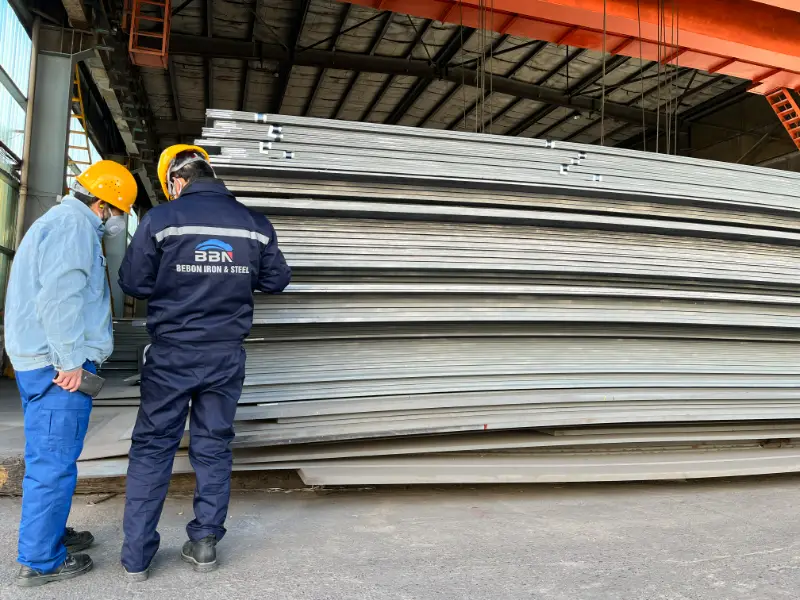
GB/T 16270 Q800D High-Strength Quenched & Tempered Steel Plate
GB/T 16270 Q800D High-Strength Quenched & Tempered Steel Plate | 800 MPa Yield, -20°C Toughness
Q800D is a quenched and tempered high-strength structural steel under Chinese standard GB/T 16270, offering minimum yield strength of 800 MPa and excellent low-temperature toughness at -20°C. Ideal for heavy-duty machinery, mining equipment, and structural applications.
Hot rolling, quenching and tempering, cutting (flame, plasma, laser), welding, forming
- Phone : +8618037372205
- Email : [email protected]
- WhatsApp: Contact via Whtsapp
- WeChat: +8618037372205
GB/T 16270 Q800D High-Strength Quenched & Tempered Steel Plate Introduction
Q800D is a high-strength quenched and tempered structural steel plate defined in GB/T 16270. It belongs to the low-alloy high-strength steel family and is designed for demanding structural applications where high load-carrying capacity and toughness at low temperatures are critical. With a minimum yield strength of 800 MPa (for thicknesses up to 50 mm), Q800D delivers an exceptional strength-to-weight ratio. The grade designation 'D' indicates guaranteed impact energy of at least 47 J at -20°C, ensuring reliable ductility in cold environments. The steel is typically supplied in the quenched and tempered condition, which provides a balanced combination of strength, toughness, and weldability. Microalloying elements such as niobium, vanadium, and titanium are used to refine grain structure and enhance precipitation hardening, while boron may be added to improve hardenability.
- Yield strength ≥ 800 MPa (≤ 50 mm thickness)
- Tensile strength 880–1100 MPa
- Excellent toughness at -20°C (≥ 47 J)
- Good weldability with proper precautions
- Supplied in quenched and tempered condition
GB/T 16270 Q800D High-Strength Quenched & Tempered Steel Plate Chemical Composition
The chemical composition limits for Q800D are shown below, as specified in GB/T 16270. Carbon content is limited to ensure weldability, while manganese, chromium, nickel, and molybdenum contribute to hardenability and strength. Microalloying with niobium, vanadium, and titanium provides grain refinement and precipitation strengthening. Boron can be added in small amounts to increase hardenability. Phosphorus and sulfur are kept low to maintain toughness and cleanliness.
- Maximum values are given unless a range is noted.
- For product analysis, tolerances per relevant standards may apply.
- Additional alloying elements may be present but are not specified.
| Element | Specified Value (max %) | Remarks |
|---|---|---|
| Carbon, C | 0.20 | |
| Silicon, Si | 0.50 | |
| Manganese, Mn | 1.50 | |
| Phosphorus, P | 0.020 | |
| Sulfur, S | 0.010 | |
| Chromium, Cr | 1.50 | |
| Nickel, Ni | 1.50 | |
| Molybdenum, Mo | 0.50 | |
| Niobium, Nb | 0.06 | |
| Vanadium, V | 0.12 | |
| Titanium, Ti | 0.05 | |
| Boron, B | 0.005 | if added to improve hardenability |
GB/T 16270 Q800D High-Strength Quenched & Tempered Steel Plate Thermal, Electrical & Physical Properties
The following physical properties are typical for quenched and tempered low-alloy steel plates similar to Q800D. Actual values may vary slightly depending on exact composition and heat treatment. These data are useful for design calculations, thermal analysis, and process planning.
- Properties are given at room temperature unless specified otherwise.
- Thermal expansion coefficient is average over the given temperature interval.
- Electrical resistivity is typical for low-alloy steel with similar alloy content.
| Property | Typical Value | Unit | Condition |
|---|---|---|---|
| Density (ρ) | 7.85 | g/cm³ | Room temperature |
| Modulus of elasticity (E) | 205 | GPa | Room temperature |
| Shear modulus (G) | 79 | GPa | Room temperature |
| Poisson's ratio (ν) | 0.30 | — | Room temperature |
| Thermal expansion coefficient (α) | 11.5 | 10⁻⁶/K | 20–100°C |
| Thermal expansion coefficient (α) | 12.5 | 10⁻⁶/K | 20–300°C |
| Thermal expansion coefficient (α) | 13.5 | 10⁻⁶/K | 20–600°C |
| Thermal conductivity (λ) | 38 | W/(m·K) | At 20°C |
| Thermal conductivity (λ) | 36 | W/(m·K) | At 200°C |
| Specific heat capacity (c) | 460 | J/(kg·K) | At 20°C |
| Electrical resistivity (ρₑ) | 0.25 | Ω·mm²/m | At 20°C |
GB/T 16270 Q800D High-Strength Quenched & Tempered Steel Plate Mechanical Properties
Mechanical properties of Q800D steel are thickness-dependent. The table below presents minimum specified values for yield strength, tensile strength, elongation, and impact energy per GB/T 16270. Tests are performed at room temperature unless otherwise noted. Longitudinal samples are used for tensile and impact testing.
- Yield strength (ReH) decreases with increasing thickness.
- Bend test is performed with a mandrel diameter of 3× plate thickness (180°).
- Impact test is mandatory: Charpy V-notch at -20°C, minimum 47 J (longitudinal).
- Values are for quenched and tempered condition.
| Property | Specified Value | Unit | Test Condition / Remarks |
|---|---|---|---|
| Yield strength (ReH) | ≥ 800 | MPa | Thickness ≤ 50 mm |
| Yield strength (ReH) | ≥ 750 | MPa | Thickness > 50–100 mm |
| Yield strength (ReH) | ≥ 700 | MPa | Thickness > 100–150 mm |
| Tensile strength (Rm) | 880–1100 | MPa | Thickness ≤ 50 mm |
| Tensile strength (Rm) | 840–1000 | MPa | Thickness > 50–100 mm |
| Tensile strength (Rm) | 800–1000 | MPa | Thickness > 100–150 mm |
| Elongation after fracture (A) | ≥ 12 | % | Thickness ≤ 50 mm, gauge length 5.65√S₀ |
| Elongation after fracture (A) | ≥ 12 | % | Thickness > 50–100 mm |
| Elongation after fracture (A) | ≥ 12 | % | Thickness > 100–150 mm |
| Charpy V-notch impact energy (KV₂) | ≥ 47 | J | At -20°C, longitudinal, individual minimum |
| Bend test (180°) | d = 3a | — | Mandrel diameter = 3 × thickness (a) |
GB/T 16270 Q800D High-Strength Quenched & Tempered Steel Plate Complete Equivalent Standards & Replacement Grades
There is no international standard that defines a steel with exactly the same chemical and mechanical requirements as Q800D. Therefore, no complete equivalent exists. However, the closest matching grades with higher strength levels are listed below. They may be considered for replacement after careful engineering evaluation, as their strength and toughness specifications differ slightly.
| Country / Region | Standard | Grade | Remarks |
|---|
GB/T 16270 Q800D High-Strength Quenched & Tempered Steel Plate Application Introduction
Q800D steel is engineered for structural components that must withstand high static and dynamic loads while operating at temperatures down to -20°C. Its high strength allows design of lighter, more efficient structures without sacrificing safety. The steel is typically delivered in quenched and tempered condition, ready for fabrication processes such as welding, cutting, and forming, though attention to preheat and heat input is essential to preserve properties. Typical application areas cover industries where heavy-duty equipment and structural integrity are paramount.
- For welded structures, low-hydrogen welding consumables and proper preheat/interpass temperature control are recommended.
- Cold forming is possible but requires sufficient press capacity; warm forming may be considered for thick sections.
- The steel is not intended for prolonged service above 400°C, as strength may degrade due to tempering effects.
Product Applications: Excavator and loader booms, arms, and buckets, Mining dump truck bodies, Mobile crane telescopic booms and outriggers, Offshore platform structural components, Armor plates for military vehicles, Pressure vessels and penstocks, Bridge girders and trusses, Wind turbine tower sections
Processed into products: Welded box sections, Cut and drilled plates for bolted assemblies, Reinforcement ribs and stiffeners, Pins and bushings (after machining from plate), Load-bearing brackets and hinges, Wear liners for material handling equipment, Structural nodes and gusset plates
Application industries: Mining and extraction, Construction and heavy civil engineering, Crane and lifting equipment, Offshore and marine engineering, Military and defense, High-pressure vessel manufacturing, Bridge building, Railway vehicles
GB/T 16270 Q800D High-Strength Quenched & Tempered Steel Plate Similar / Alternative High-Strength Steel Recommendations
The following materials are commonly used in applications similar to those of Q800D. They offer comparable or slightly higher strength and toughness characteristics and can serve as potential substitutes, provided design adjustments are made to account for the different strength levels and weldability requirements.
| Country / Region | Standard | Grade | Remarks |
|---|---|---|---|
| Europe | EN 10025-6 | S890QL (1.8925) | Quenched and tempered; minimum yield 890 MPa; -40°C toughness; closest European high-strength grade, slightly higher strength than Q800D. |
| Europe | EN 10025-6 | S960QL (1.8931) | Yield ≥ 960 MPa; significantly higher strength; suitable for weight reduction when Q800D is over-specified. |
| International | ISO 4950-2 | E890E | Quenched and tempered; 890 MPa yield; -40°C impact; equivalent to S890QL; often used in global projects. |
| Japan | JIS G 3128 | SHY685N | High yield strength plate; 685 MPa; lower strength than Q800D but with excellent toughness; suitable if lower strength is acceptable. |
| Japan | JIS G 3136 | SN490B | Structural steel for building; 490 MPa yield; only for low-demand substitutes. |
| USA | ASTM A514 / A517 | Grade Q | Quenched and tempered; 690 MPa yield; lower strength but widely available; may be an option with increased thickness. |
Notes:
- Q800D is produced in accordance with the latest revision of GB/T 16270. For exact product compliance, always refer to the material test certificate from the steel mill.
- When welding Q800D, it is essential to use matching or undermatching filler metals and to apply a suitable preheat (typically 100–200°C depending on thickness) to avoid hydrogen-induced cracking. Post-weld heat treatment is generally not required, but local stress relieving may be performed with caution to avoid strength reduction.
- The mechanical properties are guaranteed only for the as-delivered quenched and tempered condition. Hot forming or severe re-heating above tempering temperature will alter the properties.
- Ultrasonic testing (UT) according to GB/T 2970 or equivalent is often specified for thick plates to ensure internal soundness.
- Share



