
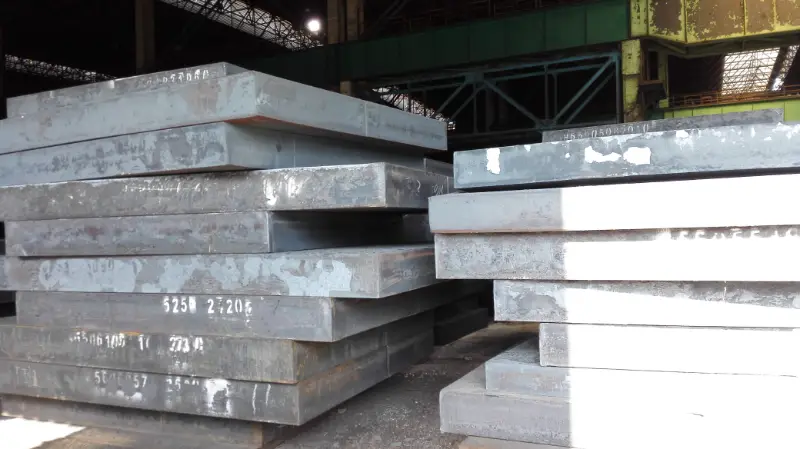
Q800C High-Strength Quenched and Tempered Steel
Q800C High-Strength Quenched and Tempered Steel - GB/T 16270 Grade Data & Equivalents
Comprehensive material data for Q800C carbon and low-alloy high-strength structural steel according to GB/T 16270. Includes chemical composition, mechanical and physical properties, international equivalents, and application guidance.
Hot rolling followed by quenching and tempering; further processing by cutting, forming, welding, and machining
- Phone : +8618037372205
- Email : [email protected]
- WhatsApp: Contact via Whtsapp
- WeChat: +8618037372205
Q800C High-Strength Quenched and Tempered Steel Introduction
Q800C is a quenched and tempered high-strength structural steel grade specified in GB/T 16270. It belongs to the carbon and low-alloy high-strength steel family, providing minimum yield strength of 800 MPa. The 'C' designation indicates that impact toughness is guaranteed at 0 °C (minimum 34 J longitudinal). The steel is delivered in the quenched and tempered condition, offering an excellent combination of strength, toughness, and weldability. Typical applications include heavy-duty machinery, crane booms, offshore structures, and pressure vessels where weight savings and high load-bearing capacity are critical.
Q800C High-Strength Quenched and Tempered Steel Chemical Composition
The chemical composition limits according to GB/T 16270 for Q800C are shown below. The steel is microalloyed with Nb, V, and Ti for grain refinement and strengthening. Low sulfur and phosphorus contents ensure good toughness and cleanliness.
- Als: total aluminum or acid-soluble aluminum ≥ 0.015% for grain size control.
- Carbon equivalent (CEV) and weldability parameters are typically controlled to meet impact and strength requirements.
| Element | Standard Value (max unless range) | Remarks |
|---|---|---|
| Carbon (C) | ≤ 0.20 | |
| Silicon (Si) | ≤ 0.80 | |
| Manganese (Mn) | ≤ 1.70 | |
| Phosphorus (P) | ≤ 0.025 | |
| Sulfur (S) | ≤ 0.015 | |
| Niobium (Nb) | ≤ 0.06 | |
| Vanadium (V) | ≤ 0.12 | |
| Titanium (Ti) | ≤ 0.05 | |
| Chromium (Cr) | ≤ 1.50 | |
| Nickel (Ni) | ≤ 2.0 | |
| Molybdenum (Mo) | ≤ 0.70 | |
| Boron (B) | ≤ 0.005 | |
| Aluminum (Al_acid-soluble) | ≥ 0.015 | Or other grain refining elements |
Q800C High-Strength Quenched and Tempered Steel Physical Properties
Physical properties are typical for low-alloy quenched and tempered steels with similar composition. Slight variations may occur depending on exact composition and heat treatment.
- Density and elastic constants are representative for engineering calculations.
- Thermal expansion, conductivity, and specific heat values are provided for the approximate temperature range 20–100 °C.
| Property | Typical Value | Unit | Conditions / Remarks |
|---|---|---|---|
| Density (ρ) | 7.85 | g/cm³ | 20 °C |
| Modulus of Elasticity (E) | 206 | GPa | 20 °C |
| Shear Modulus (G) | 80 | GPa | 20 °C |
| Poisson's ratio (ν) | 0.30 | Elastic range | |
| Thermal Expansion Coefficient (α) | 12.0 × 10−&sup6; | K−¹ | 20 – 100 °C |
| Thermal Conductivity (λ) | 42 | W/(m·K) | 20 °C |
| Specific Heat Capacity | 480 | J/(kg·K) | 20 °C |
| Electrical Resistivity (ρ_e) | 0.20 × 10−&sup6; | Ω·m | 20 °C |
Q800C High-Strength Quenched and Tempered Steel Mechanical Properties
The mechanical properties are specified for plates with thickness ≤ 50 mm. Testing is performed on transverse samples unless otherwise agreed. The impact test temperature for Q800C is 0 °C.
- Yield strength (ReH) applies to upper yield or 0.2% proof strength.
- Bend test with 180° bending and mandrel diameter = 3a (a = thickness).
- Impact energy is minimum average of three full-size Charpy V-notch specimens.
| Property | Required Value | Unit | Test Condition |
|---|---|---|---|
| Yield Strength (ReH) | ≥ 800 | MPa | Ambient; t ≤ 50 mm |
| Tensile Strength (Rm) | 880 – 1100 | MPa | Ambient; t ≤ 50 mm |
| Elongation after fracture (A) | ≥ 12 | % | Gauge length L0 = 5.65√S0; transverse |
| Bend Test (Bending angle / mandrel diameter) | 180°, d = 3a | Ambient; no cracks | |
| Impact Energy (KV2) | ≥ 34 | J | 0 °C, longitudinal, average of 3 |
Q800C High-Strength Quenched and Tempered Steel Fully Equivalent Material Standards and Substitutable Grades
| Country/Region | Standard | Grade | Remarks |
|---|---|---|---|
| No direct exact equivalent | — | — | Q800C is a unique grade under GB/T 16270. International standards do not specify a composition and property set exactly matching this grade. |
Q800C High-Strength Quenched and Tempered Steel Application Introduction
Q800C steel is designed for structures requiring extreme strength and good low-temperature toughness. It is widely employed where weight reduction without sacrificing load capacity is essential. The quenched and tempered condition ensures uniform properties through the thickness.
- Excellent weldability when proper low-hydrogen processes and preheating are used.
- Good cold-forming characteristics after tempering.
- Frequently used in mobile and fixed equipment exposed to dynamic loads.
Product Applications: High-strength plates and coils, Welded structural beams and girders, Lifting booms and telescopic arms, Offshore platform legs and nodes, Heavy-duty chassis frames, Pressurized storage tanks
Processed into products: Crane boom sections and lattice boom chords, Excavator buckets and arms, Jack-up rig legs and spudcans, Welded plate girders for bridges, Hydraulic cylinder housings, Reinforcing ribs for pressure vessels
Application industries: Crane and heavy lifting equipment, Mining machinery and earthmoving equipment, Offshore and marine engineering, Bridge construction, Pressure vessel and boiler manufacturing, Wind energy tower and foundation
Q800C High-Strength Quenched and Tempered Steel Closely Matching / Similar Substitute Materials
| Country/Region | Standard | Grade | Remarks |
|---|---|---|---|
| Europe | EN 10025-6 | S690QL | Minimum yield 690 MPa; impact at -20 °C or lower. Closest European equivalent, but yield is lower. Additional microalloying may differ. |
| Europe | EN 10025-6 | S690QL1 | Similar to S690QL with tighter limits. Not identical to Q800C. |
| USA | ASTM A514/A514M | Grade B / Grade H | Quenched and tempered alloy steel plates with yield ~690 MPa. Chemical composition differs notably. |
| Japan | JIS G 3128 | SHY 685 | High yield strength, but yield is 685 MPa minimum. Used as a bridge steel. |
Notes:
- Product analysis deviations from heat analysis shall comply with Table 3 of GB/T 16270.
- For thicknesses above 50 mm, mechanical properties may be agreed upon between manufacturer and purchaser; yield strength may be reduced.
- Preheating before welding (typically 100–175 °C) and post-weld heat treatment may be necessary to avoid hydrogen cracking.
- CEV (IIW) is usually controlled to a maximum of 0.57–0.62 depending on thickness to ensure weldability.
- Z-grade (through-thickness characteristic) can be specified according to GB/T 5313 for improved lamellar tearing resistance.
- Share



