
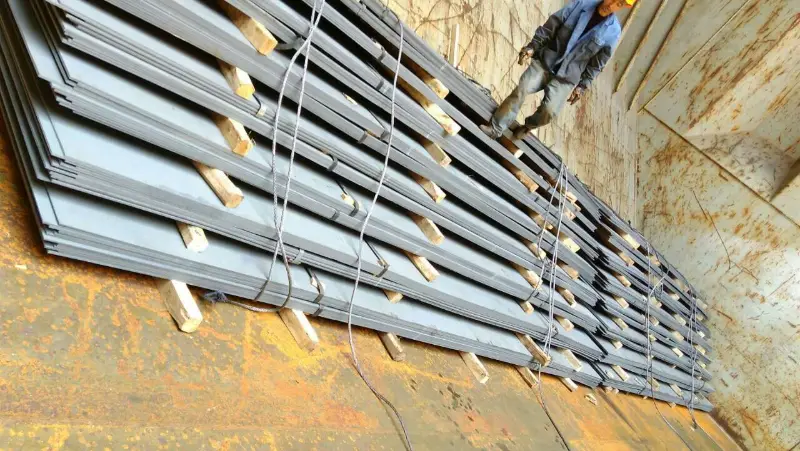
GB/T16270 Q800E Quenched & Tempered High Strength Steel Plate
Q800E High-Strength Quenched & Tempered Steel Coil to GB/T 16270
Complete material data for Q800E carbon and low-alloy high-strength steel coil according to GB/T 16270, including chemical composition, mechanical properties, and physical characteristics.
Welding, thermal cutting, cold forming (limited by high strength)
- Phone : +8618037372205
- Email : [email protected]
- WhatsApp: Contact via Whtsapp
- WeChat: +8618037372205
GB/T16270 Q800E Quenched & Tempered High Strength Steel Plate Introduction
Q800E is a quenched and tempered high-strength low-alloy structural steel specified in GB/T 16270. It delivers a minimum yield strength of 800 MPa for thicknesses up to 50 mm and guarantees excellent toughness down to -40°C (impact energy ≥27 J). With low carbon content and microalloying elements such as Nb, V, and Ti, the grade combines good weldability with high strength and ductility. Typical applications demanding weight reduction and superior load-bearing capacity benefit from its favorable strength-to-weight ratio.
- High yield and tensile strength after quenching and tempering
- Good low-temperature toughness (E class, -40°C)
- Controlled carbon equivalent (Ceq ≤0.65) for improved weldability
- Available in plate and coil form
GB/T16270 Q800E Quenched & Tempered High Strength Steel Plate Chemical Composition
Chemical composition limits according to GB/T 16270-2009 for grade Q800E. All values are maximum unless a range is specified. The steel is low in carbon and uses microalloying additions to achieve strength and toughness after quench and tempering. A minimum aluminum content is often required for grain refinement.
| Element | Specified Value (max, %) | Remarks |
|---|---|---|
| Carbon (C) | ≤0.20 | Heat analysis |
| Silicon (Si) | ≤0.80 | |
| Manganese (Mn) | ≤2.00 | |
| Phosphorus (P) | ≤0.025 | |
| Sulfur (S) | ≤0.015 | |
| Chromium (Cr) | ≤1.50 | |
| Nickel (Ni) | ≤2.00 | |
| Molybdenum (Mo) | ≤0.70 | |
| Copper (Cu) | ≤0.50 | |
| Niobium (Nb) | ≤0.06 | |
| Vanadium (V) | ≤0.12 | |
| Titanium (Ti) | ≤0.05 | |
| Boron (B) | ≤0.005 | |
| Aluminum (Alt) | ≥0.015 | Total aluminum, typical requirement for fine-grain practice |
GB/T16270 Q800E Quenched & Tempered High Strength Steel Plate Physical Properties
The following data represent typical engineering values for the low-alloy high-strength steel grade at room temperature unless otherwise noted. They are provided for design guidance and are not mandatory requirements of GB/T 16270. Actual properties may vary slightly with product form and processing.
| Property | Typical Value | Unit | Temperature / Condition |
|---|---|---|---|
| Density (ρ) | 7.85 | g/cm³ | 20 °C |
| Modulus of Elasticity (E) | 210 | GPa | 20 °C |
| Shear Modulus (G) | 81 | GPa | 20 °C |
| Poisson's Ratio (ν) | 0.3 | – | 20 °C |
| Thermal Expansion Coefficient (α) | 11.1 × 10⁻⁶ | K⁻¹ | 20 – 100 °C |
| Thermal Expansion Coefficient (α) | 11.8 × 10⁻⁶ | K⁻¹ | 20 – 200 °C |
| Thermal Expansion Coefficient (α) | 12.4 × 10⁻⁶ | K⁻¹ | 20 – 300 °C |
| Thermal Conductivity (λ) | 38 – 42 | W/(m·K) | 20 °C |
| Specific Heat Capacity (c) | 460 | J/(kg·K) | 20 °C |
| Electrical Resistivity (ρₑ) | 0.2 – 0.25 | μΩ·m | 20 °C |
GB/T16270 Q800E Quenched & Tempered High Strength Steel Plate Mechanical Properties
Minimum mechanical properties as required by GB/T 16270-2009 for grade Q800E in quenched and tempered condition. Properties depend on the nominal thickness. Charpy V‑notch impact tests are performed in the longitudinal direction at -40 °C. Bend test shows the minimum recommended former diameter.
| Property | Required Value | Unit | Test Condition (Thickness t) |
|---|---|---|---|
| Yield Strength (ReH) | ≥800 | MPa | t ≤ 50 mm |
| Yield Strength (ReH) | ≥750 | MPa | 50 < t ≤ 100 mm |
| Yield Strength (ReH) | ≥700 | MPa | 100 < t ≤ 150 mm |
| Tensile Strength (Rm) | 880 – 1100 | MPa | t ≤ 50 mm |
| Tensile Strength (Rm) | 840 – 1100 | MPa | 50 < t ≤ 100 mm |
| Tensile Strength (Rm) | 800 – 1000 | MPa | 100 < t ≤ 150 mm |
| Elongation (A) | ≥12 | % | t ≤ 50 mm, gauge length 5.65√S₀ |
| Elongation (A) | ≥12 | % | 50 < t ≤ 100 mm |
| Elongation (A) | ≥12 | % | 100 < t ≤ 150 mm |
| Charpy Impact Energy (KV₂) | ≥27 | J | -40 °C, longitudinal |
| Bend Test (180°) | d = 3a | – | t ≤ 50 mm, a = thickness |
| Bend Test (180°) | d = 4a | – | 50 < t ≤ 100 mm |
| Bend Test (180°) | d = 4a | – | 100 < t ≤ 150 mm |
GB/T16270 Q800E Quenched & Tempered High Strength Steel Plate Closest International Equivalent Grades
| Country / Region | Standard | Grade | Remarks |
|---|---|---|---|
| Europe | EN 10025-6 | S890Q | Minimum yield 890 MPa (thickness ≤50 mm); similar quenched and tempered delivery; toughness class Q (-20°C) may be upgraded to QL (-40°C) to match E class. |
| International | ISO 4950-2 / ISO 4950-3 | S890Q / S890QL | Yield and tensile ranges comparable to Q800E; ISO grades can specify -40°C with suffix QL. |
| USA | ASTM A514 / A517 | Grade B / Grade E | Minimum yield 690 MPa, lower than Q800E; used for similar heavy structural applications but with different strength level. |
| Japan | JIS G 3128 | SHY 685 | Yield strength 685 MPa class; not directly equivalent but usable for some applications after engineering assessment. |
GB/T16270 Q800E Quenched & Tempered High Strength Steel Plate Application Introduction
Q800E steel is designed for demanding structural applications where high static and dynamic loads must be sustained while minimising dead weight. Its combination of strength and low-temperature toughness makes it suitable for severe environments.
Product Applications: Welded girders and box beams for bridges, Telescopic crane booms and lattice booms, Excavator and loader arms, bulldozer blades, Heavy-duty chassis frames for off-highway vehicles, Offshore platform legs and deck structures, Penstocks and spiral casings for hydro power plants
Processed into products: Main load-bearing columns and beams, Boom chords and lattice members, Tubular joints and end connectors, Cutting edges and wear-resistant reinforcements, Complex welded sub-assemblies requiring high fatigue performance
Application industries: Heavy engineering and machinery manufacturing, Bridge construction and highway infrastructure, Offshore oil & gas platforms and shipbuilding (structural components), Mining and earthmoving equipment, Wind energy towers and foundations, Pressure vessel and boiler fabrication (with additional code approvals)
GB/T16270 Q800E Quenched & Tempered High Strength Steel Plate Similar High-Strength Steels for Reference
| Country / Region | Standard | Grade | Remarks |
|---|---|---|---|
| China | GB/T 16270 | Q690E | Lower yield strength (690 MPa); similar toughness class; cost-effective alternative when strength demand allows. |
| China | GB/T 16270 | Q960E | Higher yield strength (960 MPa); increased hardenability, but welding requires more careful heat input control. |
| Europe | EN 10025-6 | S690Q | 690 MPa class; widely used as a weldable fine grain structural steel; suitable where lower strength is acceptable. |
| Europe | EN 10025-6 | S960Q | 960 MPa class; higher strength, lower toughness may need special consideration for cold forming. |
| USA | ASTM A514 | Grade F / Grade H | 690 MPa class; good atmospheric corrosion resistance (Grade F) or higher Mn (Grade H); lower than 800 MPa. |
Notes:
- Carbon Equivalent (Ceq): typically controlled to ≤0.65 for the grade to ensure adequate weldability. Preheating and interpass temperature control may be required depending on thickness and welding process.
- Post-weld heat treatment (stress relieving) is generally not recommended because it may reduce strength; if required, a temperature below the tempering temperature must be selected.
- Cold forming capacity is limited due to high strength; minimum bending radii should follow the bend-test recommendations and spring-back must be considered.
- For ultrasonic testing and internal soundness, supplementary requirements may be agreed at the time of order (e.g., according to GB/T 2970).
- Always refer to the full GB/T 16270-2009 standard for detailed technical delivery conditions and permitted tolerances.
- Share



