
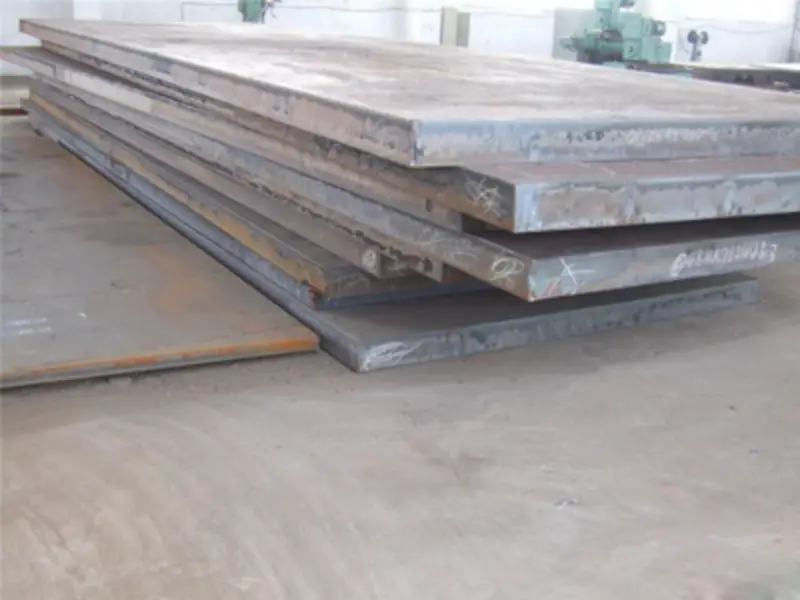
Q690E High Strength Structural Steel
Q690E High Strength Structural Steel: GB/T 16270 Properties, Equivalents & Applications
Comprehensive material data for Q690E carbon and low-alloy high-strength steel coil under GB/T 16270, covering chemical composition, mechanical properties, thermal and electrical physical values, full international equivalents, and typical applications in heavy machinery, bridges, and offshore structures.
Hot rolling + quenching and tempering; subsequent cutting, cold forming, machining, welding
- Phone : +8618037372205
- Email : [email protected]
- WhatsApp: Contact via Whtsapp
- WeChat: +8618037372205
Q690E High Strength Structural Steel Introduction
Q690E is a high strength quenched and tempered structural steel with minimum yield strength of 690 MPa, designed for welded heavy-duty structures. As per GB/T 16270, it is a carbon and low-alloy steel coil/plate that delivers excellent notch toughness at -40 °C. This grade combines high strength with good formability and weldability when proper practices are followed. Typical delivery condition is quenched and tempered (Q+T). Key features:
- High strength-to-weight ratio enabling weight reduction in heavy equipment
- Guaranteed impact energy at -40 °C (E class) for low-temperature service
- Good weldability with preheating and low-hydrogen processes
Q690E High Strength Structural Steel Chemical Composition
The chemical composition of Q690E is controlled to achieve the required strength and toughness after quenching and tempering. The table below shows the maximum allowable values according to GB/T 16270 (heat analysis). Note: The carbon equivalent (CEV) is typically limited to 0.45–0.47% to ensure weldability. Microalloying elements such as Nb, V, Ti, and B are used to refine grain size and enhance strength.
| Element | Max Value (%) | Remarks |
|---|---|---|
| C | 0.20 | Carbon, for strength and hardenability |
| Si | 0.80 | Silicon, deoxidizer |
| Mn | 1.80 | Manganese, for strength and hardenability |
| P | 0.020 | Phosphorus, controlled for toughness |
| S | 0.010 | Sulfur, controlled for cleanliness |
| Cr | 0.60 | Chromium, optional, improves hardenability |
| Ni | 0.80 | Nickel, optional, improves toughness |
| Mo | 0.30 | Molybdenum, optional, enhances temper resistance |
| Cu | 0.50 | Copper, optional, for corrosion resistance |
| Nb | 0.06 | Niobium, grain refiner |
| V | 0.10 | Vanadium, precipitation strengthening |
| Ti | 0.05 | Titanium, grain refiner and fix nitrogen |
| B | 0.005 | Boron, optional, for hardenability |
| Als | 0.015 min | Total aluminium, for deoxidation and grain refinement (if specified) |
Q690E High Strength Structural Steel Thermal and Electrical Physical Properties
Physical properties are typical for low-alloy quenched and tempered steel at room temperature unless indicated. These values are not part of the mandatory standard but are typical for design calculations. Density, thermal expansion, and conductivity are influenced by the alloy content but remain close to those of carbon steel.
| Property | Typical Value | Unit | Test Condition |
|---|---|---|---|
| Density (ρ) | 7.85 | g/cm³ | 20 °C |
| Elastic modulus (E) | 206 | GPa | 20 °C, dynamic or tensile |
| Shear modulus (G) | 79 | GPa | 20 °C, calculated |
| Poisson's ratio (ν) | 0.3 | - | Elastic range |
| Thermal expansion coefficient (α) | 12.0 – 12.5 | 10⁻⁶/K | 20–100 °C |
| Thermal expansion coefficient (α) | 13.0 – 13.5 | 10⁻⁶/K | 20–200 °C |
| Thermal conductivity (λ) | 45 – 48 | W/(m·K) | 20 °C |
| Specific heat capacity (cp) | 460 – 480 | J/(kg·K) | 20 °C |
| Electrical resistivity (ρ_e) | 0.20 – 0.25 | μΩ·m | 20 °C |
Q690E High Strength Structural Steel Mechanical Properties
Mechanical properties are verified on quenched and tempered samples according to GB/T 16270. Thickness ranges: Properties may decrease for thicker sections. The values below apply to plate thickness ≤ 50 mm unless noted otherwise. Test conditions: longitudinal direction, room temperature for tensile test, -40 °C for impact test.
| Property | Required Value | Unit | Test Condition |
|---|---|---|---|
| Yield strength (ReH) | ≥ 690 | MPa | t ≤ 50 mm |
| Yield strength (ReH) | ≥ 650 | MPa | 50 < t ≤ 100 mm |
| Yield strength (ReH) | ≥ 630 | MPa | 100 < t ≤ 150 mm |
| Tensile strength (Rm) | 770 – 940 | MPa | t ≤ 50 mm |
| Tensile strength (Rm) | 740 – 940 | MPa | 50 < t ≤ 100 mm |
| Tensile strength (Rm) | 720 – 940 | MPa | 100 < t ≤ 150 mm |
| Elongation (A, 50 mm gauge) | ≥ 14 | % | t ≤ 50 mm, longitudinal |
| Elongation (A, 50 mm gauge) | ≥ 14 | % | 50 < t ≤ 100 mm |
| Elongation (A, 50 mm gauge) | ≥ 14 | % | 100 < t ≤ 150 mm |
| Bend test (D = 3a, 180°) | No cracks | - | t ≤ 50 mm |
| Impact energy (KV₂) | ≥ 47 | J | -40 °C, longitudinal, full-size specimen |
| Impact energy (KV₂) | ≥ 47 | J | -40 °C, transverse may be specified |
Q690E High Strength Structural Steel Full International Equivalent Standards and Substitutable Grades
| Country/Region | Standard | Grade | Remarks |
|---|---|---|---|
| Europe | EN 10025-6 | S690QL | Quenched and tempered, impact -40 °C (L=low temp); closest match |
| Europe | EN 10025-6 | S690Q | Impact -20 °C; can be used if lower toughness is acceptable |
| USA | ASTM A514/A514M | Grade Q | Quenched and tempered alloy steel plate; similar strength but different composition limits |
| Japan | JIS G3128 | SHY 685 | High yield strength steel for welded structures; yield 685 MPa min, similar class |
| International | ISO 4950-2 | S690QL | High yield strength flat products; technical delivery conditions aligned with EN 10025-6 |
Q690E High Strength Structural Steel Application Introduction
Q690E combines high strength and excellent low-temperature toughness, making it suitable for heavy structural components in challenging environments. Proper welding procedures (preheating, low-hydrogen consumables, interpass control) and post-weld heat treatment if required must be followed to maintain properties. Typical uses:
Product Applications: Excavator buckets and booms, Crane main chords and luffing jibs, Offshore jacket structures and wind turbine foundations, Long-span bridge girders, Rolling stock and trailer frames, High-pressure hydraulic cylinders
Processed into products: Welded structural joints under high stress, Pinned connections and lugs for heavy equipment, Flanges and reinforcement plates in steel bridges, Boom and stick assemblies for earthmoving machines, Jack-up rig legs and spudcans
Application industries: Construction and mining machinery, Offshore and marine engineering, Bridge building, Heavy transport vehicles, Pressure vessels and lifting equipment
Q690E High Strength Structural Steel Similar/Comparable Substitute Material Recommendations
| Country/Region | Standard | Grade | Remarks |
|---|---|---|---|
| China | GB/T 16270 | Q690D | Same strength, impact temperature -20 °C; lower cost option for less severe cold conditions |
| China | GB/T 16270 | Q620E | Slightly lower yield strength (620 MPa) but same -40 °C toughness; easier to form |
| China | GB/T 1591 | Q550E | Low-alloy structural steel (non-Q+T), yield 550 MPa, -40 °C; alternative for less demanding strength |
| Europe | EN 10025-6 | S890QL | Higher yield strength (890 MPa) quenched and tempered steel; for more weight-critical applications |
Notes:
Carbon Equivalent (CEV): Often restricted to ≤0.45% (IIW formula) to ensure weldability. For Q690E, typical CEV is 0.42–0.47. Hydrogen-induced cracking (HIC): Post-weld hydrogen bake-out may be required for high-restraint joints. Preheating: Generally 100–175 °C, depending on thickness and hydrogen levels. Galvanizing: Feasible but may affect temper conditions; consult steel supplier. Data based on GB/T 16270-2009; refer to latest edition for updates.
- Share



