
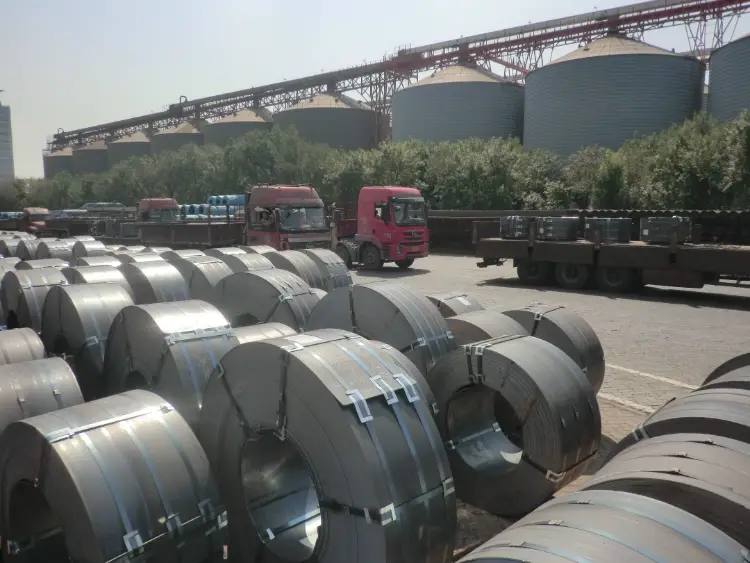
Q690D High-Strength Quenched and Tempered Steel Coil per GB/T 16270
Q690D High-Strength Quenched and Tempered Steel Coil per GB/T 16270 - Properties and Applications
Comprehensive material analysis of Q690D carbon and low-alloy high-strength steel coil according to GB/T 16270, covering chemical composition, mechanical properties, thermal and electrical properties, international equivalents, and application guidance.
Hot rolling, thermo-mechanical controlled processing (TMCP), quenching and tempering, cutting, welding, forming, machining
- Phone : +8618037372205
- Email : [email protected]
- WhatsApp: Contact via Whtsapp
- WeChat: +8618037372205
Q690D High-Strength Quenched and Tempered Steel Coil per GB/T 16270 Introduction
Q690D is a high-strength low-alloy structural steel with minimum yield strength of 690 MPa, supplied in the quenched and tempered condition. It belongs to the GB/T 16270 standard family and is widely utilized in heavy machinery, bridges, and offshore structures. Key advantages include excellent strength-to-weight ratio, good weldability (with proper preheating and consumables), and guaranteed impact toughness at -20 °C (D quality class).
- Minimum yield strength of 690 MPa for thicknesses ≤ 50 mm
- Tensile strength range 770–940 MPa
- Charpy impact energy ≥ 47 J at -20 °C
- Available as hot-rolled or thermo-mechanically rolled coil, plate, and strip
Q690D High-Strength Quenched and Tempered Steel Coil per GB/T 16270 Chemical Composition
The chemical composition of Q690D is designed to achieve a balance of high strength, good toughness, and weldability. The following limits are specified in GB/T 16270-2009. Microalloying elements (Nb, V, Ti) provide grain refinement and precipitation strengthening. The carbon equivalent (Ceq) is controlled to ensure weldability. Typical Ceq ≤ 0.47%. Elements are shown with their maximum allowed values unless a range is indicated.
| Element | Standard Value (max %) | Remarks |
|---|---|---|
| Carbon (C) | 0.18 | Key strength contributor; higher values may reduce weldability |
| Silicon (Si) | 0.50 | Deoxidizer; contributes to strength |
| Manganese (Mn) | 1.70 | Enhances hardenability and tensile properties |
| Phosphorus (P) | 0.020 | Strictly limited to avoid embrittlement |
| Sulfur (S) | 0.010 | Low level for improved toughness and formability |
| Chromium (Cr) | 0.70 | Improves hardenability and corrosion resistance |
| Nickel (Ni) | 0.80 | Enhances low-temperature toughness |
| Molybdenum (Mo) | 0.30 | Increases hardenability and high-temperature strength |
| Copper (Cu) | 0.30 | Minor element; provides some corrosion resistance |
| Niobium (Nb) | 0.06 | Microalloying for grain refinement and precipitation strengthening |
| Vanadium (V) | 0.08 | Microalloying for precipitation strengthening |
| Titanium (Ti) | 0.05 | Grain refinement; forms stable carbides and nitrides |
| Boron (B) | 0.005 | Increases hardenability even at very low concentrations |
| Aluminium (Al) | 0.015–0.060 (typical total Al) | Grain refining element; residual from deoxidation |
| Carbon Equivalent (Ceq) | 0.47 (max) | Ceq = C + Mn/6 + (Cr+Mo+V)/5 + (Ni+Cu)/15; general limit for thickness ≤ 50 mm |
Q690D High-Strength Quenched and Tempered Steel Coil per GB/T 16270 Thermal and Electrical Physical Properties
The following physical properties are typical for quenched and tempered low-alloy steels similar to Q690D. They are not mandatory standard requirements but provide reference for engineering design. Values are measured at room temperature (20 °C) unless otherwise noted. Density is 7.85 g/cm³, typical for structural steel. Elastic modulus and thermal expansion are essential for structural and thermal analyses.
- Excellent thermal conductivity for faster heat dissipation during welding
- Moderate electrical resistivity similar to carbon steels
| Property | Typical Value | Unit | Test Condition |
|---|---|---|---|
| Density (ρ) | 7.85 | g/cm³ | 20 °C |
| Elastic modulus (E) | 205 | GPa | 20 °C, longitudinal |
| Shear modulus (G) | 80 | GPa | Estimated from E and Poisson's ratio |
| Poisson's ratio (ν) | 0.3 | – | 20 °C, typical for steel |
| Thermal expansion coefficient (α) | 11.7 | 10⁻⁶ /K | 20–100 °C range |
| Thermal conductivity (λ) | 42 | W/(m·K) | 20 °C |
| Specific heat capacity (cₚ) | 460 | J/(kg·K) | 20 °C |
| Electrical resistivity (ρₑ) | 0.23 | μΩ·m | 20 °C, typical carbon steel |
Q690D High-Strength Quenched and Tempered Steel Coil per GB/T 16270 Mechanical Properties
Mechanical properties are based on the quenched and tempered condition as per GB/T 16270-2009. Values apply to samples taken from coil or plate with thickness ≤ 50 mm. Tests are conducted at room temperature unless otherwise specified. Impact test temperature is -20 °C for D quality class. All values are minimum unless a range is given.
- Yield strength ≥ 690 MPa
- Tensile strength 770–940 MPa
- Elongation A ≥ 14% (gauge length 5.65√S₀)
- Charpy V-notch impact energy (KV₂) ≥ 47 J at -20 °C (longitudinal)
- Bend test: 180° with mandrel diameter 3 × thickness, no cracks
| Property | Standard Requirement | Unit | Test Condition |
|---|---|---|---|
| Yield Strength (ReH) | 690 | MPa | Thickness ≤ 50 mm, ambient temperature |
| Tensile Strength (Rm) | 770 – 940 | MPa | Thickness ≤ 50 mm, ambient temperature |
| Elongation after fracture (A) | 14 | % | L₀ = 5.65√S₀, thickness ≤ 50 mm |
| Impact energy (KV₂) | 47 | J | Charpy V-notch, -20 °C, longitudinal direction |
| Bend test (diameter d) | d = 3×a (thickness a) | – | 180° bend, no cracks, ambient temperature |
Q690D High-Strength Quenched and Tempered Steel Coil per GB/T 16270 Fully Equivalent Material Standards and Substitutable Grades
| Country/Region | Standard | Grade | Remarks |
|---|---|---|---|
| China | GB/T 16270-2009 | Q690D | Original grade, quenched and tempered, -20 °C impact |
| European Union | EN 10025-6:2019 | S690Q (with option 2 – impact at -20 °C) | Closest equivalent; specify Charpy test temperature of -20 °C to match D quality |
| International (ISO) | ISO 4950-2:1995 | E690DD | High yield strength flat products, quenched and tempered, -20 °C impact |
| United States | ASTM A514/A514M | Grade Q (modified impact requirement) | Similar strength, but standard impact temperature may differ; supplementary agreement needed for -20 °C |
Q690D High-Strength Quenched and Tempered Steel Coil per GB/T 16270 Application Introduction
Q690D steel coil is engineered for heavy-load structural applications where high strength-to-weight ratio and reliable low-temperature toughness are required. Its excellent weldability and formability allow it to be fabricated into complex components. Common uses include: mobile crane telescopic booms, dump truck bodies, concrete pump truck booms, and bridge structures. The material is often supplied as slit coil or cut-to-length sheets for further processing.
Product Applications: Heavy-duty truck chassis and dump bodies, Concrete mixer drums and pump booms, Crawler crane booms and structural members, Offshore platform braces and deck components, Long-span bridge girders and brackets
Processed into products: Telescopic boom sections for mobile cranes, Bucket plates for mining shovels and loaders, High-strength welding flanges and gussets, Trailer frame rails and cross members, Pressure vessel shells and heads (subject to code approval)
Application industries: Construction machinery (cranes, loaders, excavators), Mining and earthmoving equipment, Bridge engineering, Shipbuilding and offshore structures, Pressure vessel and tank fabrication
Q690D High-Strength Quenched and Tempered Steel Coil per GB/T 16270 Similar/Alternative Materials with Close Properties
| Country/Region | Standard | Grade | Remarks |
|---|---|---|---|
| China | GB/T 16270-2009 | Q690C | Grade Q690 with 0 °C impact; lower toughness than Q690D; suitable for less demanding applications |
| China | GB/T 16270-2009 | Q690E | Grade Q690 with -40 °C impact; superior toughness for cryogenic conditions |
| China | GB/T 16270-2009 | Q550D | Lower strength (550 MPa yield) but same -20 °C impact; useful where strength can be reduced |
| European Union | EN 10025-6 | S690QL1 | Quenched and tempered, impact at -40 °C; slightly higher toughness, but can be used as upgrade |
| Japan | JIS G 3128 | SHY685 | High yield strength (≥685 MPa), quenched and tempered; check impact temperature compatibility |
Notes:
- Welding: Preheat (typically 100–150 °C) and low-hydrogen consumables are recommended to avoid cold cracking. Post-weld heat treatment is generally not required for thicknesses below 50 mm.
- Forming: Cold forming capability is limited due to high strength; hot forming or incremental bending is advised. Minimum bending radius should comply with supplier recommendations.
- Certification: Material must be accompanied by inspection documents according to EN 10204 type 3.1 or equivalent, confirming impact test results at -20 °C.
- Availability: Q690D is regularly produced in coil form with thicknesses ranging from 2.0 mm to 25.0 mm and widths up to 2000 mm; thicker gauges are available on request.
- Share



