
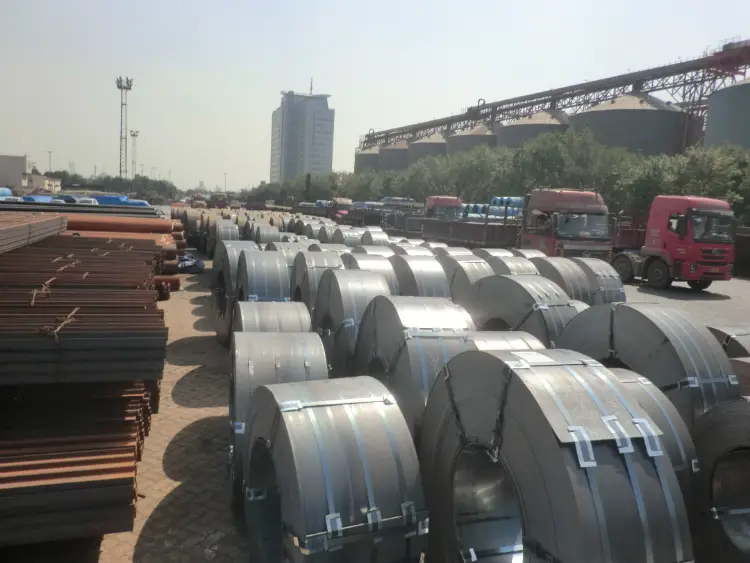
GB/T16270 Q690C High-Strength Structural Steel Coil
GB/T16270 Q690C High-Strength Structural Steel Coil: Properties, Equivalents & Applications
Comprehensive material data for Q690C steel under GB/T16270, including chemical composition, mechanical and physical properties, equivalent international grades, and application guidance for high-strength structural applications.
Welding, cutting (plasma, laser, water jet), cold forming, machining, drilling
- Phone : +8618037372205
- Email : [email protected]
- WhatsApp: Contact via Whtsapp
- WeChat: +8618037372205
GB/T16270 Q690C High-Strength Structural Steel Coil Introduction
Q690C is a high-strength low-alloy structural steel grade defined in GB/T 16270, supplied in the quenched and tempered (Q&T) condition. It offers a minimum yield strength of 690 MPa and excellent toughness, making it suitable for heavy-duty welded structures. The 'C' designation indicates guaranteed impact energy of 47 J at -20°C. Key characteristics include:
- High strength-to-weight ratio
- Good weldability with proper preheating and consumables
- Uniform mechanical properties through thickness, thanks to the Q&T process
- Low sulfur and phosphorus contents for enhanced cleanliness and ductility
The steel is typically delivered as coil or plate and is widely used in demanding structural applications such as mobile cranes, heavy machinery, bridges, and offshore platforms.
GB/T16270 Q690C High-Strength Structural Steel Coil Chemical Composition
The chemical composition of Q690C steel according to GB/T 16270 is designed to provide high strength and good weldability. Microalloying elements such as Nb, V, Ti, and B contribute to grain refinement and precipitation strengthening. Low sulfur and phosphorus levels ensure excellent toughness and resistance to lamellar tearing.
| Element | Standard Value (max) | Remarks |
|---|---|---|
| Carbon (C) | 0.18% | Max content for weldability |
| Silicon (Si) | 0.50% | Deoxidizer and strength contributor |
| Manganese (Mn) | 1.70% | Improves hardenability and strength |
| Phosphorus (P) | 0.020% | Controlled for toughness |
| Sulfur (S) | 0.010% | Ultra-low for cleanliness |
| Chromium (Cr) | 0.80% | Optional element – enhances hardenability |
| Nickel (Ni) | 0.80% | Optional – improves low-temperature toughness |
| Molybdenum (Mo) | 0.30% | Optional – increases hardenability and strength |
| Niobium (Nb) | 0.06% | Grain refiner and precipitation strengthener |
| Vanadium (V) | 0.12% | Precipitation strengthening |
| Titanium (Ti) | 0.05% | Grain refinement and deoxidation |
| Boron (B) | 0.004% | Optional – enhances hardenability |
GB/T16270 Q690C High-Strength Structural Steel Coil Physical Properties
Typical physical properties for Q690C steel. These values are representative of low-alloy high-strength steels in the quenched and tempered condition. They are not specified in GB/T 16270 but are useful for design calculations.
| Property | Typical Value | Unit | Remarks |
|---|---|---|---|
| Density (ρ) | 7.85 | g/cm³ | — |
| Modulus of elasticity (E) | 206 | GPa | At 20°C |
| Shear modulus (G) | 80 | GPa | Estimated from E and ν |
| Poisson's ratio (ν) | 0.3 | — | — |
| Thermal expansion coefficient (α) | 11.1 | 10⁻⁶/K | Between 20°C and 100°C |
| Thermal expansion coefficient (α) | 12.0 | 10⁻⁶/K | Between 20°C and 200°C |
| Thermal expansion coefficient (α) | 13.3 | 10⁻⁶/K | Between 20°C and 400°C |
| Thermal conductivity (λ) | 53 | W/(m·K) | At 20°C |
| Specific heat capacity | 460 | J/(kg·K) | At 20°C |
| Electrical resistivity (ρ_e) | 0.23 | 10⁻⁶ Ω·m | At 20°C |
GB/T16270 Q690C High-Strength Structural Steel Coil Mechanical Properties
The mechanical properties of Q690C are guaranteed in the quenched and tempered condition. The values depend on the product thickness. The steel exhibits a high yield strength of at least 690 MPa and a tensile strength in the range of 770–940 MPa for thicknesses up to 50 mm. Elongation and impact energy are determined according to GB/T 228 and GB/T 229, respectively.
| Property | Required Value | Unit | Test Condition / Remarks |
|---|---|---|---|
| Yield strength (ReH) | ≥690 | MPa | Thickness ≤50 mm |
| Yield strength (ReH) | ≥670 | MPa | Thickness >50–100 mm |
| Yield strength (ReH) | ≥630 | MPa | Thickness >100–150 mm |
| Tensile strength (Rm) | 770–940 | MPa | Thickness ≤50 mm |
| Tensile strength (Rm) | 760–930 | MPa | Thickness >50–100 mm |
| Tensile strength (Rm) | 710–900 | MPa | Thickness >100–150 mm |
| Elongation after fracture (A) | ≥14 | % | Gauge length 5.65√S₀, thickness ≤50 mm |
| Elongation after fracture (A) | ≥14 | % | Gauge length 5.65√S₀, thickness >50–100 mm |
| Elongation after fracture (A) | ≥14 | % | Gauge length 5.65√S₀, thickness >100–150 mm |
| Impact energy (KV₂) | ≥47 | J | Charpy V-notch, longitudinal, at -20°C |
| Bend test (180°) | d=3a | — | Mandrel diameter, thickness ≤50 mm |
| Bend test (180°) | d=4a | — | Mandrel diameter, thickness >50–100 mm |
GB/T16270 Q690C High-Strength Structural Steel Coil Exact Equivalent Material Standards and Substitutable Grades
| Country/Region | Standard | Grade | Remarks |
|---|---|---|---|
| China | GB/T 16270 | Q690C | Original standard; quenched and tempered; -20°C impact |
| EU | EN 10025-6 | S690Q (1.8928) | Same yield class; optional low‑temperature grades S690QL/S690QL1 for lower test temperatures |
| International | ISO 4950-2 | S690Q | Equivalent quenched and tempered high‑yield‑strength steel |
| Japan | JIS G 3128 | SHY685 | Similar high‑tensile strength steel (often used as equivalent, but verify impact test requirements) |
GB/T16270 Q690C High-Strength Structural Steel Coil Application Introduction
Q690C is engineered for welded structures where high strength and low temperature toughness are critical. Its quenched and tempered microstructure allows weight reduction without sacrificing load-bearing capacity. Typical uses are in the following areas:
Product Applications: Mobile crane booms and outriggers, Excavator arms and buckets, Dump truck bodies, Structural beams and columns for high‑rise buildings, Jack‑up rig legs and offshore platform structures, Bridge girders and orthotropic deck plates, Mining dump trucks and conveyor systems
Processed into products: Welded box sections and hollow profiles, Cut and bent structural brackets, Machined pins, bushings and bearing housings (after tempering), Dozer blade and cutting edges, Shipbuilding components such as hatch covers and crane pedestals, Press brake formed parts for heavy‑duty machine frames
Application industries: Heavy engineering and machinery, Construction and infrastructure (bridges, high‑rise buildings), Mining and earth‑moving equipment, Offshore oil & gas platforms, Transportation (heavy‑duty truck chassis, rail cars), Wind energy (tower sections, transition pieces), Pressure vessel manufacturing
GB/T16270 Q690C High-Strength Structural Steel Coil Similar and Alternative Materials
| Country/Region | Standard | Grade | Remarks |
|---|---|---|---|
| USA | ASTM A514 | Grade Q | Quench & tempered alloy steel; yield 690 MPa min; limited thickness, different chemical composition |
| USA | ASTM A709 | Grade 100 / 100W | High-strength structural steel; 690 MPa yield; used for bridges; often with weathering properties |
| EU | EN 10149-2 | S700MC | Thermo-mechanically rolled (not quenched & tempered), min yield 700 MPa but with higher elongation and better formability |
| Germany | DIN EN 10025-6 | S690QL | Same as S690Q but with guaranteed impact energy at lower temperatures, e.g., -40°C |
| China | GB/T 1591 | Q690D | Similar high‑strength low‑alloy steel under different standard; D indicates -20°C impact (but quality level may differ) |
Notes:
Welding: Preheating (typically 100–200°C) and low-hydrogen consumables are recommended. Post-weld heat treatment is usually not required for thicknesses below 50 mm but should be evaluated for thicker welds to relieve stresses. Forming: Cold forming of Q690C is possible, but due to its high strength, springback is significant; hot forming or incremental bending may be preferred. Certification: Material certificates must indicate the test results for chemical composition, tensile properties and Charpy impact energy at -20°C as per GB/T 16270.
- Share



