
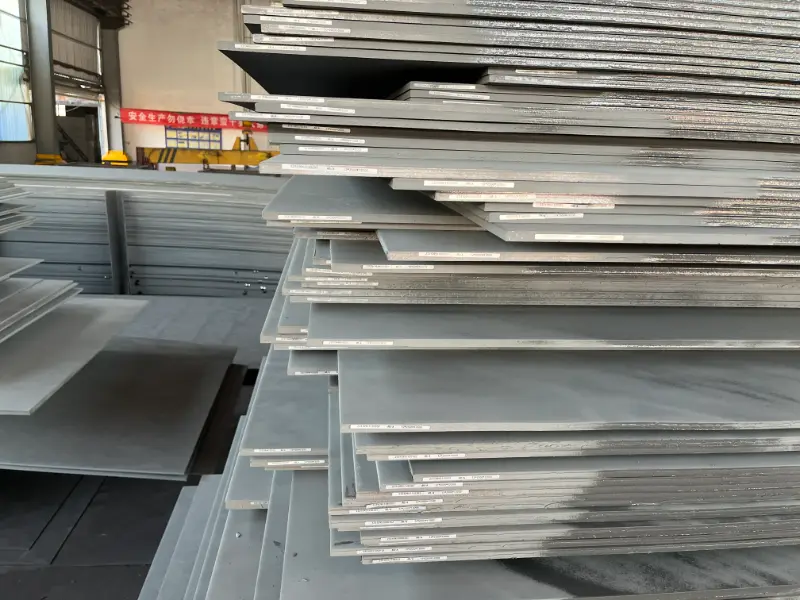
Q690F High-Strength Low-Alloy Structural Steel
Q690F High-Strength Low-Alloy Structural Steel - GB/T 16270 Technical Data
Q690F is a quenched and tempered high-strength low-alloy structural steel for welded applications, meeting GB/T 16270 with minimum 690 MPa yield and -60°C impact toughness.
Hot rolling, followed by quenching and tempering (Q+T)
- Phone : +8618037372205
- Email : [email protected]
- WhatsApp: Contact via Whtsapp
- WeChat: +8618037372205
Q690F High-Strength Low-Alloy Structural Steel Introduction
Q690F is a premium-grade, low-alloy, high-strength structural steel defined in the Chinese standard GB/T 16270. It is produced by quenching and tempering (Q+T) to achieve a minimum yield strength of 690 MPa, combined with excellent notch toughness at temperatures as low as -60°C (grade F). This steel offers a favorable balance of high strength, good weldability, and cold-forming ability, making it suitable for heavy-duty welded structures in demanding environments. The designation Q690F indicates: Q = yield strength class, 690 = minimum yield strength in MPa, F = quality grade with guaranteed impact energy at -60°C.
Q690F High-Strength Low-Alloy Structural Steel Chemical Composition
The chemical composition limits shown are from GB/T 16270-2009 Table 3 for grade Q690. Elements not listed are allowed as residuals. For grain refinement, Al ≥ 0.015% or combined additions are used. The actual aim values are adjusted to achieve required mechanical properties after quenching and tempering.
| Element | Specified Value (max. %) | Remarks |
|---|---|---|
| Carbon (C) | 0.20 | Heat analysis, maximum |
| Silicon (Si) | 0.80 | Maximum |
| Manganese (Mn) | 1.70 | Maximum |
| Phosphorus (P) | 0.020 | Maximum (grade F) |
| Sulfur (S) | 0.010 | Maximum (grade F) |
| Chromium (Cr) | 1.50 | Maximum |
| Nickel (Ni) | 2.00 | Maximum |
| Molybdenum (Mo) | 0.70 | Maximum |
| Copper (Cu) | 0.50 | Maximum |
| Niobium (Nb) | 0.06 | Maximum |
| Vanadium (V) | 0.12 | Maximum |
| Titanium (Ti) | 0.05 | Maximum |
| Boron (B) | 0.005 | Maximum |
| Aluminium (Al) | ≥0.015 | Minimum when used as grain refiner |
| Nitrogen (N) | 0.015 | Maximum |
Q690F High-Strength Low-Alloy Structural Steel Thermal and Electrical Physical Properties
These physical properties are not explicitly required by GB/T 16270 but represent typical values for low-alloy quenched and tempered structural steels with similar composition. They may be used for design calculations at ambient temperature.
| Property | Typical Value | Unit | Test Condition/Remarks |
|---|---|---|---|
| Density (ρ) | 7850 | kg/m³ | Ambient temperature |
| Modulus of Elasticity (E) | 210 | GPa | Ambient temperature |
| Shear Modulus (G) | 81 | GPa | Ambient temperature |
| Poisson's ratio (ν) | 0.30 | – | Ambient temperature |
| Thermal Expansion Coefficient (α) | 12.0 × 10⁻⁶ | 1/K | 20–100 °C |
| Thermal Conductivity (λ) | 42 | W/(m·K) | At 20 °C |
| Specific Heat Capacity (c) | 460 | J/(kg·K) | Ambient temperature |
| Electrical Resistivity (ρe) | 0.25 × 10⁻⁶ | Ω·m | At 20 °C |
Q690F High-Strength Low-Alloy Structural Steel Mechanical Properties
Mechanical properties apply to delivery condition quenched and tempered. Values vary with product thickness. Impact test uses longitudinal Charpy V-notch specimens. Bend test is performed to 180° without cracks. For intermediate thicknesses, linear interpolation may be used according to the standard.
| Property | Specified Value | Unit | Test Condition / Thickness |
|---|---|---|---|
| Yield Strength (ReH) | ≥690 | MPa | Thickness ≤ 50 mm |
| Yield Strength (ReH) | ≥670 | MPa | 50 mm < thickness ≤ 100 mm |
| Yield Strength (ReH) | ≥630 | MPa | 100 mm < thickness ≤ 150 mm |
| Tensile Strength (Rm) | 770 – 940 | MPa | Thickness ≤ 50 mm |
| Tensile Strength (Rm) | 750 – 920 | MPa | 50 mm < thickness ≤ 100 mm |
| Tensile Strength (Rm) | 720 – 900 | MPa | 100 mm < thickness ≤ 150 mm |
| Elongation after Fracture (A) | ≥14 | % | Thickness ≤ 50 mm, L0=5.65√S0 |
| Elongation after Fracture (A) | ≥14 | % | 50 mm < thickness ≤ 100 mm |
| Elongation after Fracture (A) | ≥13 | % | 100 mm < thickness ≤ 150 mm |
| Bend Test (Bend Diameter) | d = 3a (180° bend, no cracks) | – | a = specimen thickness |
| Charpy Impact Energy (KV2) | ≥27 | J | Longitudinal, testing at -60°C (grade F) |
Q690F High-Strength Low-Alloy Structural Steel Fully Equivalent Material Standards & Substitute Grades
| Country/Region | Standard | Grade | Remarks |
|---|---|---|---|
| Europe | EN 10025-6 | S690QL1 | Closest direct equivalent, minimum impact 27J at -60°C (QL1 option). Verify specification for full compliance. |
| China | GB/T 16270 | Q690F | Original grade, fully compliant with F-level toughness. |
Q690F High-Strength Low-Alloy Structural Steel Application Introduction
Q690F is engineered for load-bearing and fatigue-critical welded structures operating in sub-zero environments. Its high strength allows for weight reduction and thinner sections, while the guaranteed -60°C toughness ensures structural integrity in cold climates. Proper welding and forming procedures are essential. Preheating and post-weld heat treatment may be required depending on thickness and hydrogen control requirements.
Product Applications: Welded beams and girders for bridges, Boom and arm components of excavators and cranes, Jack-up rig legs and offshore structural nodes, Heavy-duty truck frames and dumper bodies, Wind turbine tower shells and flanges, High-head penstock and draft tubes
Processed into products: Crane boom chords and lattice columns, Load-bearing stiffeners and box sections, Welded structural joints with high fatigue demands, Shafts and pin joints for heavy machinery, Pile-driving hammer adapters, Wear plates integrated into structural members
Application industries: Mobile cranes and heavy lifting equipment, Offshore oil and gas platforms, shipbuilding, Steel bridges (especially in cold regions), Mining and earth-moving machinery, Tower structures, high-strength building columns, Pressure vessels and storage tanks (low-temperature service)
Q690F High-Strength Low-Alloy Structural Steel Similar/Comparable Material Grades
| Country/Region | Standard | Grade | Remarks |
|---|---|---|---|
| China | GB/T 16270 | Q690D | Same strength, impact at -20°C instead of -60°C; suitable for less severe low-temperature applications. |
| Europe | EN 10025-6 | S690Q | Minimum impact at -20°C; equivalent to Q690D in toughness level. |
| Europe | EN 10025-6 | S690QL | Minimum impact at -40°C; one temperature class below F grade. |
| USA | ASTM A514/A514M | Grade B / H / S | Quenched and tempered 690 MPa yield; impact properties must be requested separately, no standard -60°C guarantee. |
| Japan | JIS G 3128 (or JIS G 3140) | SHY685 / YQ690 | Japanese shipbuilding or bridge HSLA grades; need to confirm -60°C impact availability. |
Notes:
1) All mechanical properties are guaranteed in the Q+T delivery condition; re-heating or hot forming may degrade properties. 2) Welding consumables shall be carefully selected to achieve matching strength and sufficient toughness; low-hydrogen processes mandatory. 3) For plate thicknesses above 50 mm, ultrasonic testing in accordance with GB/T 2970 or equivalent is recommended. 4) Specific requirements for through-thickness properties (Z-grade) may be agreed upon order.
- Share



