
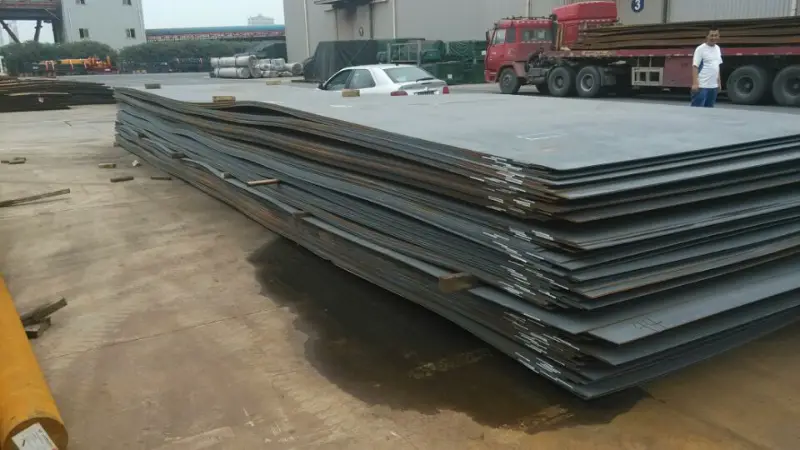
GB/T 16270 Q620F High-Strength Quenched and Tempered Steel Plate
Q620F High-Strength Quenched and Tempered Steel Plate per GB/T 16270
Q620F is a Chinese high-strength structural steel with minimum yield strength 620 MPa, suitable for welded structures requiring low-temperature toughness. Delivered in quenched and tempered condition.
Quenching and tempering (Q&T), hot rolling, welding, cutting, cold forming (limited)
- Phone : +8618037372205
- Email : [email protected]
- WhatsApp: Contact via Whtsapp
- WeChat: +8618037372205
GB/T 16270 Q620F High-Strength Quenched and Tempered Steel Plate Introduction
Q620F is a high-strength low-alloy structural steel defined in GB/T 16270 (High strength structural steel plates in the quenched and tempered condition). It offers a minimum yield strength of 620 MPa and good impact toughness at -20°C (KV ≥ 47 J). The steel is processed by quenching and tempering, which imparts a fine-grained microstructure, excellent weldability, and a balance of strength and toughness.
- Key features: high strength, good low-temperature toughness, excellent weldability, suitable for heavy-duty welded structures.
- Typical applications: construction machinery, pressure vessels, bridges, offshore structures, and vehicle frames.
GB/T 16270 Q620F High-Strength Quenched and Tempered Steel Plate Chemical Composition
The chemical composition of Q620F according to GB/T 16270 ensures weldability and strength after quenching and tempering. Carbon equivalent (CEV) is controlled to maintain good weldability. Values are ladle analysis or product analysis as per standard.
| Element | Standard Value (max, %) | Remarks |
|---|---|---|
| C | 0.20 | For thickness ≤ 50 mm; 0.22 for >50–100 mm |
| Si | 0.80 | Max |
| Mn | 1.70 | Max |
| P | 0.020 | Max |
| S | 0.010 | Max |
| Al | ≥0.015 | Total aluminum, min |
| Nb | 0.06 | Max |
| V | 0.12 | Max |
| Ti | 0.05 | Max |
| Cr | 1.00 | Max |
| Ni | 1.00 | Max |
| Mo | 0.50 | Max |
| Cu | 0.50 | Max |
| B | 0.005 | Max (if added) |
| N | 0.020 | Max |
| CEV | 0.55 | Typical max, thickness dependent |
GB/T 16270 Q620F High-Strength Quenched and Tempered Steel Plate Physical Properties
Physical properties are typical for low-alloy quenched and tempered steels and not specified in GB/T 16270. They are provided for design reference. Values may slightly vary with heat treatment and exact composition.
| Property | Typical Value | Unit | Condition/Reference |
|---|---|---|---|
| Density (ρ) | 7.85 | g/cm³ | Room temperature |
| Elastic modulus (E) | 210 | GPa | Room temperature |
| Shear modulus (G) | 81 | GPa | Room temperature |
| Poisson's ratio (ν) | 0.3 | Room temperature | |
| Thermal expansion (α) | 12.0 | 10⁻⁶/K | 20–100°C |
| Thermal expansion (α) | 13.0 | 10⁻⁶/K | 20–200°C |
| Thermal conductivity (λ) | 38 | W/(m·K) | Room temperature |
| Specific heat capacity (cp) | 460 | J/(kg·K) | Room temperature |
| Electrical resistivity (ρe) | 0.25 | μΩ·m | Room temperature |
GB/T 16270 Q620F High-Strength Quenched and Tempered Steel Plate Mechanical Properties
Mechanical properties of Q620F as per GB/T 16270 for quenched and tempered condition. Tensile testing is transverse to rolling direction. Impact energy tested at -20°C. Values depend on plate thickness.
| Property | Standard Requirement | Unit | Test Condition |
|---|---|---|---|
| Yield strength (ReH) | ≥620 | MPa | Thickness ≤ 50 mm |
| Yield strength (ReH) | ≥590 | MPa | Thickness >50–100 mm |
| Yield strength (ReH) | ≥560 | MPa | Thickness >100–150 mm |
| Tensile strength (Rm) | 730–900 | MPa | Thickness ≤ 50 mm |
| Tensile strength (Rm) | 700–880 | MPa | Thickness >50–100 mm |
| Tensile strength (Rm) | 680–860 | MPa | Thickness >100–150 mm |
| Elongation (A) | ≥15 | % | Gauge length 5.65√S₀, transverse |
| Elongation (A) | ≥14 | % | Thickness >50–100 mm |
| Elongation (A) | ≥13 | % | Thickness >100–150 mm |
| Impact energy (KV2) | ≥47 | J | -20°C, longitudinal |
| Bend test (bend radius) | 3t | 180° bend, d=3a, for thickness ≤ 50 mm |
GB/T 16270 Q620F High-Strength Quenched and Tempered Steel Plate Fully Equivalent Material Standards and Substitutable Grades
| Country/ Region | Standard | Grade | Remarks |
|---|---|---|---|
| China | GB/T 16270 | Q620F | Original designation |
| Europe | EN 10025-6 | S620Q | 95% match; impact temperature and CEV slightly differ |
| International | ISO 4950-3 | E620DD | Direct equivalent for quenched and tempered high yield strength steel |
| China | GB/T 1591 | Q550D | Closest in GB/T 1591 but lower strength; not direct equivalent |
GB/T 16270 Q620F High-Strength Quenched and Tempered Steel Plate Application Introduction
Q620F is ideal for structural applications requiring high strength, good weldability, and reliable low-temperature impact toughness. It is typically supplied as quenched and tempered plates, allowing fabrication of load-bearing components. Common processing includes gas cutting, cold bending (with large radii), and welding using low-hydrogen procedures with preheat.
Industry examples:
- Heavy construction machinery (booms, frames)
- Bridge engineering (main girders, arch ribs)
- Offshore and marine structures (jack-up rig legs)
- Pressure vessels and storage tanks (moderate temperatures)
- Mining and earthmoving equipment (buckets, dump bodies)
Product Applications: Mobile crane telescopic booms, Bridge box girders and trusses, Offshore platform legs and bracings, Heavy-duty vehicle chassis, Hydraulic cylinder bodies, High-pressure piping (within code limits)
Processed into products: Welded structural parts subject to high static and dynamic loads, Flanges and webs of built-up beams, Boom sections for excavators and loaders, Support brackets and nodes in steel frameworks, Cutting edges and wear plates (with additional hardfacing)
Application industries: Construction and infrastructure, Heavy machinery and equipment, Shipbuilding and offshore engineering, Pressure vessel manufacturing, Mining and quarrying
GB/T 16270 Q620F High-Strength Quenched and Tempered Steel Plate Similar or Approximate Substitute Materials
| Country/ Region | Standard | Grade | Remarks |
|---|---|---|---|
| USA | ASTM A514/A514M | Grade S | Yield 620 MPa min, limited thickness, requires supplemental toughness requirement for -20°C |
| Japan | JIS G 3128 | SHY685 | High yield strength, similar toughness, often used in pressure vessels |
| Europe | EN 10025-6 | S690Q | Higher strength (690 MPa) but similar toughness; may be overmatching |
| China | GB/T 16270 | Q690F | Higher strength grade in same standard, can be used if higher strength acceptable |
| USA | ASTM A709/A709M | Grade HPS 70W | Weathering bridge steel with comparable strength; additional corrosion resistance |
Notes:
Note: For thicknesses above 50 mm, mechanical properties decrease slightly. Welding should follow suitable procedures; preheating and interpass temperature control recommended based on CEV and thickness. Delivery condition: quenched and tempered, with surface inspection according to GB/T 16270. The physical properties given are typical for low-alloy Q&T steels and can be used for initial design; for critical applications, experimental data on the specific heat are advisable.
- Data is based on GB/T 16270-2009 and general engineering references.
- Contact material supplier for guaranteed properties for a specific heat and thickness.
- Share



