
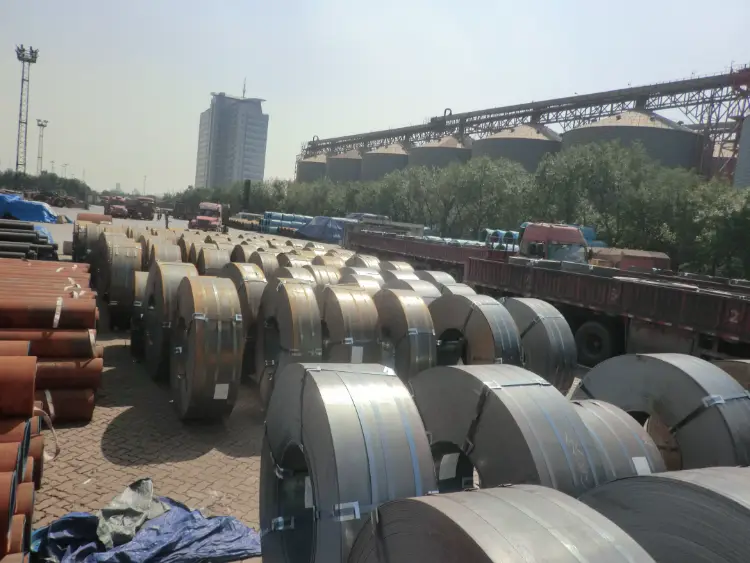
GB/T 16270 Q620E High Strength Quenched and Tempered Steel Coil
GB/T 16270 Q620E High Strength Quenched and Tempered Steel Coil - Grade E for Low Temperature Toughness
Comprehensive datasheet of Q620E carbon and low-alloy high-strength structural steel coil under GB/T 16270 standard, including chemical composition, mechanical properties, physical data, equivalent grades, and applications.
Welding, bending, cutting, machining, cold forming (limited due to high strength, warm forming recommended)
- Phone : +8618037372205
- Email : [email protected]
- WhatsApp: Contact via Whtsapp
- WeChat: +8618037372205
GB/T 16270 Q620E High Strength Quenched and Tempered Steel Coil Introduction
Q620E is a high-strength quenched and tempered structural steel specified in GB/T 16270, designed for heavy-duty welded structures operating at low temperatures. With a minimum yield strength of 620 MPa and guaranteed impact energy of 34 J at -40 °C, it offers an excellent combination of high strength, good toughness, and weldability. The steel is delivered in the quenched and tempered condition (Q+T) and is available as coils, plates, and sections. Typical applications include bridges, pressure vessels, offshore platforms, and heavy machinery where weight reduction and reliability at subzero temperatures are critical.
GB/T 16270 Q620E High Strength Quenched and Tempered Steel Coil Chemical Composition
The chemical composition of Q620E as specified in GB/T 16270. The steel is microalloyed with Nb, V, Ti, and B to achieve high strength and toughness after quenching and tempering. Carbon equivalent (CEV) is controlled to ensure good weldability. Note: Values shown are maximum limits unless a range is given.
| Element | Standard Value (max, unless range given) | Remarks |
|---|---|---|
| Carbon (C) | ≤0.20 | Heat analysis |
| Silicon (Si) | ≤0.80 | Heat analysis |
| Manganese (Mn) | ≤1.70 | Heat analysis |
| Phosphorus (P) | ≤0.020 | Heat analysis |
| Sulfur (S) | ≤0.010 | Heat analysis |
| Chromium (Cr) | ≤0.70 | Heat analysis |
| Nickel (Ni) | ≤1.50 | Heat analysis |
| Molybdenum (Mo) | ≤0.60 | Heat analysis |
| Niobium (Nb) | ≤0.06 | Heat analysis |
| Vanadium (V) | ≤0.12 | Heat analysis |
| Titanium (Ti) | ≤0.05 | Heat analysis |
| Boron (B) | ≤0.005 | Heat analysis |
| Copper (Cu) | ≤0.50 | Residual element, may be specified by agreement |
| Nitrogen (N) | ≤0.015 | If sufficient Al or other N-binding elements are present |
| Carbon Equivalent (CEV) | ≤0.52 | For thickness ≤50 mm, CEV = C + Mn/6 + (Cr+Mo+V)/5 + (Ni+Cu)/15 |
GB/T 16270 Q620E High Strength Quenched and Tempered Steel Coil Physical and Thermal Properties
Physical and thermal properties for Q620E steel. These are typical values for quenched and tempered low-alloy steel and may vary slightly depending on exact composition and heat treatment. They are provided for design and calculation purposes and are not mandatory in the standard.
| Property | Typical Value | Unit | Test Condition / Remarks |
|---|---|---|---|
| Density (ρ) | 7.85 | g/cm³ | At 20 °C |
| Modulus of Elasticity (E) | 205 | GPa | At 20 °C |
| Shear Modulus (G) | 79 | GPa | At 20 °C |
| Poisson's Ratio (ν) | 0.3 | - | At 20 °C |
| Thermal Expansion Coefficient (α) | 12.0 × 10⁻⁶ | 1/K | Between 20 °C and 100 °C |
| Thermal Expansion Coefficient (α) | 12.8 × 10⁻⁶ | 1/K | Between 20 °C and 200 °C |
| Thermal Conductivity (λ) | 42 | W/(m·K) | At 100 °C |
| Thermal Conductivity (λ) | 38 | W/(m·K) | At 200 °C |
| Specific Heat Capacity (c) | 480 | J/(kg·K) | At 20–100 °C |
| Electrical Resistivity (ρ_e) | 0.20 × 10⁻⁶ | Ω·m | At 20 °C |
GB/T 16270 Q620E High Strength Quenched and Tempered Steel Coil Mechanical Properties
Mechanical properties as required by GB/T 16270 for Q620E. Values depend on product thickness. For flat products, tensile testing is done in the transverse direction unless otherwise agreed. Impact test is performed on longitudinal Charpy-V specimens at -40 °C. Note: Multiple standard values exist for different thickness ranges; each range is shown on a separate row where applicable.
| Property | Standard Requirement | Unit | Test Condition |
|---|---|---|---|
| Yield Strength (ReH) | ≥620 | MPa | Thickness ≤50 mm, transverse specimen |
| Yield Strength (ReH) | ≥600 | MPa | Thickness >50 mm to ≤100 mm |
| Yield Strength (ReH) | ≥570 | MPa | Thickness >100 mm to ≤150 mm |
| Tensile Strength (Rm) | 720 – 890 | MPa | Thickness ≤50 mm |
| Tensile Strength (Rm) | 700 – 890 | MPa | Thickness >50 mm to ≤100 mm |
| Tensile Strength (Rm) | 670 – 830 | MPa | Thickness >100 mm to ≤150 mm |
| Elongation after fracture (A) | ≥15 | % | Thickness ≤50 mm, gauge length 5.65√S₀ |
| Elongation after fracture (A) | ≥14 | % | Thickness >50 mm to ≤100 mm |
| Elongation after fracture (A) | ≥13 | % | Thickness >100 mm to ≤150 mm |
| Charpy Impact Energy (KV₂) | ≥34 (longitudinal) | J | At -40 °C (E grade), min. individual value ≥0.75 of specified average |
| Bend Test (180°) | d = 3a | Thickness ≤16 mm, no cracking | |
| Bend Test (180°) | d = 4a | Thickness >16 mm to ≤50 mm, no cracking |
GB/T 16270 Q620E High Strength Quenched and Tempered Steel Coil Fully Equivalent Material Standards and Replaceable Grades
Internationally recognized equivalent grades that can replace Q620E in quenched and tempered condition with similar mechanical requirements and low-temperature toughness.
| Region / Standard | Delivery Condition | Grade / Designation | Remarks |
|---|---|---|---|
| European EN 10025-6: 2004+A1:2009 | Quenched and tempered | S620Q (1.8914) | Requires impact energy at designated temperature (e.g., QL1 for -40 °C). Check optional requirements for full equivalence. |
| International ISO 4950-2:1995 and ISO 4950-3:1995 | Quenched and tempered | E620DD or E620E | E620DD requires impact at -20 °C, E620E at -50 °C; adjust ordering to match -40 °C. |
| USA ASTM A514 / A514M | Quenched and tempered | Grade B, H, F, etc. (yield ≥690 MPa) | A514 grades have higher yield strength but may be substituted with strength reduction; not identical in chemistry. Impact test at -40 °C must be ordered separately. |
GB/T 16270 Q620E High Strength Quenched and Tempered Steel Coil Application Introduction
Q620E is engineered for heavy-duty welded structures requiring high strength, excellent toughness at -40 °C, and good weldability. It is extensively used in industries where weight reduction and reliability in harsh environments are crucial. The material can be processed by welding (low-hydrogen electrodes and preheating recommended), bending (preferably warm bending), and machining. Stricter quality control during welding and forming is advised due to the high strength level.
Product Applications: Welded bridge girders and box sections, Legs and spudcans of self-elevating offshore platforms, Mining dump truck frames and excavator booms, All-terrain crane telescopic booms, High-pressure penstocks and spiral cases for hydropower plants, Heavy transport trailer chassis, Large-span stadium roof trusses
Processed into products: Main load-bearing plates and stiffeners in bridge construction, Tubular joints and nodes in offshore jacket structures, High-stress welded assemblies such as crane outrigger beams, Bucket arms and structural frames of large excavators, Bottom/top flanges of crane box girders, Reinforced pads and lifting points in pressure vessels, Machined bearing housings and support plates
Application industries: Construction and civil engineering (bridges, high-rise buildings, stadiums), Shipbuilding and offshore engineering (jack-up rigs, platform legs, deck structures), Pressure vessel and boiler manufacturing (components operating at moderate temperatures), Mining and earthmoving equipment (heavy-duty truck frames, bucket arms), Crane and lifting industry (mobile crane booms, lattice structures), Power generation (wind turbine towers, hydroelectric penstocks), Transportation (railway carriages, heavy trailers)
GB/T 16270 Q620E High Strength Quenched and Tempered Steel Coil Similar Grades for Reference
These materials share similar strength levels and application areas but may differ in some specifications. They should be evaluated for each specific design case.
| Region / Standard | Grade | Description | Remarks |
|---|---|---|---|
| Chinese GB/T 16270 | Q550E | Lower strength grade, min. yield 550 MPa, E-level impact at -40 °C | Useful when lower strength is acceptable; better formability and toughness. |
| Chinese GB/T 16270 | Q690E | Higher strength grade, min. yield 690 MPa, E-level impact at -40 °C | Can be used if higher strength required; more welding care needed. |
| Chinese GB/T 1591 | Q460E | High-strength low-alloy structural steel (normalized or TMCP) | Typically lower strength, but similar low-temperature toughness and easier fabrication. |
| European EN 10025-6 | S690Q or S690QL | Quenched and tempered steel, yield ≥690 MPa | Higher strength; often used when Q620E is not sufficient. S690QL offers guaranteed impact at -40 °C or lower. |
| USA ASTM A514 | Grade Q | Quenched and tempered, yield ≥690 MPa | A similar high-strength grade, but chemical composition and impact requirements differ. |
Notes:
Q620E steel should be welded using low-hydrogen processes and consumables. Preheating (typically 100–150 °C) and interpass temperature control are essential to prevent hydrogen-induced cracking. Post-weld heat treatment (PWHT) is generally not required for thicknesses up to 50 mm, but stress relieving may be applied for heavy sections. For cold forming, the minimum bending radius should be at least 3 times the thickness to avoid cracking. Delivery condition is quenched and tempered; surface quality meets GB/T 16270 requirements. Special requirements, such as ultrasonic testing (UT) to EN 10160 or equivalent, and restricted chemical composition, should be agreed upon at the time of ordering. Caution: Q620E is not intended for elevated temperature service, as it may lose temper and strength above approximately 450 °C.
- Share



