
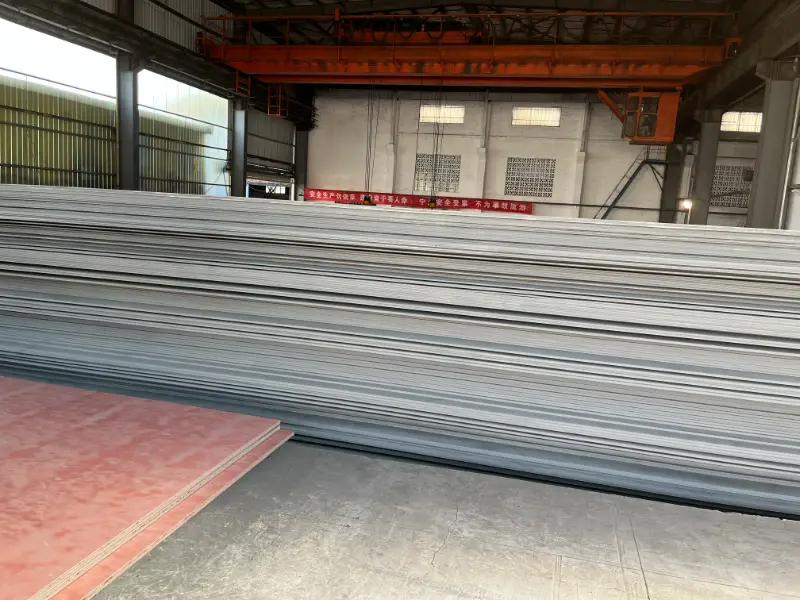
GB/T 16270 Q620D High-Strength Quenched and Tempered Steel Plate
Q620D High-Strength Quenched and Tempered Steel Plate to GB/T 16270
Detailed material data for Q620D carbon and low-alloy high-strength structural steel coil/plate, including chemical composition, mechanical properties, physical properties, international equivalents, and applications.
Cutting, cold forming (limited bending radii), welding (with proper preheating and consumables), hot-dip galvanizing (requires knowledge of tempering effects), machining
- Phone : +8618037372205
- Email : [email protected]
- WhatsApp: Contact via Whtsapp
- WeChat: +8618037372205
GB/T 16270 Q620D High-Strength Quenched and Tempered Steel Plate Introduction
Q620D is a low-alloy high-strength structural steel defined in GB/T 16270-2009 (High strength structural steel plates in the quenched and tempered condition). It features a minimum yield strength of 620 MPa, good weldability, and excellent low-temperature toughness (impact test at -20 °C). The steel is delivered after quenching and tempering (Q+T). Its main advantages include a favorable strength-to-weight ratio, enabling weight reduction in heavy structures while maintaining safety. Typical applications cover mobile cranes, bridges, building structures, and heavy machinery. The guaranteed Charpy V-notch impact energy at -20 °C makes it suitable for service in cold climates.
GB/T 16270 Q620D High-Strength Quenched and Tempered Steel Plate Chemical Composition
Maximum limit values according to GB/T 16270-2009. Fine grain practice is mandatory. The steel may contain other alloys not listed here to achieve the required properties, subject to agreement between the purchaser and manufacturer.
| Chemical Element | Standard Value (max, %) | Remarks |
|---|---|---|
| Carbon (C) | 0.20 | All thicknesses |
| Silicon (Si) | 0.80 | |
| Manganese (Mn) | 1.70 | |
| Phosphorus (P) | 0.020 | |
| Sulfur (S) | 0.010 | |
| Chromium (Cr) | 0.80 | Sum of Cr, Ni, Mo, Cu may be restricted by agreement |
| Nickel (Ni) | 1.00 | |
| Molybdenum (Mo) | 0.35 | |
| Copper (Cu) | 0.30 | |
| Niobium (Nb) | 0.06 | Nb+V+Ti ≤ 0.22% if used individually |
| Vanadium (V) | 0.12 | |
| Titanium (Ti) | 0.05 | |
| Boron (B) | 0.005 | Total boron allowed, but may not be used for all heats |
GB/T 16270 Q620D High-Strength Quenched and Tempered Steel Plate Physical Properties
These values are typical for a low-alloy Q&T steel at room temperature and are not part of the GB/T 16270 mandatory verification. Actual values can vary slightly depending on exact composition and heat treatment. They serve as engineering estimates.
| Property | Typical Value | Unit | Condition |
|---|---|---|---|
| Density (ρ) | 7850 | kg/m³ | At 20 °C |
| Elastic modulus (E) | ~206 | GPa | At 20 °C |
| Shear modulus (G) | ~79 | GPa | At 20 °C |
| Poisson's ratio (ν) | ~0.3 | – | At 20 °C |
| Thermal expansion coefficient (α) | ~12 × 10⁻⁶ | 1/K | 20 – 100 °C |
| Thermal conductivity (λ) | ~45 | W/(m·K) | At 20 °C |
| Specific heat capacity (cp) | ~460 | J/(kg·K) | At 20 °C |
| Electrical resistivity (ρ_e) | ~0.25 – 0.30 | µΩ·m | At 20 °C |
GB/T 16270 Q620D High-Strength Quenched and Tempered Steel Plate Mechanical Properties
Test specimen orientation is longitudinal. Properties are valid for plate thickness ≤ 50 mm as per GB/T 16270-2009. For greater thicknesses, the values may be slightly lower; refer to the standard for full thickness scaling. All tests are performed on quenched and tempered material.
| Property | Standard Requirement | Unit | Test Condition |
|---|---|---|---|
| Yield Strength (ReH) | ≥ 620 | MPa | Thickness ≤ 50 mm |
| Yield Strength (ReH) | ≥ 580 | MPa | 50 < thickness ≤ 100 mm |
| Tensile Strength (Rm) | 700 – 890 | MPa | Thickness ≤ 50 mm |
| Tensile Strength (Rm) | 670 – 860 | MPa | 50 < thickness ≤ 100 mm |
| Elongation after fracture (A) | ≥ 15 | % | Gauge length = 5d; thickness ≤ 50 mm |
| Elongation after fracture (A) | ≥ 14 | % | 50 < thickness ≤ 100 mm |
| Bend test (d=3a, 180°) | No cracks | – | All thicknesses |
| Charpy V-notch impact energy (KV2) | ≥ 40 | J | Longitudinal, -20 °C, thickness ≤ 100 mm |
GB/T 16270 Q620D High-Strength Quenched and Tempered Steel Plate Directly Equivalent Material Standards and Substitutable Grades
The following international grades are recognized as equivalents or very close matches to Q620D, especially considering the delivery condition (Q+T) and -20 °C impact requirement (denoted by quality level D). Substitution usually requires verification of thickness limits and application standards.
| Country/Region | Standard | Grade | Remarks |
|---|---|---|---|
| Europe | EN 10025-6 | S620Q (1.8988) / S620QL (1.8928) | S620QL offers guaranteed longitudinal impact at -40 °C, exceeding D-grade; S620Q may need supplementary impact testing at -20 °C. |
| International | ISO 4950-2 | E620DD | High yield strength flat products; DD indicates -20 °C impact (similar to D-grade). |
| Germany (superseded) | DIN EN 10025-6 | S620Q | Same as EN version. |
| USA | ASTM A514 / A517 | Grade Q (690 MPa YS) | Higher minimum yield strength (≥690 MPa), but often used for similar applications. Requires careful comparison of chemical composition and impact temperatures. |
| Japan | JIS G 3128 | SHY 685 / SHY 685N | Higher strength level (~685 MPa). Impact toughness classes differ; check requirements. |
GB/T 16270 Q620D High-Strength Quenched and Tempered Steel Plate Application Introduction
Q620D is designed for welded heavy structures requiring high strength combined with good toughness at low temperatures. Its exceptional strength-to-weight ratio allows engineers to reduce section thickness without compromising load-bearing capacity, leading to lighter and more economical structures alongside lower transportation and erection costs. Attention must be paid to cold forming limits (minimum bending radius ~4t for thickness ≤ 16 mm), welding procedure qualification (low-hydrogen consumables, preheat/interpass temperature control, post-weld heat treatment not recommended in general due to possible temper embrittlement), and avoidance of brittle fracture through proper design and surface preparation.
Product Applications: Welded box girders of telescopic crane booms, Chords and braces for lattice boom cranes, Excavator booms and arms, Drilling rig masts and base structures, Ship deck house and hatch coaming structures, Penstocks and spiral cases in hydropower plants, Heavy-duty columns and trusses in high-rise buildings, Long-span bridge girder segments
Processed into products: Crane boom base sections and telescopic elements, Hydraulic excavator front attachments (boom, arm, bucket strongbacks), Mining dump truck frames and dump bodies, Offshore platform topside module main girders, Large-diameter thick-wall tubular joints, Reversing rack segments for tunnel boring machines, Split flange connections in heavy machinery
Application industries: Heavy machinery and earth moving, Mobile crane manufacturing, Marine and offshore engineering (with additional certifications), Bridge construction (road and railway), Building and infrastructure (high-rise commercial structures, stadiums), Pressure vessel and penstock (subject to design codes), Transport and logistics (heavy vehicle chassis, trailers)
GB/T 16270 Q620D High-Strength Quenched and Tempered Steel Plate Similar or Nearby Substitute Materials
These grades are not exact matches but offer comparable strength and processing characteristics. Selection depends on available thickness, required toughness, and fabrication conditions.
| Country/Region | Standard | Grade | Remarks |
|---|---|---|---|
| China | GB/T 16270 | Q550D | Lower yield strength (≥550 MPa); direct upgrade in thickness possible but heavier. Shares same quality level D. |
| China | GB/T 16270 | Q690D | Higher yield strength (≥690 MPa); can reduce weight but requires more demanding welding procedures. |
| China | GB/T 1591 | Q500qE | High-strength bridge steel (Q+T), suitable for moving loads but different application standard. |
| Europe | EN 10025-6 | S690Q / S690QL | Higher strength, wider available dimensions; impact toughness better than Q620D. |
| USA | ASTM A709 | Grade HPS 70W | Weathering high-performance steel for bridges; minimum YS ~485 MPa, not equivalent in strength but used in similar structures. |
Notes:
The values given correspond to the state of standardization at the time of publication GB/T 16270-2009. For critical applications, a full material certificate including actual ladle analysis, mechanical test results, and non-destructive testing (UT) can be agreed upon at the time of order. Preheating before welding is generally recommended (e.g., 100–150 °C depending on plate thickness and carbon equivalent). Since Q620D is a quenched and tempered material, post-weld heat treatment (PWHT) is typically avoided unless absolutely necessary and thoroughly qualified because it can degrade the base metal strength.
Direct substitution of international equivalents must be validated against the specific design code and service conditions. The provided international grades serve as a starting point for engineering evaluation only.
- Share



