
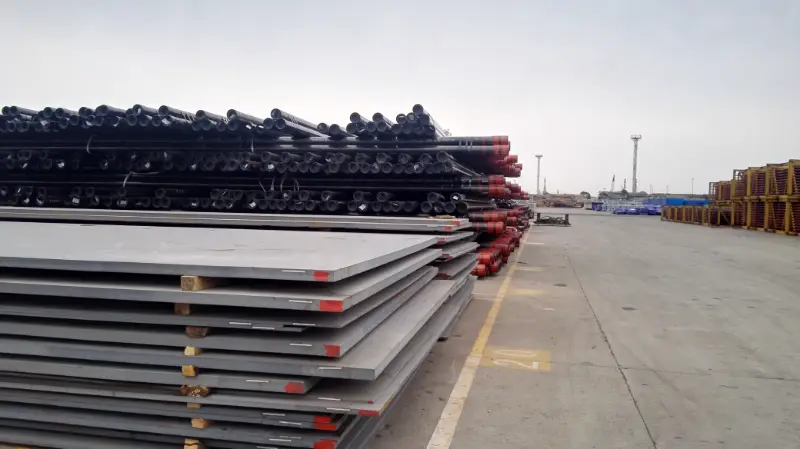
GB/T 16270 Q620C High-Strength Quenched & Tempered Steel Plate/Coil
GB/T 16270 Q620C High-Strength Quenched & Tempered Steel Plate/Coil - Q+T Delivery, Yield ≥620 MPa
A comprehensive data sheet for Q620C carbon and low-alloy high-strength structural steel to GB/T 16270. Covers chemical composition, mechanical properties, thermal and electrical physical properties, international equivalents, and applications.
Quenching and tempering (Q+T), cold forming (limited), welding, machining
- Phone : +8618037372205
- Email : [email protected]
- WhatsApp: Contact via Whtsapp
- WeChat: +8618037372205
GB/T 16270 Q620C High-Strength Quenched & Tempered Steel Plate/Coil Introduction
Q620C is a high-strength quenched and tempered structural steel grade specified in GB/T 16270. It offers a minimum yield strength of 620 MPa in thickness up to 50 mm, combined with good toughness at 0 °C. The steel belongs to the carbon and low-alloy category and is supplied in the heat-treated (quenched + tempered) condition.
- Good weldability with proper low-hydrogen procedures
- High strength-to-weight ratio
- Excellent notch toughness down to 0 °C
Q620C is widely used in heavy machinery, bridges, offshore structures, and pressure vessels where high static and dynamic loads are present.
GB/T 16270 Q620C High-Strength Quenched & Tempered Steel Plate/Coil Chemical Composition
Chemical composition according to GB/T 16270 for grade Q620C. The limits maintain a carbon equivalent (CEV) ≤ 0.52 to ensure good weldability.
- All values are maximum unless a range is given.
- Microalloying elements like Nb, V, Ti, and B may be used singly or in combination.
| Element | Standard Value (max, %) | Remarks |
|---|---|---|
| C | 0.20 | Carbon |
| Si | 0.50 | Silicon |
| Mn | 1.70 | Manganese |
| P | 0.020 | Phosphorus |
| S | 0.010 | Sulfur |
| Cr | 1.50 | Chromium |
| Ni | 2.00 | Nickel |
| Mo | 0.50 | Molybdenum |
| Cu | 0.50 | Copper |
| Nb | 0.06 | Niobium |
| V | 0.08 | Vanadium |
| Ti | 0.05 | Titanium |
| B | 0.005 | Boron |
| Alt | ≥ 0.015 | Total aluminum, if used |
| CEV | ≤ 0.52 | Carbon equivalent (typ. CEV) |
GB/T 16270 Q620C High-Strength Quenched & Tempered Steel Plate/Coil Thermal and Electrical Physical Properties
Typical physical properties for Q620C / similar quenched and tempered high-strength steel. These values are for general guidance only and are not specified in the standard. Variation may occur with actual composition, heat treatment and temperature.
| Property | Typical Value | Unit | Test Condition / Temperature |
|---|---|---|---|
| Density, ρ | 7850 | kg/m³ | 20 °C |
| Modulus of elasticity, E | 205 | GPa | 20 °C |
| Shear modulus, G | 80 | GPa | 20 °C |
| Poisson's ratio, ν | 0.3 | – | 20 °C |
| Coefficient of thermal expansion, α | 12.5 × 10⁻⁶ | K⁻¹ | 20 – 100 °C |
| Coefficient of thermal expansion, α | 13.5 × 10⁻⁶ | K⁻¹ | 20 – 200 °C |
| Thermal conductivity, λ | 42 | W/(m·K) | 20 °C |
| Specific heat capacity, cp | 460 | J/(kg·K) | 20 °C |
| Electrical resistivity, ρe | 0.25 × 10⁻⁶ | Ω·m | 20 °C |
GB/T 16270 Q620C High-Strength Quenched & Tempered Steel Plate/Coil Mechanical Properties
Mechanical properties of Q620C in the quenched and tempered condition as per GB/T 16270. Yield strength and elongation vary with plate thickness. Impact test temperature is 0 °C (grade C). All values are minimum unless stated otherwise.
| Property | Standard Requirement | Unit | Test Condition / Thickness |
|---|---|---|---|
| Tensile strength, Rm | 700 – 890 | MPa | t ≤ 150 mm |
| Yield strength, ReH | ≥ 620 | MPa | t ≤ 50 mm |
| Yield strength, ReH | ≥ 590 | MPa | 50 < t ≤ 100 mm |
| Yield strength, ReH | ≥ 560 | MPa | 100 < t ≤ 150 mm |
| Elongation after fracture, A | ≥ 15 | % | t ≤ 50 mm, gauge length 5.65√So |
| Elongation after fracture, A | ≥ 15 | % | 50 < t ≤ 100 mm |
| Elongation after fracture, A | ≥ 14 | % | 100 < t ≤ 150 mm |
| Impact energy, KV2 | ≥ 47 (longitudinal) | J | 0 °C |
| Bend test (bending diameter) | d = 3a | degree 180° | t ≤ 50 mm |
| Bend test (bending diameter) | d = 4a | degree 180° | 50 < t ≤ 150 mm |
GB/T 16270 Q620C High-Strength Quenched & Tempered Steel Plate/Coil Fully Equivalent Grades – Identical Standard and Grade
| Country / Region | Standard | Grade | Remarks |
|---|---|---|---|
| European Union | EN 10025-6 | S620Q | Quenched and tempered high-strength structural steel; directly equivalent to Q620C |
| International | ISO 4950-2 | S620Q | Technical delivery conditions for high yield strength flat products – Part 2: Q+T |
GB/T 16270 Q620C High-Strength Quenched & Tempered Steel Plate/Coil Application Introduction
Q620C steel is designed for demanding structural applications where high strength, good weldability, and reliable low-temperature toughness are required. It is typically delivered in the Q+T condition and can be cut, formed, and welded with appropriate precautions.
- Heavy-duty welded structures
- Mobile crane booms and outriggers
- Earthmoving equipment
- Bridge girders
- Offshore platform legs and decks
Product Applications: Mobile crane telescopic booms, Excavator arms and buckets, Heavy truck chassis frames, Bridge main girder plates, Jack-up rig legs, High-pressure vessels and LPG tanks
Processed into products: Welded structural beams and columns, Crane superstructure parts (boom, turntable), Boom sections for aerial work platforms, Load-bearing plates for hydraulic presses, Offshore module frames
Application industries: Construction and engineering machinery, Bridge building, Shipbuilding and offshore engineering, Pressure vessel and boiler manufacturing, Mining and material handling equipment
GB/T 16270 Q620C High-Strength Quenched & Tempered Steel Plate/Coil Similar / Alternative Materials – Close Properties
| Country / Region | Standard | Grade | Remarks |
|---|---|---|---|
| USA | ASTM A514/A514M | Grade Q | Quenched and tempered alloy steel plate; yield ≥625 MPa; used for structural applications; higher alloy content |
| Japan | JIS G 3128 | SHY685NS | High yield strength steel for building; yield ≥685 MPa; slightly higher strength class |
| Europe | EN 10025-6 | S690Q | Quenched and tempered steel with higher yield strength ≥690 MPa; may be used when higher strength is acceptable |
| China | GB/T 1591 | Q550D | Thermo-mechanical rolled high-strength steel; lower yield (≥550 MPa); not quenched and tempered |
Notes:
- The steel should be protected from rain and moisture during storage to avoid hydrogen-induced cracking.
- Preheating is recommended when welding thickness >20 mm; interpass temperature not to exceed 200 °C.
- For hot forming, temperature should not exceed the tempering temperature (usually ≤600 °C) to preserve the strength.
- Ultrasonic testing is commonly required to EN 10160 Class S2 for plates used in critical structures.
- Share



