
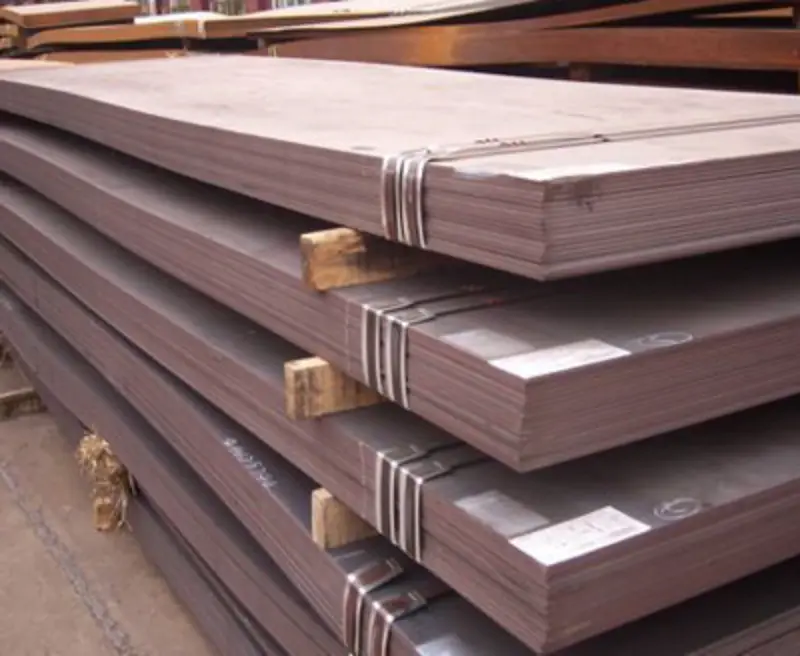
GB/T 16270 Q550E High-Strength Structural Steel Coil Plate
GB/T 16270 Q550E High-Strength Structural Steel Coil Plate - Composition, Properties & Uses
Complete technical data for Q550E carbon and low-alloy high-strength steel coil according to GB/T 16270, including chemical composition, mechanical properties, thermal properties, equivalent grades, and application guidelines.
Quenching and tempering (Q+T) heat treatment; weldable, formable, machinable following appropriate preheating and procedures.
- Phone : +8618037372205
- Email : [email protected]
- WhatsApp: Contact via Whtsapp
- WeChat: +8618037372205
GB/T 16270 Q550E High-Strength Structural Steel Coil Plate Introduction
Q550E is a quenched and tempered high-strength structural steel plate/coil defined in Chinese standard GB/T 16270. It belongs to the low-alloy high-strength steel family with a minimum yield strength of 550 MPa. The 'E' designation indicates guaranteed impact toughness at -40°C. The grade offers an excellent combination of high strength, good toughness, and weldability, making it suitable for heavy-load structures, bridges, lifting equipment, and pressure vessels operating in low-temperature environments.
GB/T 16270 Q550E High-Strength Structural Steel Coil Plate Chemical Composition according to GB/T 16270-2009
The chemical composition of Q550E is designed to provide deep hardenability and excellent toughness after quenching and tempering. Microalloying elements such as Nb, V, and Ti are commonly added to refine grain size and improve strength.
- Phosphorus and sulfur are strictly controlled to enhance ductility and impact properties.
- Carbon equivalent (CEV) is typically limited to ensure good weldability.
| Element | Standard Value (%) | Remarks |
|---|---|---|
| Carbon (C) | ≤ 0.18 | Ladle analysis |
| Silicon (Si) | ≤ 0.60 | Ladle analysis |
| Manganese (Mn) | ≤ 1.70 | Ladle analysis |
| Phosphorus (P) | ≤ 0.020 | Ladle analysis |
| Sulfur (S) | ≤ 0.010 | Ladle analysis |
| Niobium (Nb) | ≤ 0.06 | Optional microalloying element |
| Vanadium (V) | ≤ 0.12 | Optional microalloying element |
| Titanium (Ti) | ≤ 0.05 | Optional microalloying element |
| Boron (B) | ≤ 0.005 | May be added for hardenability |
| Carbon Equivalent (CEV) | Typically ≤ 0.50 | Based on agreement; calculated as CEV = C + Mn/6 + (Cr+Mo+V)/5 + (Ni+Cu)/15 |
GB/T 16270 Q550E High-Strength Structural Steel Coil Plate Thermal and Electrical Physical Properties for Q550E
Physical properties are typical for quenched and tempered low-alloy steel and may vary slightly with heat composition and tempering temperature.
- Density is near pure iron density.
- Elastic properties are essential for stiffness calculations in structural design.
- Thermal expansion and conductivity data apply for room temperature unless stated otherwise.
| Property | Typical Value | Unit | Test Condition |
|---|---|---|---|
| Density (ρ) | 7.85 | g/cm³ | At 20°C |
| Elastic Modulus (E) | 200 | GPa | At 20°C, static tension |
| Shear Modulus (G) | 80 | GPa | At 20°C, calculated from E and ν |
| Poisson's Ratio (ν) | 0.3 | – | At 20°C, elastic range |
| Thermal Expansion Coefficient (α) | 12.0 × 10⁻⁶ | /K | Linear, 20–100°C |
| Thermal Conductivity (λ) | 45 | W/(m·K) | At 20°C |
| Specific Heat Capacity (c) | 460 | J/(kg·K) | At 20°C |
| Electrical Resistivity (ρₑ) | 0.23 × 10⁻⁶ | Ω·m | At 20°C |
GB/T 16270 Q550E High-Strength Structural Steel Coil Plate Mechanical Properties for Q550E
Mechanical properties are determined on quenched and tempered specimens according to GB/T 16270. The values represent minimum requirements unless otherwise specified.
- Yield strength and tensile strength are guaranteed in the transverse direction for plate products.
- Impact testing is performed at -40°C with Charpy V-notch specimens in the longitudinal direction.
| Property | Standard Required Value | Unit | Test Condition |
|---|---|---|---|
| Yield Strength (ReH) | ≥ 550 | MPa | Plate thickness ≤ 50 mm |
| Yield Strength (ReH) | ≥ 530 | MPa | Plate thickness 50–100 mm |
| Tensile Strength (Rm) | 670 – 830 | MPa | Plate thickness ≤ 100 mm |
| Elongation after Fracture (A) | ≥ 16 | % | Gauge length L0 = 5.65√S0 (usually ~50 mm) |
| Charpy Impact Energy (KV2) | ≥ 34 | J | -40°C, longitudinal direction |
| Bend Test (Bend Diameter) | d = 3a | – | 180° bend, a = specimen thickness; no cracking |
GB/T 16270 Q550E High-Strength Structural Steel Coil Plate Fully Equivalent Material Standards and Replaceable Grades
| Country/Region | Standard | Grade | Remarks |
|---|---|---|---|
| China | GB/T 16270 | Q550E | Original grade; quenched and tempered, -40°C impact |
| EU | EN 10025-6 | S550QL (1.8926) | Direct equivalent for quenched and tempered structural steel with longitudinal impact at -40°C |
| EU | EN 10025-6 | S550QL1 (1.8986) | Alternative with slightly different chemical composition, equivalent toughness |
| Japan | JIS G3128 | SHY685N | Similar yield class, quenched and tempered, low-temperature toughness; check thickness range |
| USA | ASTM A514 / A517 | Grade B | High-strength quenched and tempered plate; yield ~690 MPa, need to verify toughness at -40°C |
GB/T 16270 Q550E High-Strength Structural Steel Coil Plate Application Introduction
Q550E is specifically designed for applications where high strength, durability, and excellent low-temperature toughness are required. Its quenched and tempered condition provides a superior strength-to-weight ratio, enabling lighter constructions without sacrificing safety.
- Typical industries include heavy engineering, mining, shipbuilding, and infrastructure.
- Products range from structural beams to wear-resistant components.
- Common manufacturing processes involve welding, cutting, and moderate cold forming.
Product Applications: Crane booms, jibs, and lattice structures, Excavator buckets and arms, Heavy-duty dump truck bodies, Bridge main girders and box sections, Offshore platform legs and braces, Penstocks and water pipelines, Mining support arches and shields, Pressure vessel shells
Processed into products: Welded structural frames and beams, Cut and machined wear plates, Bent flanges and brackets, Bolted or riveted connections, Laser or plasma-cut parts for complex assemblies, Reinforcing ribs and stiffeners, Shafts and axles (when moderate hardness is sufficient)
Application industries: Heavy Machinery and Equipment Manufacturing, Mining and Earthmoving Machinery, Bridge Construction and Civil Engineering, Offshore and Marine Structures, Pressure Vessel and Tank Manufacturing (non-cryogenic), Wind Turbine Tower and Foundation Structures, Railway Car and Heavy Vehicle Chassis
GB/T 16270 Q550E High-Strength Structural Steel Coil Plate Similar or Near-Equivalent Alternative Materials for Q550E
| Country/Region | Standard | Grade | Remarks |
|---|---|---|---|
| China | GB/T 1591 | Q550D | Hot-rolled or normalized condition; lower toughness requirements (impact at -20°C), yield ≥550 MPa |
| China | GB/T 16270 | Q550D | Quenched and tempered, but impact only guaranteed at -20°C; otherwise identical mechanical properties |
| EU | EN 10025-6 | S460QL | Yield strength 460 MPa class; may be used if lower strength is acceptable, with similar toughness |
| USA | ASTM A656/A656M | Grade 80 | High-strength low-alloy hot-rolled; yield ≥550 MPa, but no guaranteed low-temperature impact |
| International | ISO 4950-3 | S550Q | Quenched and tempered high yield strength steel; similar requirements, verify impact temperature |
Notes:
For welding, preheating and interpass temperature control are recommended, especially for thick sections, to avoid cold cracking. Post-weld heat treatment is generally not required but may be specified depending on service conditions.
- Verify actual carbon equivalent from the mill certificate to select proper welding consumables and parameters.
- When forming, the minimum bending radius should be respected (typically ≥3t for cold bending) to prevent cracking.
- Delivery condition can include normalized or Q+T; for Q550E, Q+T is mandatory by standard.
- Surface inspection (e.g., ultrasonic testing) can be ordered as per EN 10160 or GB/T 2970 for internal quality.
- Share



