
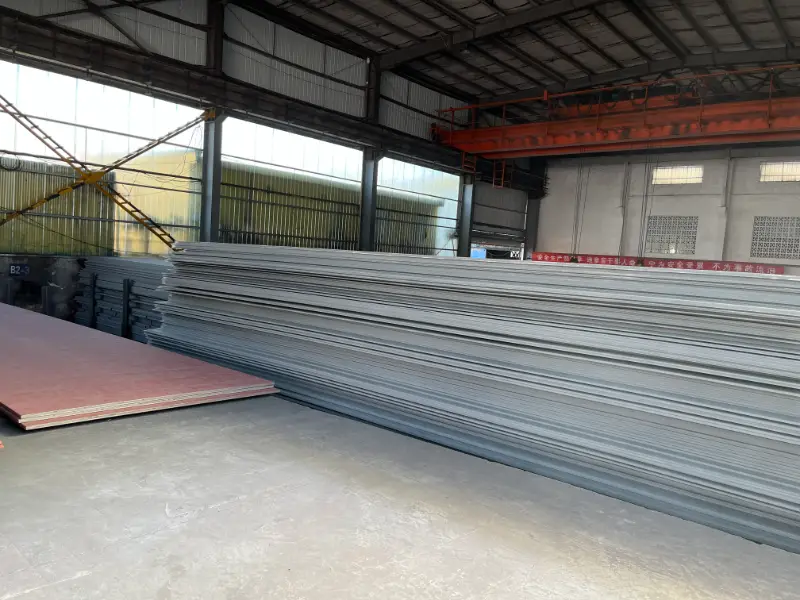
Q550C Quenched & Tempered High Strength Steel
GB/T 16270 Q550C High Strength Structural Steel - Properties & Equivalents
Q550C is a quenched and tempered high-strength low-alloy structural steel with minimum yield strength of 550 MPa, good toughness at 0°C, used in heavy machinery, bridges, and pressure vessels.
Hot rolling followed by quenching and tempering (Q&T). Further fabrication: flame cutting, cold forming (with caution), welding (preheat and low-hydrogen practices recommended), and machining.
- Phone : +8618037372205
- Email : [email protected]
- WhatsApp: Contact via Whtsapp
- WeChat: +8618037372205
Q550C Quenched & Tempered High Strength Steel Introduction
Q550C is a high-strength low-alloy structural steel grade defined in GB/T 16270-2009 (High strength structural steel plates in the quenched and tempered condition). It offers a minimum yield strength of 550 MPa and is designed for welded structures requiring high load-bearing capacity and good low-temperature toughness. The "C" designation indicates that the steel guarantees Charpy V‑notch impact energy of at least 47 J at 0 °C. Produced via quenching and tempering (Q&T), Q550C exhibits a fine-grained martensitic/bainitic microstructure, ensuring a good combination of strength, ductility, and weldability. Typical applications include heavy-duty machinery, bridges, offshore platforms, and pressure vessels where weight savings and durability are critical. It is supplied in the quenched and tempered condition and can be formed, welded, and machined using conventional methods with appropriate precautions.
Q550C Quenched & Tempered High Strength Steel Chemical Composition
The chemical composition of Q550C according to GB/T 16270-2009. Elements not listed (e.g., Al, Sn) are present only as residuals and are within normal limits.
- Carbon equivalent CEV typically ≤ 0.47 for thickness ≤ 50 mm to ensure good weldability.
- Fine grain practice is mandatory; Nb, V, Ti serve as micro-alloying elements.
| Element | Value (max, unless range) | Remarks |
|---|---|---|
| Carbon (C) | 0.18% | For thickness ≤ 100 mm |
| Silicon (Si) | 0.60% | For deoxidation and strength |
| Manganese (Mn) | 1.80% | Contributes to strength and toughness |
| Phosphorus (P) | 0.025% | Low for improved toughness |
| Sulfur (S) | 0.015% | Low for inclusion control |
| Chromium (Cr) | 0.80% | Optional, improves hardenability |
| Nickel (Ni) | 0.80% | Optional, enhances low-temperature toughness |
| Molybdenum (Mo) | 0.30% | Optional, increases hardenability |
| Copper (Cu) | 0.50% | Residual or intentional addition |
| Niobium (Nb) | 0.06% | Grain refinement and precipitation strengthening |
| Vanadium (V) | 0.10% | Precipitation strengthening |
| Titanium (Ti) | 0.05% | Grain refinement and nitrogen fixation |
| Boron (B) | 0.004% | Optional, significantly improves hardenability |
| Carbon Equivalent (CEV) | ≤ 0.47 (typical) | For thickness ≤ 50 mm, CEV = C + Mn/6 + (Cr+Mo+V)/5 + (Ni+Cu)/15 |
Q550C Quenched & Tempered High Strength Steel Physical Properties
Physical properties are generic for low-alloy quenched and tempered steel at room temperature unless specified. Variations depend on exact chemical composition and microstructure.
| Property | Value | Unit | Condition |
|---|---|---|---|
| Density (ρ) | 7.85 | g/cm³ | At 20 °C |
| Modulus of elasticity (E) | 205 – 210 | GPa | At 20 °C |
| Shear modulus (G) | ~ 80 | GPa | At 20 °C |
| Poisson's ratio (ν) | 0.28 – 0.30 | – | At 20 °C |
| Thermal expansion coefficient (α) | 11.1 × 10⁻⁶ | K⁻¹ | Between 20 °C and 100 °C |
| Thermal expansion coefficient (α) | 12.5 × 10⁻⁶ | K⁻¹ | 20 – 300 °C |
| Thermal conductivity (λ) | ~ 35 – 45 | W/(m·K) | At 20 °C; decreases with temperature |
| Specific heat capacity (c) | ~ 460 – 480 | J/(kg·K) | At 20 °C |
| Electrical resistivity (ρₑ) | ~ 0.20 – 0.25 | µΩ·m | At 20 °C |
Q550C Quenched & Tempered High Strength Steel Mechanical Properties
Mechanical properties as per GB/T 16270-2009. These values are guaranteed for plates in the quenched and tempered condition. Note: Values depend on product thickness. Impact test temperature: 0 °C.
| Property | Value | Unit | Test Condition / Thickness Range |
|---|---|---|---|
| Upper yield strength (ReH) | ≥ 550 | MPa | Thickness ≤ 50 mm |
| Upper yield strength (ReH) | ≥ 530 | MPa | 50 < t ≤ 100 mm |
| Tensile strength (Rm) | 640 – 820 | MPa | Thickness ≤ 100 mm |
| Elongation after fracture (A) | ≥ 16 | % | Longitudinal, proportional test piece, 5.65√S₀ |
| Charpy V‑notch impact energy (KV₂) | ≥ 47 | J | 0 °C, transverse test pieces |
| Bend test (bend angle 180°) | d = 3a | – | Thickness ≤ 50 mm; wider specimen if required |
| Bend test (bend angle 180°) | d = 4a | – | 50 < t ≤ 100 mm |
Q550C Quenched & Tempered High Strength Steel Fully Equivalent Material Standards and Alternative Grades
| Country/Region | Standard | Grade | Remarks |
|---|---|---|---|
| Europe | EN 10025-6 | S550Q | Same minimum yield and comparable toughness at 0°C (S550Q+AR or +QT) |
| Europe | EN 10025-6 | S550QL | Guarantees impact at -20°C, thus a step above Q550C; otherwise similar chemistry |
| Japan | JIS G 3128 | SHY685 | High tensile strength steel; YS ≥ 685 MPa, slightly higher; a substitute for upgraded designs |
| International | ISO 4950-2 | E550DD | Same yield class; DD indicates 0°C impact energy |
Q550C Quenched & Tempered High Strength Steel Application Introduction
Q550C steel is designed for demanding structural applications where high strength-to-weight ratio and reliable impact toughness at 0°C are required. It is widely used in heavy engineering and transport sectors.
- Weldability is good with low-hydrogen procedures; preheating (150–200 °C) is advisable for thick sections.
- Cold forming is possible but springback must be accounted for; hot forming should be performed below the tempering temperature.
Product Applications: Mobile crane booms and chassis, Bridge girders and deck structures, Offshore platform legs and modules, Excavator booms and arms, Heavy-duty vehicle frames, Wind turbine towers and transition pieces, Industrial pressure vessels and penstocks, Mining dump truck bodies
Processed into products: Welded box sections and plate girders, Pin-connected structural assemblies, Lifting lugs and clevises, Crane outrigger beams, Tubular nodes for offshore jackets, Flanges and stiffeners in pressure vessels, Bucket shells and cutting edges, Roll-over protective structures (ROPS/FOPS)
Application industries: Construction and civil engineering, Heavy machinery and lifting equipment, Shipbuilding and offshore engineering, Mining and mineral processing, Wind energy, Transportation (trailers, railcars), Pressure vessel and storage tank fabrication
Q550C Quenched & Tempered High Strength Steel Similar / Alternative Material Recommendations
| Country/Region | Standard | Grade | Remarks |
|---|---|---|---|
| China | GB/T 16270 | Q550D, Q550E | Higher toughness levels (-20°C, -40°C) of the same strength class |
| China | GB/T 1591 | Q550D | Hot-rolled high strength low alloy, but not quenched and tempered; lower toughness |
| USA | ASTM A514 | Grade E | Quenched and tempered alloy steel; YS ≥ 690 MPa, very high strength; suitable for heavier sections |
| Europe | EN 10025-6 | S690Q | Higher strength grade (690 MPa YS); common heavy-lifting structure option |
| Germany | DIN EN 10025-6 | S460Q | Lower strength grade; good weldability, often used when 550 MPa is over-specified |
Notes:
- Q550C is usually supplied with inspection certificate EN 10204 type 3.1 or 3.2 as agreed.
- Ultrasonic testing according to GB/T 2970 or EN 10160 may be required for critical applications.
- For welded structures, post-weld heat treatment (PWHT) is generally not required but can be performed at temperatures below the tempering temperature (typically ≤ 550 °C) to avoid strength loss.
- The steel has good atmospheric corrosion resistance but painting or galvanizing is recommended for exposed environments.
- When using Q550C under high restraint conditions, a hydrogen diffusion heat treatment after welding may be necessary to avoid cold cracking.
- Share



