
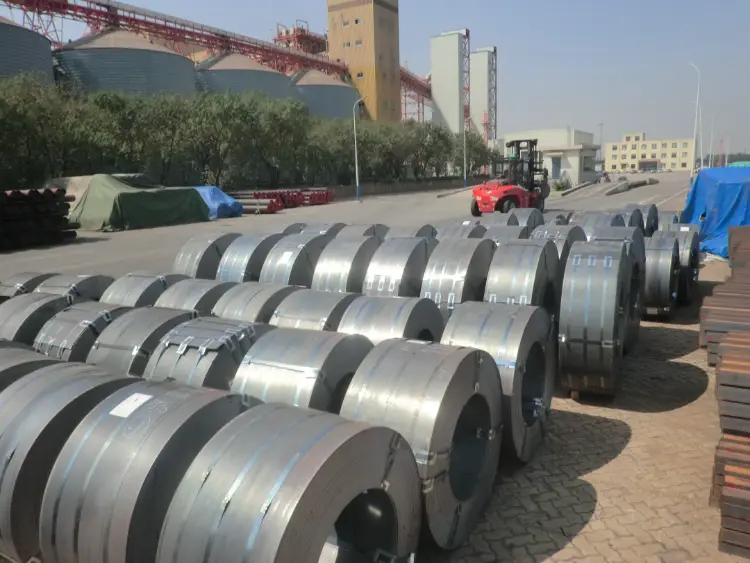
GB/T16270 Q550D High-Strength Quenched & Tempered Steel Coil
GB/T16270 Q550D High-Strength Quenched & Tempered Steel Coil - Technical Data & Equivalents
Complete material datasheet for Q550D carbon and low-alloy high-strength structural steel according to GB/T 16270. Includes chemical composition, mechanical and physical properties, international cross-references, and application examples.
Welding, hot forming, machining, bending (with care for high strength), cutting (plasma, laser, shear)
- Phone : +8618037372205
- Email : [email protected]
- WhatsApp: Contact via Whtsapp
- WeChat: +8618037372205
GB/T16270 Q550D High-Strength Quenched & Tempered Steel Coil Introduction
Q550D is a high-strength quenched and tempered structural steel plate/coil defined in GB/T 16270, with a minimum yield strength of 550 MPa and guaranteed impact energy at -20°C. It belongs to the carbon and low-alloy high-strength structural steel category, offering a good combination of high strength, excellent toughness, and weldability after proper preheating. The steel is supplied in the quenched and tempered condition (Q+T). It is widely used in heavy-duty machinery, bridges, offshore structures, and pressure vessels where weight reduction and high load-bearing capacity are required.
GB/T16270 Q550D High-Strength Quenched & Tempered Steel Coil Chemical Composition
Based on GB/T 16270-2009 for grade Q550D. The values are maximum limits, except where ranges are indicated. Fine grain practice elements such as Nb, V, Ti are added individually or in combination.
- Cr, Ni, Mo, Cu may be added, but their total content should not exceed the sum of individual maximums unless specially agreed.
- Boron is permitted in small amounts for additional hardenability.
| Element | Value (max, %) | Remarks |
|---|---|---|
| Carbon (C) | 0.18 | CEV / PCM may be specified for weldability |
| Silicon (Si) | 0.50 | |
| Manganese (Mn) | 1.70 | |
| Phosphorus (P) | 0.020 | Lower for higher toughness |
| Sulfur (S) | 0.010 | Low level to ensure cleanliness |
| Chromium (Cr) | 0.80 | |
| Nickel (Ni) | 0.80 | |
| Molybdenum (Mo) | 0.30 | |
| Copper (Cu) | 0.50 | |
| Niobium (Nb) | 0.06 | For grain refinement |
| Vanadium (V) | 0.08 | Microalloy precipitation hardening |
| Titanium (Ti) | 0.05 | Grain refinement and nitrogen fixation |
| Boron (B) | 0.004 | Optional for increased hardenability |
GB/T16270 Q550D High-Strength Quenched & Tempered Steel Coil Thermal and Electrical Physical Properties
The following data represent typical values for low-alloy high-strength quenched and tempered steels at room temperature unless specified otherwise. They are not mandatory requirements of GB/T 16270 but are essential for design calculations.
- Values may vary slightly depending on exact chemical composition and heat treatment condition.
| Property | Typical Value | Unit | Test Condition |
|---|---|---|---|
| Density (ρ) | 7.85 | g/cm³ | Room temperature |
| Modulus of elasticity (E) | 205 - 210 | GPa | Room temperature, tensile |
| Shear modulus (G) | ~ 80 | GPa | Calculated from E and Poisson ratio |
| Poisson's ratio (ν) | 0.30 | - | Room temperature |
| Thermal expansion coefficient (α) | 11.7 × 10⁻⁶ | 1/K | 20°C to 100°C |
| Thermal expansion coefficient (α) | 12.5 × 10⁻⁶ | 1/K | 20°C to 200°C |
| Thermal expansion coefficient (α) | 13.5 × 10⁻⁶ | 1/K | 20°C to 400°C |
| Thermal conductivity (λ) | 45 - 50 | W/(m·K) | Room temperature |
| Specific heat capacity (cp) | ~ 460 | J/(kg·K) | Room temperature |
| Electrical resistivity (ρₑ) | ~ 0.17 | μΩ·m | Room temperature |
GB/T16270 Q550D High-Strength Quenched & Tempered Steel Coil Mechanical Properties
Minimum required values according to GB/T 16270-2009. Test specimens are taken in the transverse direction. Impact test at -20°C with Charpy V-notch (KV2).
- Yield strength decreases for thicknesses >50 mm.
- Tensile strength range remains 670-830 MPa across all thicknesses up to 100 mm.
| Property | Required Value | Unit | Test Condition |
|---|---|---|---|
| Yield Strength (ReH) | ≥ 550 | MPa | Thickness ≤ 50 mm |
| Yield Strength (ReH) | ≥ 530 | MPa | Thickness > 50 to 100 mm |
| Tensile Strength (Rm) | 670 - 830 | MPa | Thickness ≤ 100 mm |
| Elongation after fracture (A) | ≥ 16 | % | Gauge length 5.65√S₀, transverse |
| Impact energy (KV2) | ≥ 47 (average) / ≥ 33 (single) | J | -20°C, Charpy V-notch, transverse |
GB/T16270 Q550D High-Strength Quenched & Tempered Steel Coil Internationally Equivalent Standards and Direct Substitute Grades
| Country/Region | Standard | Grade | Remarks |
|---|---|---|---|
| Europe | EN 10025-6 | S550QL (1.8926) | Yield ≥550 MPa, tensile 670-830 MPa, -20°C impact; direct equivalence |
| International | ISO 4950-2 (withdrawn) | E550DD | Similar concept, but standard is no longer current. |
GB/T16270 Q550D High-Strength Quenched & Tempered Steel Coil Application Introduction
Q550D steel is ideally suited for welded structures that require high strength, good toughness at sub-zero temperatures, and excellent service performance under dynamic or static loads. Typical processing: Hot-rolled coils and plates are delivered in the quenched and tempered condition. Cold forming should be performed with large radii and possibly stress-relief treatments to avoid cracking. Welding requires low-hydrogen procedures and appropriate preheat/interpass temperatures; post-weld heat treatment may be necessary depending on thickness and service conditions.
Product Applications: Welded bridge girders and box sections, Lattice boom sections for crawler cranes, Offshore platform legs and A-frames, Heavy-duty mining truck frames and bodies, Penstocks and pressure pipes, Wind turbine tower tubes and transition pieces
Processed into products: Boom chords and lacings, Base plates and stiffeners in heavy structures, Fatigue-critical connections, Buckling plates and diaphragms, Load-bearing nodes in tubular structures
Application industries: Construction and heavy civil engineering (bridges, high-rise frames), Offshore and marine engineering (jack-ups, semi-submersibles), Mining and earth-moving equipment (dump truck bodies, excavator booms), Crane manufacturing (mobile cranes, tower cranes), Wind tower structures (tower sections, flanges), Pressure vessel and boiler components (where strength and toughness are required)
GB/T16270 Q550D High-Strength Quenched & Tempered Steel Coil Similar High-Strength Quenched & Tempered Steels
| Country/Region | Standard | Grade | Remarks |
|---|---|---|---|
| China | GB/T 16270 | Q550E | Same strength, -40°C impact (superior toughness), can replace Q550D with better low-temp performance. |
| China | GB/T 16270 | Q550C | Same strength, 0°C impact (lower toughness), only suitable when -20°C toughness is not required. |
| Europe | EN 10025-6 | S550Q | Yield ≥550 MPa, tensile 670-830 MPa, 0°C impact; slightly less tough, but similar strength. |
| Europe | EN 10025-6 | S690QL | Higher strength (≥690 MPa yield), -20°C impact; provides higher strength-to-weight ratio, but less formable. |
| China | GB/T 1591 | Q460D | Lower strength (≥460 MPa yield), -20°C impact; as-rolled or normalized; can be used where 550 MPa is over-specified. |
Notes:
Typical delivery condition: quenched and tempered (Q+T). Plates and coils are normally supplied with inspection certificates EN 10204 type 3.1. Non-destructive ultrasonic testing according to GB/T 2970 or EN 10160 can be ordered. Q550D steel may also be supplied with additional restrictions on carbon equivalent (CEV) or weldability indices (PCM) to improve welding performance. For tandem use with Q550D in European projects, the direct substitute S550QL to EN 10025-6 is widely accepted.
- Share



