
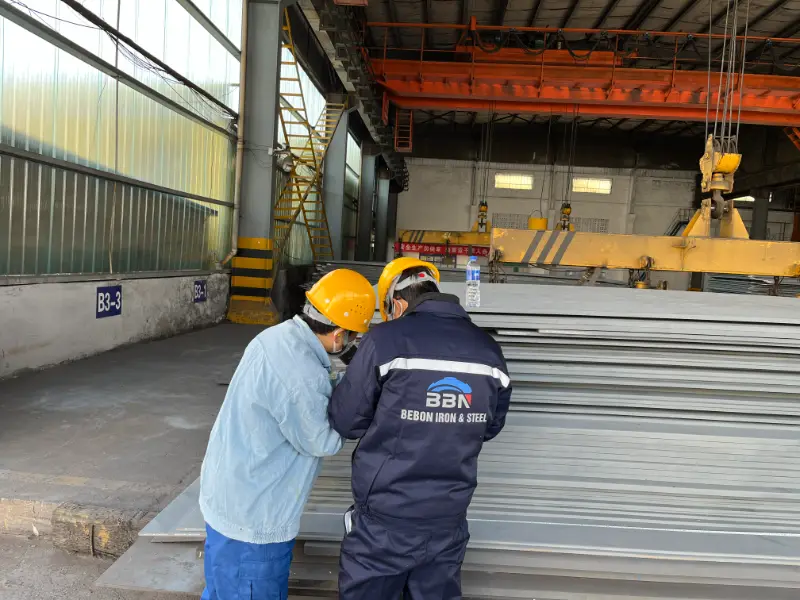
Q550F Carbon and Low-Alloy High-Strength Steel
Q550F Carbon and Low-Alloy High-Strength Steel - Exceptional Toughness at -60°C
Q550F is a quenched and tempered high-strength structural steel with a minimum yield strength of 550 MPa, designed for critical welded structures operating at temperatures down to -60 °C. It offers excellent low-temperature impact toughness and good weldability, widely used in heavy machinery, bridges, and offshore engineering.
Hot rolling + quenching and tempering; cold forming; thermal cutting; welding (with low hydrogen processes); machining; surface treatment
- Phone : +8618037372205
- Email : [email protected]
- WhatsApp: Contact via Whtsapp
- WeChat: +8618037372205
Q550F Carbon and Low-Alloy High-Strength Steel Introduction
Q550F is a high-strength low-alloy structural steel grade specified in GB/T 16270 (High strength structural steel plates in the quenched and tempered condition). It belongs to the Q550 strength category with quality level "F", which guarantees minimum Charpy impact energy of 27 J at -60 °C (longitudinal). The steel is supplied in the quenched and tempered (Q+T) condition and possesses a refined microstructure that combines high strength, excellent low-temperature toughness, and good weldability. Typical applications include heavy-duty welded structures such as bridges, offshore platforms, pressure vessels, and construction machinery. The low carbon equivalent (CEV) of Q550F reduces susceptibility to cold cracking during welding. It is available in plates, coils, and strips, and can be processed by bending, cutting, and welding, but hot forming above the tempering temperature should be avoided to maintain the mechanical properties.
Q550F Carbon and Low-Alloy High-Strength Steel Chemical Composition
The chemical composition of Q550F conforms to GB/T 16270-2009. The steel is microalloyed with niobium, vanadium, and titanium to ensure fine grain size and high strength. Low phosphorus and sulfur contents are maintained to guarantee excellent low-temperature toughness and weldability. The carbon equivalent (CEV) is typically controlled below 0.50 to avoid cold cracking.
| Element | Standard Value (max, unless otherwise stated) | Remarks |
|---|---|---|
| Carbon (C) | ≤ 0.18 | Ladle analysis |
| Silicon (Si) | ≤ 0.50 | Ladle analysis |
| Manganese (Mn) | ≤ 1.70 | Ladle analysis |
| Phosphorus (P) | ≤ 0.020 | Ladle analysis |
| Sulfur (S) | ≤ 0.010 | Ladle analysis |
| Chromium (Cr) | ≤ 0.80 | Ladle analysis |
| Nickel (Ni) | ≤ 0.80 | Ladle analysis |
| Molybdenum (Mo) | ≤ 0.30 | Ladle analysis |
| Vanadium (V) | ≤ 0.10 | Ladle analysis |
| Niobium (Nb) | ≤ 0.06 | Ladle analysis |
| Titanium (Ti) | ≤ 0.05 | Ladle analysis |
| Boron (B) | ≤ 0.005 | Ladle analysis |
| N (Nitrogen) | ≤ 0.015 | If present, not intentionally added |
| Carbon Equivalent (CEV) | ≤ 0.50 (typical agreement) | CEV = C + Mn/6 + (Cr+Mo+V)/5 + (Ni+Cu)/15 |
Q550F Carbon and Low-Alloy High-Strength Steel Physical and Thermal Properties
The following physical properties are not specified in GB/T 16270 but are typical for low-alloy quenched and tempered steels of this classification. Values may vary slightly with exact composition and heat treatment. Data are provided for engineering calculations and design.
| Property | Typical Value | Unit | Test Condition |
|---|---|---|---|
| Density (ρ) | 7.85 | g/cm³ | 20 °C |
| Modulus of Elasticity (E) | 206 | GPa | 20 °C |
| Shear Modulus (G) | 79.3 | GPa | Calculated from E and ν |
| Poisson's Ratio (ν) | 0.30 | – | 20 °C |
| Thermal Expansion Coefficient (α) | 11.5 | 10⁻⁶/K | 20 °C – 100 °C |
| Thermal Expansion Coefficient (α) | 12.3 | 10⁻⁶/K | 20 °C – 200 °C |
| Thermal Expansion Coefficient (α) | 13.2 | 10⁻⁶/K | 20 °C – 300 °C |
| Thermal Conductivity (λ) | 38 | W/(m·K) | 20 °C |
| Thermal Conductivity (λ) | 36 | W/(m·K) | 200 °C |
| Specific Heat Capacity (cp) | 460 | J/(kg·K) | 20 °C |
| Electrical Resistivity (ρe) | 0.25 | Ω·mm²/m | 20 °C |
Q550F Carbon and Low-Alloy High-Strength Steel Mechanical Properties
The mechanical properties depend on plate thickness. The values are valid for the quenched and tempered condition in accordance with GB/T 16270. Impact properties are for longitudinal specimens (standard) and minimum average energy 27 J at -60 °C. For thicknesses over 50 mm, property reductions are specified in the standard; values below represent the thickness range ≤ 50 mm. The bend test is performed with a mandrel diameter depending on thickness.
| Property | Requirement (min, unless range) | Unit | Test Condition / Thickness |
|---|---|---|---|
| Yield Strength (ReH) | ≥ 550 | MPa | t ≤ 50 mm |
| Tensile Strength (Rm) | 670 – 830 | MPa | t ≤ 50 mm |
| Elongation (A5) | ≥ 16 | % | t ≤ 50 mm, gauge length 5.65√S₀ |
| Charpy Impact Energy (KV₂) | ≥ 27 (longitudinal) | J | -60 °C, longitudinal, specimen 10×10 mm |
| Charpy Impact Energy (KV₂) | ≥ 20 (transverse, agreed) | J | -60 °C, transverse, specimen 10×10 mm |
| Bend Test (d = mandrel diameter, a = thickness) | d = 3a | – | t ≤ 16 mm, 180° |
| Bend Test | d = 4a | – | 16 < t ≤ 50 mm, 180° |
Q550F Carbon and Low-Alloy High-Strength Steel Exact Equivalent Material Standards and Substitute Grades
| Country/Region | Standard | Grade Designation | Remarks |
|---|---|---|---|
| China | GB/T 16270 | Q550F | Original designation |
| Europe | EN 10025-6 | S550QL1 | Closest European equivalent with guaranteed impact at -60 °C (QL1). Some compositional differences exist. |
| International | ISO 4950-3 / ISO 4951-2 | S550QL1 | ISO designation for quenched and tempered high yield strength structural steel. |
Q550F Carbon and Low-Alloy High-Strength Steel Application Introduction
Q550F is tailored for heavy-duty welded structures subjected to high static and dynamic loads in cold climates. Its outstanding low-temperature toughness allows safe operation at -60 °C without brittle fracture. Key usage guidelines:
- Preheating may be required for thick sections before welding to avoid hydrogen cracking.
- Hot forming above 600 °C can alter the quenched and tempered properties and should be followed by a new heat treatment.
- Low-hydrogen welding processes (SMAW, SAW, GMAW) with matching filler metals are recommended.
- Post-weld heat treatment (stress relieving) should be controlled to avoid temper embrittlement.
Product Applications: Welded plate girders for long-span bridges, Jack-up rig legs and offshore platform nodes, Lifting booms and counter-jib structures of mobile cranes, Penstocks and spiral casings for hydroelectric plants, Coke drums and pressure vessels operating at low ambient temperatures, Wind turbine tubular towers and transition pieces, Reinforced structural members in high-rise buildings, Excavator arms, dump truck bodies, and heavy-duty buckets
Processed into products: Main beams and cross-beams of box and truss bridges, Flanges and webs of welded built-up sections, Crane boom chords and lattice structures, Foundation nodes and bracing for offshore jackets, Thick-walled cylindrical shells for pressure vessels, End plates and stiffeners for heavy connections, Welded T-joints and K-joints in tubular structures, Wear plates and structural inserts in mining machinery
Application industries: Bridge construction, Offshore and marine engineering, Heavy machinery and cranes, Pressure vessel and boiler manufacture, Wind energy (tower sections, foundations), Mining and earthmoving equipment, Shipbuilding (special structural parts), Building and infrastructure frames
Q550F Carbon and Low-Alloy High-Strength Steel Similar and Closely Related Substitute Materials
| Country/Region | Standard | Grade Designation | Remarks |
|---|---|---|---|
| China | GB/T 16270 | Q550D / Q550E | Lower toughness levels: Q550D -20 °C, Q550E -40 °C. Similar strength but less demanding impact test. |
| USA | ASTM A514/A514M | Grade B | Yield strength 690 MPa, similar alloy concept, but higher strength and impact at -40 °C. |
| Japan | JIS G 3128 | SHY 685 | Yield strength 685 MPa, quenched and tempered, for high-strength structural purposes. |
| Germany | DIN EN 10025-6 | S690QL1 | Higher strength alternative with impact at -60 °C, often used in lieu of Q550F when weight reduction is critical. |
| Europe | EN 10025-6 | S500QL1 | Lower strength (500 MPa) but same -60 °C toughness; suitable for overmatching weld design. |
Notes:
Additional information:
- For thicknesses above 50 mm, mechanical properties shall be agreed upon at the time of ordering; the values may be reduced.
- Ultrasonic testing in accordance with GB/T 2970 may be required for critical applications.
- The steel can be supplied with specific surface conditions: as-rolled, pickled, or shot-blasted and primed.
- When welding Q550F, it is essential to use consumables that meet the required toughness level to ensure sound welded joints.
- Special attention must be paid to the maximum service temperature; the material is intended for applications where toughness at low temperatures is paramount, but its elevated temperature strength should be confirmed separately for temperatures above 400 °C.
- Share



