
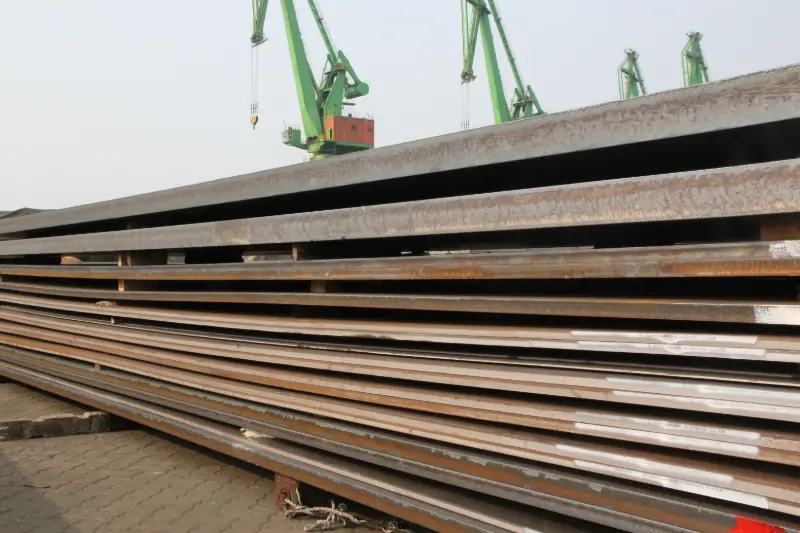
GB/T16270 Q500F Quenched & Tempered High-Strength Steel
GB/T 16270 Q500F High-Strength Structural Steel – Properties, Equivalents & Applications
Complete data sheet for GB/T 16270 Q500F carbon and low-alloy high-strength steel coil/plate: chemical composition, mechanical and physical properties, thermal & electrical values, international equivalents, and application guide.
Thermomechanically controlled rolling (TMCP), normalizing (upon agreement), quenching and tempering (upon agreement)
- Phone : +8618037372205
- Email : [email protected]
- WhatsApp: Contact via Whtsapp
- WeChat: +8618037372205
GB/T16270 Q500F Quenched & Tempered High-Strength Steel Introduction
Q500F is a fine-grain, low-alloy high-strength structural steel specified in GB/T 16270. It is supplied in hot-rolled coil, plate or strip form, primarily in the thermomechanically rolled (TMCP) condition. With a minimum yield strength of 500 MPa and good low-temperature toughness (-20°C impact energy ≥34 J), Q500F offers an excellent balance of strength, weldability and formability. It is widely used for weight-critical structures in construction machinery, bridges, offshore platforms and heavy vehicles. The fine-grain microstructure, achieved through controlled rolling and microalloying (Nb, V, Ti), ensures consistent mechanical properties and good resistance to brittle fracture.
GB/T16270 Q500F Quenched & Tempered High-Strength Steel Chemical Composition
The chemical composition of Q500F is tightly controlled to ensure both high strength and excellent toughness. Grain-refining elements such as niobium, vanadium and titanium are added singly or in combination. The carbon equivalent (CEV) is limited to guarantee good weldability. Maximum residual element levels are specified to avoid detrimental effects on ductility and impact properties.
| Element | Specified Value (max, %) | Remarks |
|---|---|---|
| Carbon (C) | ≤0.20 | ―― |
| Silicon (Si) | ≤0.60 | ―― |
| Manganese (Mn) | ≤1.70 | Higher Mn may be agreed for thicker gauges |
| Phosphorus (P) | ≤0.025 | ―― |
| Sulfur (S) | ≤0.015 | ―― |
| Aluminium (Alt) | ≥0.015 | Total aluminium, for grain refinement |
| Niobium (Nb) | ≤0.07 | ―― |
| Vanadium (V) | ≤0.20 | ―― |
| Titanium (Ti) | ≤0.20 | ―― |
| Niobium + Vanadium + Titanium | ≤0.22 | Sum of Nb+V+Ti |
| Chromium (Cr) | ≤0.30 | Residual element |
| Nickel (Ni) | ≤0.50 | Residual element |
| Copper (Cu) | ≤0.30 | Residual element |
| Molybdenum (Mo) | ≤0.20 | Residual element |
| Nitrogen (N) | ≤0.015 | If present, must be bound by adequate Ti/Al |
| Carbon Equivalent (CEV) | ≤0.47–0.50 (typical) | Depending on thickness; CEV = C + Mn/6 + (Cr+Mo+V)/5 + (Ni+Cu)/15 |
GB/T16270 Q500F Quenched & Tempered High-Strength Steel Thermal and Electrical Physical Properties
The values below are typical for low-alloy structural steel at room temperature unless otherwise stated. They are provided for design and engineering calculations and may vary slightly depending on the exact heat treatment and composition.
| Property | Typical Value | Unit | Condition / Test Method |
|---|---|---|---|
| Density (ρ) | 7.85 | g/cm³ | At 20°C |
| Modulus of Elasticity (E) | 206 | GPa | At 20°C, tensile modulus |
| Shear Modulus (G) | 79.3 | GPa | At 20°C, calculated from E and ν |
| Poisson's Ratio (ν) | 0.30 | — | At 20°C, elastic range |
| Thermal Expansion Coefficient (α) | 11.7 | 10⁻⁶/K | 20–100°C |
| Thermal Expansion Coefficient (α) | 12.5 | 10⁻⁶/K | 20–200°C |
| Thermal Expansion Coefficient (α) | 13.2 | 10⁻⁶/K | 20–300°C |
| Thermal Conductivity (λ) | 52 | W/(m·K) | At 20°C |
| Thermal Conductivity (λ) | 50 | W/(m·K) | At 100°C |
| Specific Heat Capacity (cp) | 0.46 | kJ/(kg·K) | At 20°C |
| Electrical Resistivity (ρₑ) | 0.23 | μΩ·m | At 20°C |
GB/T16270 Q500F Quenched & Tempered High-Strength Steel Mechanical Properties
The mechanical properties are determined on transverse test pieces except impact tests (longitudinal). The yield strength decreases with increasing product thickness, and the impact energy is guaranteed down to -20°C. Bending tests are performed around a mandrel diameter that depends on the thickness.
| Property | Specified Value | Unit | Test Condition / Remarks |
|---|---|---|---|
| Yield Strength (ReH) | ≥500 | MPa | Thickness ≤16 mm |
| Yield Strength (ReH) | ≥490 | MPa | Thickness >16 mm ≤40 mm |
| Yield Strength (ReH) | ≥470 | MPa | Thickness >40 mm ≤63 mm |
| Yield Strength (ReH) | ≥450 | MPa | Thickness >63 mm ≤80 mm |
| Tensile Strength (Rm) | 610–770 | MPa | Thickness ≤40 mm |
| Tensile Strength (Rm) | 590–770 | MPa | Thickness >40 mm ≤80 mm |
| Elongation (A, Lo=5.65√So) | ≥16 | % | Longitudinal, thickness ≤40 mm |
| Elongation (A) | ≥15 | % | Thickness >40 mm ≤63 mm |
| Elongation (A) | ≥14 | % | Thickness >63 mm ≤80 mm |
| Impact Energy (KV₂) | ≥34 (average) | J | At -20°C, longitudinal, full-size specimen (10×10 mm) |
| Impact Energy (KV₂) | ≥27 (individual) | J | At -20°C, longitudinal |
| Bend Test (180°) | d = 3a | mm | Thickness ≤16 mm; a = specimen thickness |
| Bend Test (180°) | d = 4a | mm | Thickness >16 mm ≤40 mm |
GB/T16270 Q500F Quenched & Tempered High-Strength Steel Fully Equivalent Standards & Substitutable Grades
| Country/Region | Standard | Grade | Remarks |
|---|---|---|---|
| Europe | EN 10149-2 | S500MC | Thermomechanically rolled, minimum YS 500 MPa, -20°C impact 27 J (optional); essentially identical |
| International | ISO 4951-2 | S500MC | Same as EN 10149-2 S500MC |
| Japan | JIS G 3134 | SPFH540 | HSLA for automotive frames; yield 540 MPa class, but impact requirements may differ – confirm for -20°C toughness |
GB/T16270 Q500F Quenched & Tempered High-Strength Steel Application Introduction
Q500F combines high strength, good cold formability and reliable low-temperature toughness. It is particularly suited for weight-saving structures subjected to heavy loads and moderate fatigue. The steel is delivered with improved surface quality from coil, making it ideal for laser, plasma or oxy-fuel cutting and robotic welding with appropriate heat input control.
Product Applications: Excavator booms, arms and buckets, Truck chassis, long members and cross-members, Lifting mast sections for forklifts, Wind turbine tower internal platforms, Bridge girder flanges and webs, Modular container frames, Railway wagon side sills and center sills
Processed into products: Bent and welded box sections, Laser-cut brackets and gussets, Cold-formed profiles (C, Z, U channels), Stiffened panels for heavy vehicles, Bogie frames for railcars, Winch bases and outrigger pads, Reinforcement plates in fatigue-critical joints
Application industries: Construction Machinery (excavators, bulldozers, crane booms), Heavy Truck & Trailer Manufacturing (chassis, subframes), Bridge Building (modular bridges, girder components), Offshore & Marine Engineering (deck structures, jack-up legs), Pressure Vessel & Storage Tank Fabrication (limited to moderate HIC service), Railway Vehicle Manufacturing (wagons, underframes), Agricultural Equipment (high-strength frames, tillage tools)
GB/T16270 Q500F Quenched & Tempered High-Strength Steel Similar / Alternative Materials for Cross-Reference
| Country/Region | Standard | Grade | Remarks |
|---|---|---|---|
| China | GB/T 16270 | Q500E | Same strength level, but impact test at -40°C; suitable for lower temperature applications |
| China | GB/T 16270 | Q550F | Higher yield strength (≥550 MPa); suitable when thinner gauges can carry the load |
| China | GB/T 1591 | Q500D/Q500E | Similar strength, but delivery condition typically normalised; check impact temperature |
| Europe | EN 10025-6 | S500QL | Quenched and tempered, YS 500 MPa; used for wear plates and high-strength applications |
| USA | ASTM A1011/A1011M | Grade 50 [345] | Lower strength (345 MPa); for reference only, not a direct substitute |
Notes:
Thickness tolerances and flatness conform to GB/T 709. Welding: use low-hydrogen consumables and preheat above 50°C when plate thickness exceeds 30 mm. Cold forming: minimum bend radius 1.5–2.5t, depending on plate orientation and thickness. For sour service or hydrogen-induced cracking (HIC) resistance, special steel grades with low sulphur (<0.002%) and calcium treatment are required; Q500F is not typically certified for HIC service. Surface condition: as-rolled or pickled and oiled may be available on request.
- Share



