
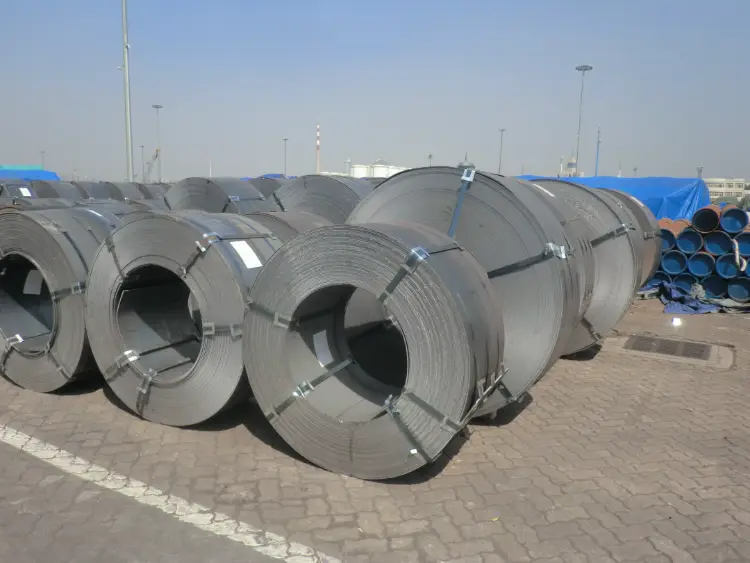
GB/T 16270 Q500E High Strength Steel Coil
GB/T 16270 Q500E High Strength Steel Coil: Offshore & Structural Grade Properties
Comprehensive material data for GB/T 16270 Q500E carbon and low-alloy high-strength steel coil covering chemical composition, mechanical and physical properties, international equivalents, and application insights.
Hot rolling, quenching and tempering, thermomechanical controlled processing (TMCP), welding, machining
- Phone : +8618037372205
- Email : [email protected]
- WhatsApp: Contact via Whtsapp
- WeChat: +8618037372205
GB/T 16270 Q500E High Strength Steel Coil Introduction
Q500E is a high-strength low-alloy structural steel grade specified in GB/T 16270, primarily designed for offshore structures, heavy machinery, and bridge construction. With a minimum yield strength of 500 MPa and excellent low-temperature impact toughness (E-grade, -40°C impact test), it offers an optimal balance of strength, weldability, and ductility. The steel is typically supplied in quenched and tempered (Q+T) or thermomechanically rolled (TMCP) condition, ensuring fine grain structure and consistent mechanical properties. Key characteristics include:
- High yield and tensile strength
- Good notch toughness at temperatures down to -40°C
- Superior weldability with low carbon equivalent (Ceq ≤0.47)
- Excellent through-thickness properties
It is widely used in demanding environments where weight reduction and structural integrity are critical.
GB/T 16270 Q500E High Strength Steel Coil Chemical Composition , Ladle Analysis
Chemical composition limits according to GB/T 16270-2009 for grade Q500E. Values represent maximum unless otherwise noted. The carbon equivalent (Ceq) is calculated to ensure good weldability and mitigate cold cracking risks. Micro-alloying elements such as Nb, V, and Ti are used for grain refinement and precipitation strengthening, enhancing both strength and toughness.
| Chemical Element | Standard Value (wt%) | Remarks |
|---|---|---|
| Carbon (C) | ≤ 0.18 | Maximum |
| Silicon (Si) | ≤ 0.55 | Maximum |
| Manganese (Mn) | ≤ 1.80 | Maximum |
| Phosphorus (P) | ≤ 0.020 | Maximum |
| Sulfur (S) | ≤ 0.010 | Maximum |
| Chromium (Cr) | ≤ 0.80 | Maximum |
| Nickel (Ni) | ≤ 0.80 | Maximum |
| Molybdenum (Mo) | ≤ 0.40 | Maximum |
| Copper (Cu) | ≤ 0.50 | Maximum |
| Niobium (Nb) | ≤ 0.06 | Maximum |
| Vanadium (V) | ≤ 0.10 | Maximum |
| Titanium (Ti) | ≤ 0.05 | Maximum |
| Aluminum (Alt) | ≥ 0.015 | Minimum, total aluminum |
| Boron (B) | ≤ 0.005 | Maximum |
| Carbon Equivalent (Ceq) | ≤ 0.47 | For thickness ≤ 50 mm |
GB/T 16270 Q500E High Strength Steel Coil Thermal and Electrical Physical Properties
Physical properties are characteristic of low-alloy high-strength steels and are provided as typical reference values for Q500E at ambient temperature unless otherwise noted. Thermal and electrical properties may vary slightly with microstructure and temperature.
| Property | Standard Requirement Value | Unit | Test Condition |
|---|---|---|---|
| Density (ρ) | 7.85 | g/cm³ | Room temperature |
| Elastic Modulus (E) | 210 | GPa | 20°C |
| Shear Modulus (G) | 81 | GPa | 20°C |
| Poisson's Ratio (ν) | 0.30 | — | Elastic range |
| Thermal Expansion Coefficient (α) | 11.5 | ×10⁻⁶ /K | 20–100°C |
| Thermal Expansion Coefficient (α) | 12.4 | ×10⁻⁶ /K | 20–300°C |
| Thermal Conductivity (λ) | 47 | W/(m·K) | 20°C |
| Specific Heat Capacity (c) | 460 | J/(kg·K) | 20°C |
| Electrical Resistivity (ρ_e) | 0.21 | ×10⁻⁶ Ω·m | 20°C |
GB/T 16270 Q500E High Strength Steel Coil Mechanical Characteristics
Mechanical properties as per GB/T 16270-2009 for Q500E, tested at room temperature with longitudinal test pieces. Values depend on product thickness and delivery condition. Impact tests were conducted on standard Charpy V-notch specimens at -40°C for E-grade designation. Bending tests use a 180° angle with specified mandrel diameters.
| Property | Standard Requirement Value | Unit | Test Condition |
|---|---|---|---|
| Yield Strength (ReH) | ≥ 500 | MPa | Thickness ≤ 50 mm |
| Yield Strength (ReH) | ≥ 480 | MPa | Thickness > 50–100 mm |
| Yield Strength (ReH) | ≥ 440 | MPa | Thickness > 100–150 mm |
| Tensile Strength (Rm) | 610 – 770 | MPa | All thicknesses |
| Elongation (A) | ≥ 17 | % | Thickness ≤ 50 mm, gauge length 5.65√So |
| Elongation (A) | ≥ 15 | % | Thickness > 50–100 mm |
| Elongation (A) | ≥ 14 | % | Thickness > 100–150 mm |
| Impact Energy (KV2) | ≥ 47 | J | -40°C, longitudinal, thickness ≤ 50 mm |
| Impact Energy (KV2) | ≥ 31 | J | -40°C, longitudinal, thickness > 50–150 mm |
| Bend Test (180°) | d = 3a | — | Thickness ≤ 16 mm |
| Bend Test (180°) | d = 4a | — | Thickness > 16–40 mm |
| Bend Test (180°) | d = 5a | — | Thickness > 40–60 mm |
GB/T 16270 Q500E High Strength Steel Coil Fully Equivalent Material Standards and Substitute Grades
| Country/Region | Standard | Grade | Remarks |
|---|---|---|---|
| Europe | EN 10025-6 | S500Q | Quenched and tempered; similar strength and toughness |
| International | ISO 4950-2:1992 | S500Q | High yield strength plate; comparable chemical and mechanical properties |
| China (alternate) | GB/T 1591-2018 | Q500D / Q500E | High-strength low-alloy structural steel; closely matched, with minor composition differences |
GB/T 16270 Q500E High Strength Steel Coil Application Introduction
Q500E steel is engineered for heavy-duty welded structures exposed to low ambient temperatures and high static/dynamic loads. Its outstanding low-temperature toughness makes it particularly suited for offshore and polar engineering applications. Proper welding procedures—including preheat, low-hydrogen consumables, and post-weld heat treatment for thick sections—are essential to maintain joint integrity and avoid cold cracking.
Product Applications: Steel Plates (quenched, TMCP), Hot-rolled Coils & Strips, Heavy-section Bars & Profiles, Seamless and Welded Pipes, Structural Steel Sections (H-beams, angles)
Processed into products: Offshore platform legs, bracings, and decks, Ship hull plates and stiffeners, Bridge main girders, box girders, and arch ribs, Pressure vessel shells and heads, Crane booms, excavator buckets, Mining dump truck frames, Wind turbine tower sections
Application industries: Offshore & Marine Engineering, Bridge & Civil Construction, Pressure Vessel & Boiler Manufacturing, Mining & Heavy Machinery, Shipbuilding, Wind Energy (tower, foundation)
GB/T 16270 Q500E High Strength Steel Coil Similar or Comparable Material Recommendations
| Country/Region | Standard | Grade | Remarks |
|---|---|---|---|
| Europe | EN 10025-3 | S500N / S500NL | Normalized steel; similar yield strength, lower impact temperature for N/NL variants |
| Japan | JIS G 3106 | SM570 | Lower specified yield (450 MPa) but similar tensile range; good weldability |
| USA | ASTM A572 / A709 | Grade 65 / HPS 70W | Lower minimum yield (450 MPa); can be considered after engineering review |
| Germany (historic) | DIN 17100 | StE 500 | Former grade with comparable strength; now superseded by EN standards |
Notes:
Welding recommendations: Use low-hydrogen processes (SMAW, SAW, GMAW) with matching or slightly over-matching filler metals. Preheat typically 100–150°C for thickness >20 mm, and maintain interpass temperature below 250°C. Post-weld heat treatment (PWHT) may be required for thick sections to relieve residual stresses. Corrosion protection: In offshore environments, apply suitable coating systems (e.g., epoxy zinc-rich primer, polyurethane topcoats) or cathodic protection. Forming: Q500E can be cold-formed with generous bend radii to avoid strain hardening; for severe forming, intermediate stress-relief annealing is recommended. Further processing: The steel is readily machinable in normalized or Q+T condition using carbide tooling.
- Share



