
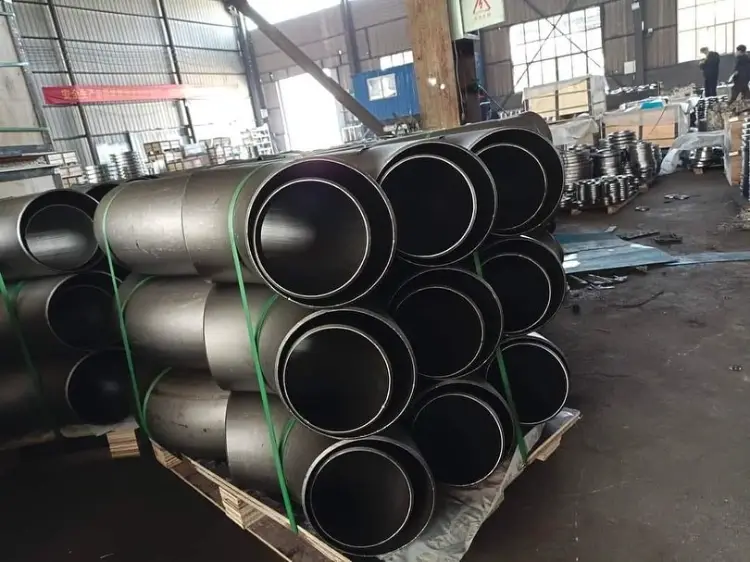
API 5L PSL1 Grade A (L210) Pipeline Steel
API 5L PSL1 Grade A (L210) Pipeline Steel Coil – Properties, Equivalents & Applications
Comprehensive technical data for API 5L PSL1 Grade A (L210) pipeline steel coil, including chemical composition, mechanical properties, thermal and electrical physical properties, international equivalents, and application guidance.
Hot rolling, cold forming, welding (ERW, SAW), bending, coating
- Phone : +8618037372205
- Email : [email protected]
- WhatsApp: Contact via Whtsapp
- WeChat: +8618037372205
API 5L PSL1 Grade A Pipeline Steel Introduction
API 5L PSL1 Grade A (L210) is a low-carbon steel grade primarily used for the manufacture of welded line pipe for conveying oil, gas, and water. It belongs to the PSL 1 (Product Specification Level 1) category, which specifies basic quality requirements without stringent toughness testing. This grade offers minimum yield strength of 210 MPa and good weldability, making it suitable for standard pressure applications. It is typically supplied as hot-rolled coil and formed into spiral or longitudinal welded pipes. The material meets the requirements of API Specification 5L (American Petroleum Institute) and is widely accepted in international pipeline projects.
API 5L PSL1 Grade A Pipeline Steel Chemical Composition
The chemical composition of API 5L PSL1 Grade A is prescribed per API 5L, 46th Edition, Table 1. Only maximum limits are specified for carbon, manganese, phosphorus, and sulfur. No intentional addition of microalloying elements is required. Typical control of these elements ensures good weldability and ductility.
| Chemical Element | Standard Value (max, %) | Notes |
|---|---|---|
| Carbon (C) | 0.22 | Heat analysis |
| Manganese (Mn) | 0.90 | Heat analysis |
| Phosphorus (P) | 0.030 | For PSL1 |
| Sulfur (S) | 0.030 | For PSL1 |
| Niobium (Nb) | Not specified | May be present as residual; no specified limit |
| Vanadium (V) | Not specified | May be present as residual; no specified limit |
| Titanium (Ti) | Not specified | May be present as residual; no specified limit |
API 5L PSL1 Grade A Pipeline Steel Thermal and Electrical Physical Properties
The following data are typical for low‑carbon steel similar to API 5L Grade A. These values are not mandatory in the standard but are representative for engineering calculations. They are affected by temperature and microstructure.
| Property | Standard Requirement Value (Typical) | Unit | Test Condition / Reference |
|---|---|---|---|
| Density (ρ) | 7.85 | g/cm³ | At room temperature |
| Elastic Modulus (E) | 210 | GPa | Tension, room temperature |
| Shear Modulus (G) | 80 | GPa | Calculated from E and ν |
| Poisson's Ratio (ν) | 0.3 | – | Typical for carbon steel |
| Thermal Expansion Coefficient (α) | 12.0 (approx.) | 10⁻⁶/K | Between 20 °C and 100 °C |
| Thermal Conductivity (λ) | 50 (approx.) | W/(m·K) | At 20 °C |
| Specific Heat Capacity (c) | 500 (approx.) | J/(kg·K) | At 20 °C |
| Electrical Resistivity (ρₑ) | 0.15 (approx.) | 10⁻⁶ Ω·m | At room temperature |
API 5L PSL1 Grade A Pipeline Steel Mechanical Properties
Mechanical properties are based on API 5L Table 10 for PSL1 pipe body. Yield strength and tensile strength are strictly specified; elongation values depend on specimen dimensions. The values below reflect standard transverse strip specimens (38.1 mm wide) tested at room temperature. Bend test and impact test are not mandatory for PSL1 unless specified by supplementary requirements.
| Property | Standard Requirement Value | Unit | Test Condition |
|---|---|---|---|
| Yield Strength (ReH) | 210–310 (min. 210) | MPa | Transverse, 0.5% total extension under load |
| Tensile Strength (Rm) | ≥335 | MPa | Transverse, full-section or strip specimen |
| Elongation after fracture (A) | ≥28 | % | 50 mm gauge, transverse strip (38.1 mm wide); value per Table 10 for this specimen size |
| Elongation after fracture (alternative) | Calculated per e=1940·A0.2/U0.9 | % | When specimen area differs; A = cross-sectional area (mm²), U = specified min. tensile strength (MPa) |
| Bend Test | Not required | – | PSL1 pipe unless specified in purchase order |
| Charpy Impact (KV) | Not required | J | PSL1 pipe unless specified by purchaser |
API 5L PSL1 Grade A Pipeline Steel Completely Equivalent Material Standards and Substitutable Grades
| Country/Region | Standard | Grade | Remarks |
|---|---|---|---|
| International | ISO 3183 | L210 | Line pipe, PSL 1; identical to API 5L Grade A |
| Europe | EN 10208-1 | L210GA | Steel pipes for pipelines for combustible fluids; PSL1 equivalent |
| China | GB/T 9711 | L210 | Petroleum and natural gas industries – steel pipe for pipelines; PSL1 |
| Canada | CSA Z245.1 | Grade 210 | Steel pipe; similar strength and chemical requirements |
| Russia | GOST 8732 / GOST 10705 | Analogous to strength class K34–K38 | Steel pipe for oil and gas; not exact match, see similar materials |
API 5L PSL1 Grade A Pipeline Steel Application Introduction
API 5L PSL1 Grade A (L210) is designed for low‑pressure, non‑sour service transportation pipelines. Its soft, ductile nature and good weldability make it suitable for a variety of structural and conveyance applications where stringent fracture toughness is not required.
Product Applications: Spiral welded pipes (SSAW) and longitudinal welded pipes (ERW/LSAW), Coated line pipe (3LPE, FBE) for buried service, Casing and conductor pipe, Rectangular and square hollow sections fabricated from coil, Water well casing and screens
Processed into products: Straight pipe segments, Elbows, tees, reducers (fabricated from plate or coil), Flanges and end caps, Venturi nozzles and spools, Tank shells and supports (when re‑rolled into plate)
Application industries: Oil and gas transmission (distribution lines, flowlines), Water supply and wastewater engineering, Mining slurry transport, Piling and structural applications (e.g., bollards, columns), Fire protection piping systems
API 5L PSL1 Grade A Pipeline Steel Similar / Closely Equivalent Materials
| Country/Region | Standard | Grade | Remarks |
|---|---|---|---|
| USA | ASTM A53 / A53M | Grade A | Pipe grade with yield strength 205 MPa; similar chemistry and formability |
| USA | ASTM A106 / A106M | Grade A | Seamless carbon steel pipe for high-temperature service; min. tensile 330 MPa |
| Europe | EN 10217-1 | P235TR1 | Welded steel tubes for pressure purposes; yield min. 235 MPa, but comparable weldability |
| China | GB/T 8163 | 10# | Seamless steel tube for liquid service; carbon content similar, Rm ≥335 MPa |
| Japan | JIS G3452 | SGP | Carbon steel pipes for ordinary piping; low carbon, similar applications |
Notes:
- PSL1 Grade A pipe is not intended for sour service (H₂S-containing environments). Refer to PSL2 or Annex H for sour service grades.
- Supplementary requirements (SR1 to SR15) may apply for weld repair, non-destructive examination, etc., if specified in the purchase order.
- Total elongation formula is valid for specimen cross-sectional areas between 100 mm² and 1000 mm².
- Physical properties given are for estimation only; actual values depend on exact chemical composition and processing.
- Share



